• Members of the previous forum can retrieve their temporary password here, (login and check your PM).

Botany 1st Time Grower!

Growing logs with advice and results.

Big Jon

Rising Star
AFirst time grower here.

I have been reading a little bit about growing Peyote & San Pedro from l vendor websites. I really honestly cannot find too much information on how to grow it. I definitely need to read more on this forum but I was wondering if anyone has any sources or books to read from or where to start.

I’ve successfully grown weed in coco coir, mushrooms + truffles using PF Tek and monotubs, and extracted my own DMT and recrystallized it.

I am growing with the intention of supplying myself with enough medicine to supply myself with a few strong trips every 3-6 months or so. What is a good variety to grow for this? Does San Pedro grow faster than Peyote? I have a grow tent if that helps.

Any help would be greatly appreciated!
Thanks!
 
Trichocereus (or Echinopsis, but people usually prefer the old names) spp. grow way faster than peyote, and may have better legal status in some jurisdictions. I've been doing some hydroponic T. pachanoi, in coir/perlite under lights. I grew some from seeds, but most individuals contained no detectable mescaline and the remainder were weak (by HPLC). T. pachanoi is typically reported to be inconsistent from seed, but I was surprised to see it that low. I suspect that may be a selection effect in the literature, that completely inactive samples just don't get published at all. T. bridgesii is typically reported to be more consistent.

I've also grown some named clones. 'PC' ('predominant cultivar', a particular clone that's very commonly traded) and 'Lumberjackius' both went fast, adding about 24" in a year, including the time to root the 8" cuttings. New growth was narrower than the original cutting, especially on the PC. This might be etiolation, at 20-30 klux, 16 hours light and 8 dark. The 'Lumberjackius' showed much shorter spines than on the cutting, perhaps due to better irrigation. I water by hand but pretty often, before the medium goes totally dry. This is Andean cactus, typically reported to benefit from more water than desert species. I recently chopped my plants to propagate and took samples at that time, but I haven't analyzed yet.

I don't think this cactus is frequently grown cannabis-style (hydroponically in coir, under lights), but it's a great area to explore. Irrigation and other conditions before harvest may greatly affect alkaloid content. My Sceletium tortuosum is ~10x as strong drought-stressed as well-irrigated, though I think that's an unusually big effect. If you try this then keep the best records you can, since even without analytical facilities your yields (just by mass of crystals) are useful information.
 
Trichocereus / Echinopsis, I think is the way forward for the mescaline consumer willing to grow their own. Though every three to six months may be relatively a large ask until you've got several established cacti and are bioassayed. You may have some that end up beautiful specimens but minimal to no mescaline. Read through The Cactus Analysis Thread and look for commonalities. There are links in there as well with great information from Trout and contributions from the community.

Find a species that likes to pup a lot, grows fast, is resilient to the harsh aspects of your environment, contains an acceptable amount of mescaline, and it'll out produce peyote by a large margin in fresh or dry plant material by weight. Provide them the right soil, sun, water and they'll grow with ease. They are quite low maintanence really besides having to deal with forcing dormancy and storing them through winter if you have to do that and your collection gets of any large size. Then you have to wheen them out into the sun to avoid sunburn which takes a couple weeks. Peak growing season I water mine every week roughly. Sometimes I forget and they get watered in ten to fourteen days without any complaint or dead cacti. My tomatoes would be dead in two or three days max. Mescaline also seems to be stress induced to some degree, so like aizoaceous mentioned, starving cacti of water before cutting it and or storing it in darkness for periods of time before extract / consumption are things you can read about.

I've got different named cuts but have yet to test any. Wish the testing was not as expensive as it is but likely select a few of the ones that stand out and do it. My random observations from growing trichocereus but not fact. Keep a cacti in a small pot they'll stay small. If you can put them in three to seven gallon pots they'll get big dang fast. A 6"x6" square pot is a happy medium to where I've found cacti will grow pretty well if you are constrained on space. They'll get root bound though so refresh the soil and deal with the root bound cacti as needed. Large mid stumps ( 6-12" wide ) produce large pups and small mid cuts produce small pups in my experience. Tip cuts I find hard to get root fully and grow without some form of etoilation. So anymore I go after mid cuts if priced cheaper or a tip cut I just cut the tip off, root that if I want to separately, root the mid cut, and let the mid cut pup when it's ready.

There are a few fungal, rot, and pest issues that can happen but that applies to growing anything. I love peyote and have a couple but they just don't grow fast enough if the intent is consumption unless you graft them to pereskiopsis.
 
This was definitely all helpful info!

I’ll post a few more questions when I got out of work
 
on my beak and couldn’t wait bc I’m so excited lol.

I should add that I am willing to wait 1-2 years (is that the correct time duration?) to grow peyote, if that means a guaranteed mescaline content versus pachanoi, esp if I could grow the peyote with San Pedro.

I have heard that bridgessi has a higher mescaline content than other San Pedro, but did not know that pachanoi is not as consistent as bridgessi in terms of having NO mescaline, just thought it was weaker. Good to know.

Can you point me towards any sources regarding how to graft cacti?

Will post more questions when I have time.
 
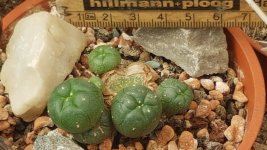
Here's a peyote grafted onto PC pachanoi. It has pupped like crazy!
View attachment 104245
and the mother plant for comparison, with fewer, smaller pups:
View attachment 104246


Wow! Can you DM me on how you did that and the source(s) you learned it from? I’m down to even order books if I have to.


So, aizoaceous said that cacti aren’t generally grown in coir under lights. Can they be grown indoors though?
 
Here’s some info I got from one cacti seller in Oregon:

Dirt: They like a good standard potting soil with extra drainage. We usually get a good potting soil like Ocean Forest or Happy Frog and add 1/3 extra pumice, perlite, or lava rock. Drainage is very helpful for making the soil lighter so that the cacti do not stay wet too long. A regular soil will do as long as you don’t over water, but extra drainage will definitely make them last longer and be happier.


Pots: They like well-draining pots with holes in the bottom. Clay pots work well but need to be watered more often and sometimes best to soak them in a dish full of water. We prefer plastic pots in hot arid climates and clay pots in coastal humid climates. We always wait at least a week to water after transplanting which allows for roots to heal. Cactus heal by drying out. This calluses them against mold and infection. All succulents and Cacti like to dry out for this reason. A 3-inch-tall cactus needs a small pot. 10in cactus needs a gallon pot. An 18in cactus needs a 3-gallon pot… The bigger the pot, the faster they grow. Bigger pots need to be watered less often.


Watering: Water when plants dry out. How do you know plants are dry? Pick up the pot and feel if it is hollow, dig finger in the top 2-3 inches, and if dry, then water. Spring and Fall plants will need less water. Summertime plants will need more water. I stop watering in November and start watering again in March. That’s right, now water for many months, even for cactus inside. This allows them to go dormant and rest. On average, we water plants once a week spring and fall and twice a week in summertime. We never water a wet plant. If you are going out of town for a month, Cacti will be fine not being watered, they just won’t grow quite as much.

Feeding: Mountain Cacti love food. We give them same food we give to our garden or house plants, and feed them every two weeks. Treat them like you do your tomatoes or cannabis, and they will thrive. Don’t feed them and they will thrive as well! We don’t recommend high nitrogen foods, rather nice balanced organic foods are best. I love Botanicare and Dr. Earth. Cacti love minerals as well - Calcium, Magnesium, and Azomite will all boost growth.

But when it comes to light they just talk about outdoor or greenhouse light


Is this accurate?
 
Wow! Can you DM me on how you did that and the source(s) you learned it from? I’m down to even order books if I have to.


So, aizoaceous said that cacti aren’t generally grown in coir under lights. Can they be grown indoors though?
I had a little peyote that I mistakenly thought had come down with root rot, along with too much PC pach, so I just followed a grafting guide that's somewhere in the cactus forum here.

It's probably as quick just to type a summary here as to track down the relevant thread:

You will need:-
  • Razor sharp knife
  • isopropyl alcohol
  • clean paper tissues
  • grafting tape* or
  • soft cotton twine with small weights, 2 per length of string [2 inch × ¹/₄" bolts will suffice]
  • smallish live peyote cactus
  • PC pachanoi cactus of about 2" diameter, well-hydrated and growing happily in a pot or the ground.
If using string, cut four or five 10" lengths and secure a weight to each end.

Use the isopropanol and paper tissue to sterilise the knife blade and the area around the circumference of the pach you intend to cut. Aim to remove 4" or more of tip, but not so much that the cactus core is likely to be excessively woody. Make a single, straight, clean cut that is practically horizontal.

Next cut off the edges of the newly cut surface to form a sloped shoulder of about 45°: the cross section of the cactus stock should resemble a fairly regular polygon, so you're usually cutting off five to seven small slivers, each one parallel to one of the edges. Take care to leave the circular vascular bundle aroung the centre intact.

It's possible to do this bit of the cutting some days in advance, so you can spend a day preparing grafting stock if you want to do a lot of grafts.

Clean the knife and the circumference of the peyote, then take a deep breath and cut off your grafting scion a little above ground level. If your stock was cut in advance it's now time to very quickly cut a thin sliver off the centre so there's a completely fresh, totally flat surface. Remember to clean/sterilise the knife first!

Place the peyote scion onto the stock so that the circular vascular bundles are touching comfortably or very slightly overlapping. This is absolutely essential for the stock to be able to transfer sap into the scion so that it survives and the graft holds.

Press the scion firmly but gently into place and secure it either with a piece of grafting tape stretched over the top, or by hanging the weighted strings carefully over the top of the graft.

Say a prayer of thanks to Mescalito, and hope that your graft takes!

*Ordinary transparent sticky tape can also be used to secure grafts.

The reason for the slanted shoulders is two- or threefold: as the cut surface of the stock dries and calluses over, it also shrinks. This causes the hardened cactus skin around the outside to become raised up, which can both trap moisture (rain) and/or possibly push the graft off if not removed. It also makes it simpler when cutting a really fresh surface on the vascular bundle.

That's a less brief summary than intended, but I hope it's helpful.

 
Here's a peyote grafted onto PC pachanoi. It has pupped like crazy!
View attachment 104245
and the mother plant for comparison, with fewer, smaller pups:
View attachment 104246
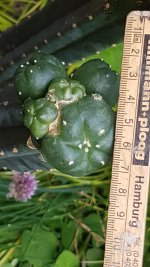
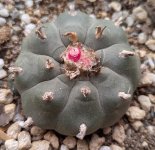
How long ago did you graft that to the pachanoi? Pup city and healthy. Here is one of mine not grafted. Nothing for scale but is about 6.5cm wide ( was winter at the time and of course now I see animal hair everywhere after uploading ):
108561.jpg

...
  • grafting tape* or
  • soft cotton twine with small weights, 2 per length of string [2 inch × ¹/₄" bolts will suffice]
...
I also find panty hose accessible, you get a lot after you start cutting it up, and its cheap if your grafting to something with spines that it'll stay stuck to. No-spined varieties may struggle but short spines you'd be surprised if you can get it stuck in a couple different spots. Cut a section the appropriate width / length relatively. You can anchor the panty hose on some spine(s), do your graft and get it where you want it, pull it over the top of the new graft while keeping it in place, and then pull it down onto some opposite spine(s). Relatively uniform pressure applied, allows spines to poke through but great for lophophora too, and breaths quite nice. Easy to remove once done as well.
 
How long ago did you graft that to the pachanoi? Pup city and healthy. Here is one of mine not grafted. Nothing for scale but is about 6.5cm wide ( was winter at the time and of course now I see animal hair everywhere after uploading ):
View attachment 104248


I also find panty hose accessible, you get a lot after you start cutting it up, and its cheap if your grafting to something with spines that it'll stay stuck to. No-spined varieties may struggle but short spines you'd be surprised if you can get it stuck in a couple different spots. Cut a section the appropriate width / length relatively. You can anchor the panty hose on some spine(s), do your graft and get it where you want it, pull it over the top of the new graft while keeping it in place, and then pull it down onto some opposite spine(s). Relatively uniform pressure applied, allows spines to poke through but great for lophophora too, and breaths quite nice. Easy to remove once done as well.
Not much panty hose (or 'tights material' as we might say in my quarter) at Transform Towers, but a great tip. Lovely plant you have, too.

I grafted my peyote just over a year ago, the photographic record of the exact time is not currently directly to hand. The grafted plant/plants is/are currently outside, unlike the ungrafted peyotes, which I've kept under cover. July was exceedingly wet here this year.
 
Tons of great info.

It’s opening up a whole new world for me! So excited to do this. I actually just topped my cannabis plant (Bubblicious from Nirvana Seeds) last night, kinda reminds me of topping but more technical.
 
I Googled if peyote can be grown indoors, and here is what it said:

Yes, peyote (Lophophora williamsii) can be grown indoors, but it requires specific conditions to thrive
.
Here's what you need to know:
  • Light: Peyote needs bright, direct light for most of the day. A south-facing window is ideal, but grow lights may be necessary in some indoor environments.
  • Soil: Well-draining soil is crucial to prevent root rot. A good mix includes components like pumice, perlite, and a small amount of organic matter, aiming for a 70% mineral to 30% organic ratio. Some growers even utilize black lava sand, small pumice, zen sand, and worm castings for a well-draining medium.
  • Watering: Peyote is very sensitive to overwatering. Allow the soil to dry completely between waterings, especially in winter when the plant is dormant. During the growing season, water when the top inch of soil feels dry to the touch.
  • Temperature: Peyote prefers warm temperatures, ideally between 70-90°F (21-32°C) during the growing season. It can tolerate lower temperatures during dormancy, but avoid freezing temperatures as they can be fatal.
  • Humidity: Peyote prefers drier environments, so avoid placing it near humidity-loving plants. Good airflow is important to prevent fungal problems.
  • Fertilizing: Peyote grows slowly and doesn't require frequent fertilization. Light feeding with a diluted, balanced fertilizer during the growing season is sufficient, stopping completely during dormancy.


The thing is, I like to know exactly what type of lights to use (LED, T5, etc) or how many watts, how far the light should be from the cacti, what type of fertilizer and how much, to use and I really can’t find that info.

Can I use the General Hydroponics Flora Series nutrients that I’ve been using for my bud? What type of soil and lights do you guys use?
 
I dunno, as long as you have free-draining substrate, I've found you can get away with a surprising amount of "non-standard" approaches. For example, my peyote cacti were a bit crusted - largely due to my general lack of competence - and successfully having tried out the recommendation to fertilise my trichs throughout the growing season using fresh, undiluted urine, I decided to feed my lophs with a few frugal doses of the same. The results appear to speak for themselves - no more crusting, steady, healthy growth, and I've yet to lose a loph specimen since, whereas two or three had succumbed to sudden rot before this point.

I'm still cautious of overfeeding and overwatering: I probably overdid the urine with some of my trichs and they've had some problems which I'd now associate with nutrient overload. This made them susceptible to infections related to poor ventilation during the winter, which then came to a head in the spring. Fortunately, all the plants survived, they're just a bit disfigured. New growth has been clear and I've left them out in a more exposed location so the rain has had ample chance to flush the compost of excess nutrients.

On a related note, the trichs have been standing in up to two inches of water and appear to be quite happy with that. It has rained so much lately that the water has remained fresh and gets no chance to stagnate. @Keeper Trout has reported that peyote, in its natural environment, can survive several weeks of complete submersion when their gully locations get flooded. This one snippet helped me to feel a whole lot more confident about peyote cultivation, so I'm very grateful for that. Keeper Trout's works on cacti, psychoactive plants and entheogenic culture in general come as highly recommended - there are some links to a few of his cacti-oriented works in our resource section, and much of the information can also be found on his Trout's Notes website.

Back to one more of your questions, my plants seemed happy enough with a cheap , white LED floodlight through the winter, but obviously a grow-oriented red/blue system would be more energy efficient.
 
So, aizoaceous said that cacti aren’t generally grown in coir under lights. Can they be grown indoors though?
I should emphasize that I don't mean it's a bad idea, just that it's an unexplored area. It's likely that optimized hydroponic conditions will produce higher amounts of the desired constituents in a given growing area than more natural cultivation. That's well-known for cannabis, and I found superior conditions for Sceletium and Phalaris brachystachys with some luck and modest effort. I'm just not aware that anyone has found and published those conditions for mescaline cactus yet.

my plants seemed happy enough with a cheap , white LED floodlight through the winter, but obviously a grow-oriented red/blue system would be more energy efficient.
The cannabis growers spend a lot of time comparing grams yield per watt for different lights, and they typically prefer white LEDs now. At least for cannabis, the green light apparently does provide some benefit even as most is reflected, though I think the primary benefit is just that a lot more R&D effort goes to white LEDs than blue or red so they're more efficient. Their preferred light is usually something like an LM301B, which is probably ~twice the watts optical per watt electrical of your floodlight. It's also more expensive, but depending on your electricity prices you may find that pays back pretty fast.
 
Back
Top Bottom