4-Acetoxy-DMT Examined: *Includes safety data sheet.* Simply search substance name. ^
Hopefully this thread can help open the door into this fascinating compound as well as unlock the previous and further mentioned sub-forums for this particular compound.
 wiki.dmt-nexus.me
Interesting data broken down into sub sections: Consider and tread carefully before choosing to use these substances.
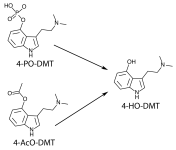
O-Acetylpsilocin (also known as Psilacetin, 4-Acetoxy-DMT, or 4-AcO-DMT) is a synthetically produced psychoactive drug and has been suggested by David Nichols to be a potentially useful alternative to psilocybin for pharmacological studies, as they are both believed to be prodrugs of psilocin. However, many report that O-Acetylpsilocin's effects differ greatly from that of psilocybin and psilocin. It is the acetylated form of the psilocybin mushroom alkaloid psilocin, and is a lower homologue of 4-AcO-DET, 4-AcO-MiPT and 4-AcO-DiPT.
--
O-Acetylpsilocin can be obtained by acetylation of psilocin under alkaline or strongly acidic conditions. It is a synthetic compound. However, it is believed to be a prodrug of psilocin, which is natural and occurs in many mushrooms along with psilocybin. O-Acetylpsilocin is more resistant than psilocin to oxidation under basic conditions due to its acetoxy group. While O-acetylpsilocin is not well researched (considered by many to be a research chemical, as opposed to psilocin and psilocybin), it is not as difficult to produce as psilocybin, and may be an appropriate substitute for psilocybin in psychedelic research because of their similar mechanism of action.
--
O-Acetylpsilocin (psilacetin) and several other esters of psilocin were patented on January 16, 1963 by Sandoz Ltd. via Albert Hofmann & Franz Troxler (US Patent # 3,075,992). Despite this fact, psilacetin remains a psychedelic with a limited history of use. It is theorized to be a prodrug for psilocin, as is psilocybin, which is naturally occurring in various mushrooms. Psilacetin is O-acetylated psilocin, whereas psilocybin is O-phosphorylated.
--
In the body O-acetylpsilocin is deacetylated to psilocin by deacetylases/acetyltransferases during first pass metabolism[citation needed] and during subsequent passes through the liver (evident as psilacetin is also active via parenteral routes of ingestion). Its ability to alter cellular metabolism by competing for the deacetylase enzyme causes a perceptible loss of cellular heat generation capacity at doses between 0.4 and 0.8mmol.
--
Claims of subjective differences in effect between the acetylated and not acetylated forms of psilocin; some users report that O-acetylpsilocin lasts slightly longer; others report that it lasts for a considerably shorter time. Many users report less body load and nausea compared to psilocin. Some users find that the visual distortions produced by O-acetylpsilocin more closely resemble those produced by DMT than those produced by psilocin. These differences could be possible if psilacetin is active itself and not merely as a prodrug.
...
See & Read More Here:
O-Acetylpsilocin - Wikipedia
Here:
4-AcO-DMT
And Here:
Erowid 4-Acetoxy-DMT Vault
Hopefully this thread can help open the door into this fascinating compound as well as unlock the previous and further mentioned sub-forums for this particular compound.
4-Acetoxy-DMT - DMT-Nexus Wiki
Interesting data broken down into sub sections: Consider and tread carefully before choosing to use these substances.
O-Acetylpsilocin (also known as Psilacetin, 4-Acetoxy-DMT, or 4-AcO-DMT) is a synthetically produced psychoactive drug and has been suggested by David Nichols to be a potentially useful alternative to psilocybin for pharmacological studies, as they are both believed to be prodrugs of psilocin. However, many report that O-Acetylpsilocin's effects differ greatly from that of psilocybin and psilocin. It is the acetylated form of the psilocybin mushroom alkaloid psilocin, and is a lower homologue of 4-AcO-DET, 4-AcO-MiPT and 4-AcO-DiPT.
--
O-Acetylpsilocin can be obtained by acetylation of psilocin under alkaline or strongly acidic conditions. It is a synthetic compound. However, it is believed to be a prodrug of psilocin, which is natural and occurs in many mushrooms along with psilocybin. O-Acetylpsilocin is more resistant than psilocin to oxidation under basic conditions due to its acetoxy group. While O-acetylpsilocin is not well researched (considered by many to be a research chemical, as opposed to psilocin and psilocybin), it is not as difficult to produce as psilocybin, and may be an appropriate substitute for psilocybin in psychedelic research because of their similar mechanism of action.
--
O-Acetylpsilocin (psilacetin) and several other esters of psilocin were patented on January 16, 1963 by Sandoz Ltd. via Albert Hofmann & Franz Troxler (US Patent # 3,075,992). Despite this fact, psilacetin remains a psychedelic with a limited history of use. It is theorized to be a prodrug for psilocin, as is psilocybin, which is naturally occurring in various mushrooms. Psilacetin is O-acetylated psilocin, whereas psilocybin is O-phosphorylated.
--
In the body O-acetylpsilocin is deacetylated to psilocin by deacetylases/acetyltransferases during first pass metabolism[citation needed] and during subsequent passes through the liver (evident as psilacetin is also active via parenteral routes of ingestion). Its ability to alter cellular metabolism by competing for the deacetylase enzyme causes a perceptible loss of cellular heat generation capacity at doses between 0.4 and 0.8mmol.
--
Claims of subjective differences in effect between the acetylated and not acetylated forms of psilocin; some users report that O-acetylpsilocin lasts slightly longer; others report that it lasts for a considerably shorter time. Many users report less body load and nausea compared to psilocin. Some users find that the visual distortions produced by O-acetylpsilocin more closely resemble those produced by DMT than those produced by psilocin. These differences could be possible if psilacetin is active itself and not merely as a prodrug.
...
See & Read More Here:
O-Acetylpsilocin - Wikipedia
Here:
4-AcO-DMT
And Here:
Erowid 4-Acetoxy-DMT Vault