Tracing this back a bit:
- repeats claim
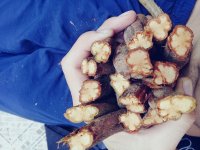
Banisteriopsis muricata - Red Ayahuasca (plant) - references Rätsch (1998)
https://drugs-forum.com/threads/plants-containing-dmt-and-relative-advantages-of-each.8680/ - references Ott (1994)
Ott (1994) p.38 references Ghosal (1972), Ghosal & Mazumder (1971) and Ghosal
et al. (1971c.), which are the following:
Ghosal, S. 1971. "Occurrence of some psychodelic [
sic] substances in some Indian medicinal plants"
Planta Medica 21 (2): 200-209.
Ghosal, S. and U.K. Mazumder 1971. "Malpighiaceae: Alkaloids of the leaves of
Banistereopsis [
sic]
argentea"
Phytochemistry 10: 2840-2841. [Banisteriopsis argentea is a synonym for B. muricata]
Ghosal, S.
et al 1971c. "Chemical and pharmacological evaluation of
Banistereopsis [
sic]
argentea Spring ex Juss"
Journal of Pharmaceutical Sciences 60(8): 1209-1212.
Amounts of DMT recovered were small, around 0.003% (yes, that's 0.003%), with the total amount of alkaloids being a rather meagre 0.02%. So, those who are finding B. muricata to be something special have got better specimens or a difference species altogether than that tested by Ghosal and colleagues, unless Ghosal's extraction methods left something to be desired.
If working with this plant, it would seem necessary to be wary of variations between separate specimens as well as effects from location and the exact conditions of harvesting.