• Members of the previous forum can retrieve their temporary password here, (login and check your PM).

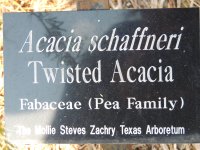
Acacia Schaffneri AKA Twisted Acacia Texas Native Specimen @ Botanical Garden

Migrated topic.
Acacia Schaffneri AKA Twisted Acacia Texas Native Specimen @ Botanical Garden

Photos taken on 12/4/12 in Central Texas this was a Arboretum raised young/immature specimen of 3 foot heigth, which I am guessing was less than 2 years old.

This video clip is fairly good showing 2 young trees in detail


Attachments

  • Acacai+rigidula%2C+berlandieri%2C+twisted%2C+farnesiana%2C+and+greggii+106.JPG
    Acacai+rigidula%2C+berlandieri%2C+twisted%2C+farnesiana%2C+and+greggii+106.JPG
    3.2 MB · Views: 0
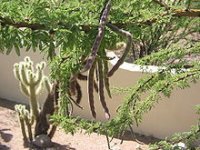
  • 220px-Acacia-schaffneri-seed-pods.jpg
    220px-Acacia-schaffneri-seed-pods.jpg
    17.5 KB · Views: 0
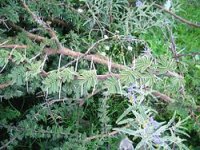
  • 250px-Acacia-schaffneri-thorns.jpg
    250px-Acacia-schaffneri-thorns.jpg
    22.7 KB · Views: 0
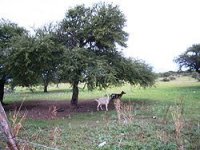
  • 250px-Acacia-schaffneri-goat-forage.jpg
    250px-Acacia-schaffneri-goat-forage.jpg
    16.5 KB · Views: 0
..hey, lovely and thank you very much fractalicious :)

..yeah..you know the authors of the controversial A. rigidula/berlandieri findings still stand by the result..
http://catbull.com/alamut/Bibliothek/chem of texas acacias.pdf ..they claimed A. schaffneri leaves contained phenethylamines, hordenine and tyramine..

..elsewhere, traces of mescaline have been claimed for Acacia schaffneri..mysterious indeed..

in the case of A. rigidula, all 44 alkaloids were minutely trace except phenethylamine, NMT, DMT, n-methyl-tyramine and 1 or 2 others..

..cattle graze staggering amounts (pun intended!:) of leaves before getting a non usually fatal loco-motor temporary 'disorder'..

so, i would say definitely alkaloids..question is what..?
 
The link to the Texas Uni PDF in Wikipedia and other sites is broken, but the paper had to be found somewhere else...

It was published in Phytochemistry, V.46-2, in 1997. I'm leaving it attached.
 

Attachments

  • Toxic+Amines+and+Alkaloids+from+Acacia+Berlandieri.pdf
    375.7 KB · Views: 0
Sorry ... that one doesn't appear to be published anywhere, and the original links seem dead. I can only find the papers about berlandieri and rigidula, but hopefully nen will correct me.
 
nen888 said:
..elsewhere, traces of mescaline have been claimed for Acacia schaffneri..mysterious indeed..


elsewhere being? this post was ver interesting to read. didnot know traces of mescaline could be found in these trees.. :surprised
 
Keeper Trout said:
The exif data places it's creation at least as far back as 10 July 1998 but I have not yet been able to nail it down to the place and date of publication.

10 July 1998 is probably the correct date... it's not too long after the "Toxic amines and alkaloids..." paper and it precedes some of Forbes' other work on Texas Acacia species (see below).

It looks like it was only published online through the Texas A&M AgriLife Extension at Uvalde (http://uvalde.tamu.edu/). There are many other agriculture-related papers on their website in roughly the same format... all without dates of publication, and apparently not published in any print journals. The earliest reference to the paper I could find through the Internet Archive was captured in February 1999.

On a related note, it looks like there are some other interesting guajillo-related papers from Forbes et al. on the Uvalde site (hope this isn't getting too off-track for a thread about A. schaffneri). The links to the papers are dead on the current site, so I'm taking the liberty of attaching archived copies to this post. The papers are:

  • The Nutritive Value of Guajillo as a Component of Goat Diets. H. Nantoume, T.D.A. Forbes, C.M. Hensarling and S.S. Sieckenius. (PDF file creation date: 28 Jan 2002)
  • Influence of a Supplement and Monensin on the Intake of Guajillo (Acacia berlandieri) by Wether Goats. T.D.A. Forbes, H. Nantoume, C.M. Hensarling and S.S. Sieckenius. (PDF file creation date: 28 Jan 2002)
  • Phenolic Amines from Acacias Affect Reproduction in Livestock. T.D.A. Forbes, and R.D. Randel. (PDF file creation date: 10 Jul 1998)
 

Attachments

  • Nutritive+value.pdf
    132.3 KB · Views: 0
  • Influence+of+a+supplement.pdf
    143.8 KB · Views: 0
  • Phenolic+amines+from+Acacias.pdf
    59 KB · Views: 0
All these samples need is a stamp after seperating the upper bark (taken only from Berlandieri and from a diseased 6 inch branch that was pruned back) plus leaf and stem, they are not a viable place to end this testing just a leaping off point. These youngsters can yield no root bark without harm.

These samples await a destination.

Of disappointment is that they are all immature specimens, but data showing change with age is important.

So the data from these is not a total waste it just needs to be supplemented.


I am digging the Arundo Donax rhizome/root this week here as well and will include samples of it with others. This plants seeds are sterile and it reproduces by propagation of the roots.
 
nen888 - The internet sucks in so many ways despite being such a wonderfully amazing and powerful tool.
Impermanence of contents & links and an ephemeral history that is constantly being rewritten, replaced or deleted makes internet references a less than desireable replacement for books imho.
Feel free to discuss this in a PM but if any keywords for a search pop into mind I'd love to help search for that German link. MOST times things go dead or offline I can manage to find another copy someplace else online. Not always but I can usually succeed more than 90% of the time when I have the patience.


fractilicious -- I should have no problem obtaining some samples from adults of schaffneri, berlandieri and rigidula in March in Starr or Jim Hogg County. I won't have problems with ID since they will all be in flower when I'm there. Plus I'll be there with a botanist if I have questions. Its valuable to test any parts of any plant at any age. Even zero is a useful figure to know.
Let's talk more details on the rest in a PM


Entropymancer -- thanks for that. I should be able to follow my way through to a good outcome.
 
..thanks wira..and thank you fractalicious for instigating this renewed interest in these US species..!:)

i've attached the following paper below:
Chemistry of Acacia's from South Texas TT.D.A. Forbes and B.A. Clement
Leaves from plants of A. berlandieri, A. rigidula, A. greggii, and A. schaffneri were hand-plucked from ten plants at each of two locations on the George Lyles ranch in Zavala Co. Texas, in the spring and fall. All leaf samples contained phenethylamine, N-methyl-phenethylamine, tyramine and hordenine.

..the dead mescaline claim link is Naturheilpraxis Fachforum [http://72.14.253.104/search?q=cache: XL1yXM2FygQJ:www.naturheilpraxis.de/exclusiv/nh-online/2005/nhp05/a_nh-ff02.html+%22Acacia+farnesiana%22+tryptamine+-wikipedia&hl=en&ct=clnk&cd=10&gl=us]
as cited in the Encyclopedia of Life acacia section..
the site (a good one) is still up [http://www.naturheilpraxis.de/nh/] but i haven't had a chance to contact them..
but i doubt it's a formal finding..
 

Attachments

  • chem+of+texas+acacias.pdf
    53.3 KB · Views: 0
nen888 said:

Here's a copy of that page that was archived in 2010: Naturheilpraxis - Fachforum - Die Heilkraft der Akazien Ein einführender Überblick

Interessanterweise enthalten einige in Süd-Texas heimische Acacia-Spezies (Acacia berlandieri BENTH., Acacia rigidula BENTH., Acacia smallii ISELY1 und Acacia schaffneri (L.) WILLD.) auch ganz andere psychotrope Wirkprinzipien, nämlich Nikotin, Harmalaalkaloide, Meskalin (!) und diverse Amphetamine bzw. –Derivate (!!).

No specific reference is given for the claim that mescaline occurs in the mentioned species. Maybe it stems from a simple misreading of the work by Forbes & Clement? I initially read that sentence to mean that each of the mentioned species contains one or more of the active principles that he lists... but the table at the bottom of the page clearly indicates that the author believes mescaline occurs in A. schaffneri. Then again, the table doesn't list nicotine as an component of any of the species named in the sentence I quoted above... so perhaps it's just a case of disorganized note-taking.
 
Thanks Entropymancer. I'll bet you're right and the author extrapolated the Acacias mentioned in that paper to include that whole list. (Even though leaving off greggii)
The other points could just be disorganization as you suspect although listing farnesiana/smallii might suggest adding confused to disorganized?
 
..yes, seems like a case of a mix-up..

it would be great to clear up the trace Mescaline in A. rigidula finding (Clements et al. )
..obviously acacias can easily create phenethylamines, including cactus PEAs like Hordenine..
but what is required to create mescaline is an intriguing question, and i wish this could be confirmed or refuted..
.
 
Back
Top Bottom