• Members of the previous forum can retrieve their temporary password here, (login and check your PM).

Amsonia tabernaemontana / Harmine

Migrated topic.

grollum

Rising Star
Hello Nexians,

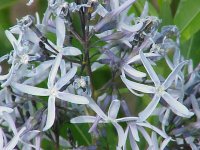
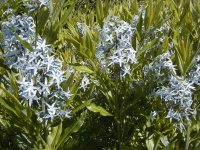
I just stumbled over this plant: Amsonia tabernaemontana
It is listed as Harmine containing here: Ayahuasca Analogs and Pharmahuasca / Erowid

Anyone has any info on this. It seems to be frost hardy and easy to grow.
 

Attachments

  • Amsonia_tabernaemontana0.jpg
    Amsonia_tabernaemontana0.jpg
    45.5 KB · Views: 0
  • Amsonia_tabernaemontana.jpg
    Amsonia_tabernaemontana.jpg
    388.3 KB · Views: 0
I don't actually know anything about this plant but, being in the dogbane family, it's likely to have a bunch of other alkaloids ("and others"), very possibly in higher concentrations than the harmine, which will in all likelihood have other probably undesirable pharmacological properties.

Many plants have been found to contain low levels of harmine in the flowers. Through its fluorescence harmine acts as a bee attractant.

Possible references:

Deulofeu, V. 1973. "Distribution of indolethylamines and β-carbolines in plants" Ciência e Cultura 25(7): 649-659

Van Beek, T.A. et al 1984. "Tabernaemontana L. (Apocynaceae): A review of its taxonomy, phytochemistry, ethnobotany and pharmacology" Journal of Ethnopharmacology 10(1): 1-156.
 
I found this info in the description of the broader dogbane family.

All plant-derived (i.e., phytochemical) natural products have some inherent toxicity on ingestion[citation needed], and many are very toxic, even lethal. This is true of many species of plants from the Apocynaceae family, with some being extremely poisonous if parts are ingested, or if they are not handled properly. Genera containing cardiac glycosides— Acokanthera, Apocynum, Cerbera, Nerium, Thevetia, Strophanthus, etc.[citation needed]—have therapeutic ranges, but are often associated with accidental poisonings, in many cases lethal (see below). Alkaloid-producing species like Rauvolfia, Catharanthus, and Tabernathe are likewise the source of compounds with possible therapeutic ranges, but which have significant associated toxicities if not taken in appropriate doses and in controlled fashion.[citation needed]

Many plants have been found to contain low levels of harmine in the flowers. Through its fluorescence harmine acts as a bee attractant.
Thats an interesting info. Thanks downwardsfromzero


Some plants in the Tabernaemontana genus are said to contain Ibogaïne.
@BundleflowerPower: I heard as well that there is yohimbine somewhere in one of the genus.
 
One further reference I overlooked is:

Allen, J.R.F. and B.R.Holmstedt 1980. "The simple β-carboline alkaloids" Phytochemistry 19: 1573-1582.

Yeah, gotta watch them Dogbanes. Apocynum cannabinum is listed as containing harmol, but I don't think you'd want to play around with that one either.
 
Thanks! Interesting! Will have a look.

My friends cat ordered some seeds of Amsonia tabernaemontana.
With a bit of luck there will be enough material to send in for analysis end of summer.

Seems that most of the plants in this family have quite complex ingredient mixtures with often toxic parts. But maybe there is a gem there somewhere.
 
I was once tempted to explore alternative sources of harmine and ordered some seeds of Calycanthus occidentalis. Further research showed that the harmine content was incidental to a couple of predominant dimeric tryptamine alkaloids with convulsant properties, so research came to something of a halt at that point.

I'm sure you'll have been looking into the toxicology already; reassuringly, perhaps, a brief search turns up this:
The Bluestars’ [i.e. Amsonia tabernaemontana] latex sap is mildly irritating and not considered to be harmful to humans.
And this:
Although the sap of some relatives such as Nerium contains highly toxic alkaloids, the sap of Amsonia is relatively innocuous. It is not known to be harmful to humans but does seem to discourage predation by deer and other mammals

Having read a bit more, it sounds like a nice garden plant that might even grow reasonably well in my locality so I'll be looking into ordering some seeds as well. It would be nice to add another data point to your study :)

In all likelihood this plant won't have the quick-brew convenience of P.harmala and a careful review of the phytochemistry is still a must. It's quite possible that the Manske precipitation will be our friend here, if the harmine can be obtained in a high enough concentration for precipitation to be effective. Otherwise preparative dry flash chromatography might well have to be considered (fortunately this is pretty easy).

Best not get too far ahead on the chemical details before any seeds have hit the soil, but this kind of stuff sets me thinking (and I just had a large cup of coffee 😁 ). Perhaps an ethanolic tincture could be used to precipitate harmala alkaloids with HCl, as was also recently mentioned here in another thread.

And presumably you've had a look at: Erowid Online Books : "Ayahuasca: alkaloids, plants, and analogs" by Keeper of the Trout which gives slightly more detail as well as highlighting that it's the Allen & Holmstedt reference that's the principle source for most of the harmine plant information.

Cultivation notes:
A. tabernaemontana was successfully propagated by direct sowing or transplanting. The shoots can be cut 2 years after planting and seeds are produced from the 3rd year onwards.-Gyogynov.

A few more alkaloids found in A. tabernaemontana:
(R = in roots, S = in seeds, L = in leaves)

tabersonine
vincadifformine

vincadine L
dehydrovincadine L
lochnericine L
tetrahydroalstonine L

(+)-1,2-dehydroaspidospermine S
(-)-tetrahydroalstonine S
(-)-quebrachamine S

tetrahydrosecamine R
tetrahydropresecamine R
eburnamine R
decarbomethoxytetrahydrosecamine R (Late winter)

Zsadon B, Décsei L, Otta K, Szilasi M, Kaposi P. [Isolation of aspidosperma alkaloids and rutin from Amsonia tabernaemontana Walt]. Acta Pharm Hung. 1974 Jun;0(0):suppl 1:74-9. [Article in Hungarian]

Panas JM, Morfaux AM, Le Men-Olivier L, Le Men J. [Alkaloids from the roots of Amsonia tabernaemontana Walt. (Apocynacea)]. Ann Pharm Fr. 1972 Nov;30(11):785-7. [Article in French]

 
:) I have to admit that I didn't find to much about the toxicology so far. But didn't try to hard. So thanks for your affords.

The list of alkaloids feels a bit to long for me. But the Manske might do a good job by separating the good from the bad. Thanks for filling this list.

Like you said it seems like a nice garden plant so nothing to loose ;) .
 
A late follow-up here, I planted some Amsonia hubertii which is very similar but it failed to get established. Will try again.

Did your seeds show any success, grollum?
 
Back
Top Bottom