• Members of the previous forum can retrieve their temporary password here, (login and check your PM).

Blue DMT

Icon

Titanium Teammate
Donator
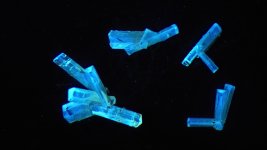
Pic for attention :p
This is DMT under 365nm UV.
104691-ec0e32ce28459a21b45764b042a1517f.jpg


But I read an article about chrysanthemin the other day that got me wondering.
One of the latest applications in this field is the use of chrysanthemin to produce blue wine! Recently, a new blue wine product was invented, which was made adopting anthocyanins and some indole-type compounds in the wine making process.
A brief effort didn't dig up any more about it, but might there be a way to get blue dmt afterall? If only for an aesthetic, scientific exercise. You can see a resemblance in indigo's indoxyl precursor.
Indican-to-Indigotin.jpg
 
I don't think we can tune the HOMO–LUMO gap of nn-DMT in the hope of a floppy, twisty chromophore in any way to make it blue-ish?

Wait, wut? 🤔


Kind regards,

The Traveler
I was wondering about co-crystallization; whether certain pigments could integrate in the lattice or get included in structural defects.

Idk if inorganic minerals are a good example, but ruby and sapphire for example are both corundum, a colorless mineral that is tinted by trace impurities.

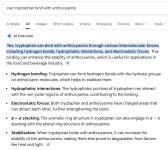
I know the situation is probably less favorable for DMT, but it looks like tryptophan binds well with anthocyanins.
chrome_2025-11-12_18-53-16.png
 
Last edited:
I was wondering about co-crystallization; whether certain pigments could integrate in the lattice or get included in structural defects.

Idk if inorganic minerals are a good example, but ruby and sapphire for example are both corundum, a colorless mineral that is tinted by trace impurities.

I know the situation is probably less favorable for DMT, but it looks like tryptophan binds well with anthocyanins.
View attachment 106185
Can't you just use blue food colouring?

One easy source is - surprisingly, perhaps - sunflower seeds. Soak some hulled seeds in water and check it out. That's your anthocyanins right there, and for mere pennies.

Beetroot's colour comes from a different class of compounds, the betacyanins. These would most likely turn yellow in contact with freebase DMT as the pKₐ for them turning completely blue is above 12 (based on practical experimentation).

Red cabbage is of course the obvious classic for anthocyanin pigments, although a CWE from sunflower seeds is arguably the easiest approach.

This latter paper led to a minor rabbit hole in that sunflower seeds, aren't really seeds - they're in fact not even achenes either, but rather cypselae on account of the inferior ovary. Extra points if you've even heard of a cypsela before (I hadn't, so maybe that's why the botanists didn't want to talk to me. The more you know…).

Some useful details here:
Their early work on the achenes:
Expect around 1% anthocyanins from a sunflower cypselae extraction using formic acid, although this may depend on the variety of sunflower:
Epigenetic techniques might help yield higher anthocyanin levels, although it probably makes more sense to use the pericarps if you're breeding sunflowers for the purpose of, er, dyeing your DMT blue.
 

Attachments

  • pifferi1983.pdf
    470.2 KB · Views: 0
  • vaccari1982.pdf
    382.7 KB · Views: 0
Now, how long until we start getting posts of pictures of commercially-packaged carts filled with the famous ultra-potent blue DMT?
Crossed my mind too, lol. Even if a blue solid isn't stable, I think anthocyanins are PG soluble. If it's anything like blue wine, the presence of DMT or trace tryptophan might stabilize a blue color.
 
Crossed my mind too, lol. Even if a blue solid isn't stable, I think anthocyanins are PG soluble. If it's anything like blue wine, the presence of DMT or trace tryptophan might stabilize a blue color.
It might be a win-win if the blue colour also stabilises the DMT. Next rabbithole - the antioxidant properties of anthocyanins…
 
It might be a win-win if the blue colour also stabilises the DMT. Next rabbithole - the antioxidant properties of anthocyanins…
Well, I'm afraid the alkaline properties of nn-DMT will help breakdown the anthocyanins a lot faster.

It seems nn-DMT does not want to be associated with blue-ish coloring and the accompanying Breaking Bad vibe. 😎


Kind regards,

The Traveler
 
Can't you just use blue food colouring?

One easy source is - surprisingly, perhaps - sunflower seeds. Soak some hulled seeds in water and check it out. That's your anthocyanins right there, and for mere pennies.

Beetroot's colour comes from a different class of compounds, the betacyanins. These would most likely turn yellow in contact with freebase DMT as the pKₐ for them turning completely blue is above 12 (based on practical experimentation).

Red cabbage is of course the obvious classic for anthocyanin pigments, although a CWE from sunflower seeds is arguably the easiest approach.

This latter paper led to a minor rabbit hole in that sunflower seeds, aren't really seeds - they're in fact not even achenes either, but rather cypselae on account of the inferior ovary. Extra points if you've even heard of a cypsela before (I hadn't, so maybe that's why the botanists didn't want to talk to me. The more you know…).

Some useful details here:
Their early work on the achenes:
Expect around 1% anthocyanins from a sunflower cypselae extraction using formic acid, although this may depend on the variety of sunflower:
Epigenetic techniques might help yield higher anthocyanin levels, although it probably makes more sense to use the pericarps if you're breeding sunflowers for the purpose of, er, dyeing your DMT blue.
Thanks bro :) It makes me smile that you went down a rabbit hole on this.

It's still not clear to me whether this could be possible or not, so I'm going to conduct some experiments. I'm gonna hold off on sunflowers seeds for now, apparently chrysanthemin is only in the purple-hull variety. I've never seen those before but if I come across them I'll try.

I'm going to try red cabbage, black caps (black raspberry), one of several other foods, and food coloring.
For solvents I'm thinking of testing water, PG, n-butanol, IPA, ethanol, acetone. I guess heptane too for some non-polar observations.
Idk what techniques yet for co-crystallization. I guess I'll see which solvents extract the dye best, then add DMT to them and try to freeze it back out, or evaporate and see what happens. I'll try DMT benzoate for water, maybe for all of the solvents. I feel like the benzoate salt could be a better candidate than freebase, with the extra phenyl structure. Fumarate might be worth trying too, it seems like carboxyl groups could bind with anthocyanin's. Mono-fumarate could be ideal.
Not sure to what lengths I can isolate anthocyanins, so it'll probably be a mixture of them that could work out or hinder the experiment's success. If traditional crystal growing doesn't pick up the color I'll try adding the color directly to a melt of DMT, maybe under the microscope. If nothing works I'll retry with a dash of tryptophan to see if that changes anything.

Papers I'm reading:
Extraction and purification of anthocyanins: A review
Metal-free production of natural blue colorants through anthocyanin–protein interactions

The latter seems to imply metal ions might be involved in some stabilization techniques. I suspect metal ions could also get stuck in DMT's aromatic rings, so maybe they would make a anthocyanin-metal-dmt sandwich?
 
Back
Top Bottom