"There are 2 isoforms of MAO: MAO-A and MAO-B. MAO-A preferentially deaminates serotonin, melatonin, epinephrine, and norepinephrine. MAO-B preferentially deaminates [phenylethylamine] and trace amines. Dopamine is equally deaminated by both types. MAO-A, the form predominantly expressed in the gut wall and the liver, normally serves as an enzymatic barrier to systemic tyramine circulation. In the presence of monoamine oxidase inhibitors (MAOIs), tyramine is unable to undergo metabolism (ie, deamination)."[1]
"MAO-A inhibition results in increases in NE, 5HT, and DA in the synaptic cleft, while selective MAO-B inhibitors increase only DA."[2]
"90% of MAO activity in the intestine involves the MAO-A isoform."[3]
Tyramine and reversibility:
"Linezolid is an oxazolidinone antibiotic possessing weak, reversible, nonselective MAOI activity. Linezolid is differentiated from other MAOIs marketed in the United States because it is a weak, reversible MAOI, whereas other MAOIs are irreversible, leading to more pronounced pressor effects when combined with small amounts of tyramine. Recommended tyramine quantities for patients receiving linezolid are <100 mg per meal,4 whereas recommended tyramine quantities for patients receiving other MAOIs are <6 mg.5 According to the product labeling for Zyvox (brand of linezolid, Pfizer, New York, NY), “A significant pressor response has been observed in normal adult subjects receiving linezolid and tyramine doses of more than 100 mg. Therefore, patients receiving linezolid need to avoid consuming large amounts of foods or beverages with high tyramine content.”4 The labeling states, “Large quantities of foods or beverages with high tyramine content should be avoided while taking Zyvox. Quantities of tyramine consumed should be <100 mg per meal. Foods high in tyramine content include those that may have undergone protein changes by aging, fermentation, pickling, or smoking to improve flavor, such as aged cheeses (0-15 mg tyramine per ounce); fermented or air-dried meats (0.1-8 mg tyramine per ounce); sauerkraut (8 mg tyramine per 8 ounces); soy sauce (5 mg tvramine per teaspoon): and tap beers (38 mg tyramine per 12 ounces). The tyramine content of any protein-rich food may be increased if stored for long periods or improperly refrigerated.”"4[4]
"Moclobemide is prescribed in the United Kingdom without dietary tyramine restriction but with a general precaution in the product labeling to avoid excessive amounts of tyramine-rich foods."[5]
"The vast majority of foods on the high tyramine list would not comprise a hospitalized patient’s meal tray offerings or dietary choices—beer, wine, yeast extract, or aged or cured meats. […] However, even if these foods were on the menu, large quantities would need to be consumed. For example, a patient would need to consume 5 oz of aged cheese to receive 100 mg of tyramine (assuming 100% bioavailability).15 In 1 study, patients had difficulty ingesting the amounts of cheese needed to provide 400 mg tyramine.17 Even if other foods included in Table 1 would need to be consumed in large quantities, such quantities typically would not be found in meals for hospitalized patients. Given these features, a wide tolerability margin for linezolid and dietary tyramine is expected."[6]
"Very few individuals will ingest more than 25 mg of tyramine, even when consuming high-tyramine foods. For patients on MAOIs, ingestion of amounts under 50 mg are unlikely to cause significant blood pressure effects. Even in the early 1960s, when food tyramine was much higher and MAOI users received no dietary guidance, only 14 deaths were reported among an estimated 1.5 million patients who took MAOIs."[7]
"Tyramine pharmacokinetics are greatly altered by food. Oral bioavailability of tyramine is estimated to be approximately 50%. The bioavailability of oral tyramine is reduced by 50% when administered with food. Studying the effect of food on the pharmacokinetics of tyramine, VanDenBerg et al18 administered a 200-mg oral capsule of tyramine to 8 volunteers after an overnight fast. Following a 1-week tyramine-washout period, these patients also received a 200-mg oral capsule of tyramine together with a standard breakfast. Tyramine bioavailability was reduced by half (range, 32%-81%; P < .05), and the maximum concentration was reduced by 72% (range, 21%-96%; P <
.05). The authors concluded that “systemic exposure to tyramine from foods is expected to be lower by approximately half compared to that obtained when tyramine is administered to fasting subjects in an experimental situation.”18,p609 In another study, 2.8 times higher oral tyramine doses were necessary to produce the pressor effect in fed vs fasted subjects.19"
"In the study on which the recommendation to limit tyramine to <100 mg per meal for patients taking linezolid was based, tyramine was not administered with a meal.6 Additionally, the dose of linezolid used was 625 mg, not the 600-mg marketed dose. In the only other study involving administration of tyramine to subjects receiving linezolid, tyramine was administered intravenously.7 Although linezolid coadministered with intravenous tyramine pressor testing demonstrated potentiation of SBP increases, tyramine pressor challenge tests are difficult to translate into clinical significance of drug–tyramine interactions. Much higher doses of oral tyramine are required to produce a pressor response compared with intravenous tyramine.20"[8]
"I don’t diet before ceremony. Amazonians usually don’t either. It’s just a tourist thing and everyone makes up their own version."[9]
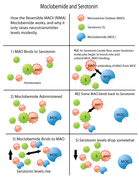
Insight into how reversible MAOIs differ from irreversible MAOIs:
1. Rumore, M.M., Roth, M. and Orfanos, A. 2010. Dietary Tyramine Restriction for Hospitalized Patients on Linezolid. Nutrition in Clinical Practice, 25: 265-269. doi: 10.1177/0884533610368711 (page 265)
2. Blackburn, T., Wasley, J. 6.03 Affective Disorders: Depression and Bipolar Disorders (6.03.5.2.1 Monoamine oxidase, p. 67) [Comprehensive Medicinal Chemistry II, vol. 6. Taylor, J. B., Triggle, D. J. 2006. Elsevier. ISBN 9780080445137]
3. Effects of tyramine administration in Parkinson’s disease patients treated with selective MAO-B inhibitor rasagiline. deMarcaida JA, Schwid SR, White WB, Blindauer K, Fahn S, Kieburtz K, Stern M, Shoulson I. 2006. Movement Disorders, 21(10), 1716–1721. doi:10.1002/mds.21048 (Introduction)
4. Rumore, M.M., Roth, M. and Orfanos, A. 2010. Dietary Tyramine Restriction for Hospitalized Patients on Linezolid. Nutrition in Clinical Practice, 25: 265-269. doi:10.1177/0884533610368711 (pages 265–66)
5. ⇧ Ibidem, Discussion, p. 267
6. ⇧ Ibidem
7. Meyer, J.M. Modern Use of MAOIs. Psychopharmacology Institute, 2019-07-01 (3. Dietary Restriction: What to Tell Patients About Tyramine)
8. Rumore, M.M., Roth, M. and Orfanos, A. 2010. Dietary Tyramine Restriction for Hospitalized Patients on Linezolid. Nutrition in Clinical Practice, 25: 265-269. doi:10.1177/0884533610368711 (Discussion, p. 268)
9. MapachoCura, 2024-04-25, reddit.com/r/Ayahuasca
Understanding the safety profile of MAOIs
"MAO-A inhibition results in increases in NE, 5HT, and DA in the synaptic cleft, while selective MAO-B inhibitors increase only DA."[2]
"90% of MAO activity in the intestine involves the MAO-A isoform."[3]
Tyramine and reversibility:
"Linezolid is an oxazolidinone antibiotic possessing weak, reversible, nonselective MAOI activity. Linezolid is differentiated from other MAOIs marketed in the United States because it is a weak, reversible MAOI, whereas other MAOIs are irreversible, leading to more pronounced pressor effects when combined with small amounts of tyramine. Recommended tyramine quantities for patients receiving linezolid are <100 mg per meal,4 whereas recommended tyramine quantities for patients receiving other MAOIs are <6 mg.5 According to the product labeling for Zyvox (brand of linezolid, Pfizer, New York, NY), “A significant pressor response has been observed in normal adult subjects receiving linezolid and tyramine doses of more than 100 mg. Therefore, patients receiving linezolid need to avoid consuming large amounts of foods or beverages with high tyramine content.”4 The labeling states, “Large quantities of foods or beverages with high tyramine content should be avoided while taking Zyvox. Quantities of tyramine consumed should be <100 mg per meal. Foods high in tyramine content include those that may have undergone protein changes by aging, fermentation, pickling, or smoking to improve flavor, such as aged cheeses (0-15 mg tyramine per ounce); fermented or air-dried meats (0.1-8 mg tyramine per ounce); sauerkraut (8 mg tyramine per 8 ounces); soy sauce (5 mg tvramine per teaspoon): and tap beers (38 mg tyramine per 12 ounces). The tyramine content of any protein-rich food may be increased if stored for long periods or improperly refrigerated.”"4[4]
"Moclobemide is prescribed in the United Kingdom without dietary tyramine restriction but with a general precaution in the product labeling to avoid excessive amounts of tyramine-rich foods."[5]
"The vast majority of foods on the high tyramine list would not comprise a hospitalized patient’s meal tray offerings or dietary choices—beer, wine, yeast extract, or aged or cured meats. […] However, even if these foods were on the menu, large quantities would need to be consumed. For example, a patient would need to consume 5 oz of aged cheese to receive 100 mg of tyramine (assuming 100% bioavailability).15 In 1 study, patients had difficulty ingesting the amounts of cheese needed to provide 400 mg tyramine.17 Even if other foods included in Table 1 would need to be consumed in large quantities, such quantities typically would not be found in meals for hospitalized patients. Given these features, a wide tolerability margin for linezolid and dietary tyramine is expected."[6]
"Very few individuals will ingest more than 25 mg of tyramine, even when consuming high-tyramine foods. For patients on MAOIs, ingestion of amounts under 50 mg are unlikely to cause significant blood pressure effects. Even in the early 1960s, when food tyramine was much higher and MAOI users received no dietary guidance, only 14 deaths were reported among an estimated 1.5 million patients who took MAOIs."[7]
"Tyramine pharmacokinetics are greatly altered by food. Oral bioavailability of tyramine is estimated to be approximately 50%. The bioavailability of oral tyramine is reduced by 50% when administered with food. Studying the effect of food on the pharmacokinetics of tyramine, VanDenBerg et al18 administered a 200-mg oral capsule of tyramine to 8 volunteers after an overnight fast. Following a 1-week tyramine-washout period, these patients also received a 200-mg oral capsule of tyramine together with a standard breakfast. Tyramine bioavailability was reduced by half (range, 32%-81%; P < .05), and the maximum concentration was reduced by 72% (range, 21%-96%; P <
.05). The authors concluded that “systemic exposure to tyramine from foods is expected to be lower by approximately half compared to that obtained when tyramine is administered to fasting subjects in an experimental situation.”18,p609 In another study, 2.8 times higher oral tyramine doses were necessary to produce the pressor effect in fed vs fasted subjects.19"
"In the study on which the recommendation to limit tyramine to <100 mg per meal for patients taking linezolid was based, tyramine was not administered with a meal.6 Additionally, the dose of linezolid used was 625 mg, not the 600-mg marketed dose. In the only other study involving administration of tyramine to subjects receiving linezolid, tyramine was administered intravenously.7 Although linezolid coadministered with intravenous tyramine pressor testing demonstrated potentiation of SBP increases, tyramine pressor challenge tests are difficult to translate into clinical significance of drug–tyramine interactions. Much higher doses of oral tyramine are required to produce a pressor response compared with intravenous tyramine.20"[8]
"I don’t diet before ceremony. Amazonians usually don’t either. It’s just a tourist thing and everyone makes up their own version."[9]
Insight into how reversible MAOIs differ from irreversible MAOIs:
–ChatGPTReversible MAOIs inhibit monoamine oxidase by temporarily attaching to the enzyme’s active site. They act as competitive inhibitors: serotonin, norepinephrine, and epinephrine can displace them, because these neurotransmitters compete for the same binding spot. This provides some built-in flexibility — the inhibition can lessen if monoamine levels surge. However, combining reversible MAOIs with medications that elevate serotonin, norepinephrine, or epinephrine can still trigger life-threatening toxicity, including serotonin syndrome or hypertensive crises. The flexibility does not make these combinations safe, and fatalities have occurred.
Irreversible MAOIs corrupt MAO enzymes when MAO enzymes metabolize them. In this process, a reactive intermediate forms a covalent bond with the enzyme, while the excess of the molecule is excreted. Because the inactivated enzymes must be replaced by new ones, which are synthesized slowly, the risk of dangerous interactions with serotonin-, norepinephrine-, or epinephrine-elevating medications persists well beyond the drug’s clearance from the body.
In short:
• Reversible MAOIs = More forgiving than irreversibles, but still dangerous and potentially fatal.
• Irreversible MAOIs = Highest risk. Their permanent enzyme inactivation means serotonin surges can spiral out of control, making such combinations life-threatening.
1. Rumore, M.M., Roth, M. and Orfanos, A. 2010. Dietary Tyramine Restriction for Hospitalized Patients on Linezolid. Nutrition in Clinical Practice, 25: 265-269. doi: 10.1177/0884533610368711 (page 265)
2. Blackburn, T., Wasley, J. 6.03 Affective Disorders: Depression and Bipolar Disorders (6.03.5.2.1 Monoamine oxidase, p. 67) [Comprehensive Medicinal Chemistry II, vol. 6. Taylor, J. B., Triggle, D. J. 2006. Elsevier. ISBN 9780080445137]
3. Effects of tyramine administration in Parkinson’s disease patients treated with selective MAO-B inhibitor rasagiline. deMarcaida JA, Schwid SR, White WB, Blindauer K, Fahn S, Kieburtz K, Stern M, Shoulson I. 2006. Movement Disorders, 21(10), 1716–1721. doi:10.1002/mds.21048 (Introduction)
4. Rumore, M.M., Roth, M. and Orfanos, A. 2010. Dietary Tyramine Restriction for Hospitalized Patients on Linezolid. Nutrition in Clinical Practice, 25: 265-269. doi:10.1177/0884533610368711 (pages 265–66)
5. ⇧ Ibidem, Discussion, p. 267
6. ⇧ Ibidem
7. Meyer, J.M. Modern Use of MAOIs. Psychopharmacology Institute, 2019-07-01 (3. Dietary Restriction: What to Tell Patients About Tyramine)
8. Rumore, M.M., Roth, M. and Orfanos, A. 2010. Dietary Tyramine Restriction for Hospitalized Patients on Linezolid. Nutrition in Clinical Practice, 25: 265-269. doi:10.1177/0884533610368711 (Discussion, p. 268)
9. MapachoCura, 2024-04-25, reddit.com/r/Ayahuasca
Understanding the safety profile of MAOIs
Last edited: