• Members of the previous forum can retrieve their temporary password here, (login and check your PM).

DMT Oxalate precipitate from water?

I got a solid red clumpy powder at the bottom of the beaker. So I decanted and added more water which helped pull some of the color. I'll let it sit overnight and filter off. I'll than do an isopropanol soak just to see if it improves the color. After that I'll probably freebase with sodium carbonate and do isopropanol pull once dry and precipitate with benzoic acid. Even if this only removes the need to completely dry the tea it helps since tea has lots of sugars and stuff which makes the final few hundred ml harder to evaporate since I need to reduce the heat to prevent boiling over. If I could precipitate with oxalic acid and proceed from there without NP it'll help me but likely not worth the trouble since I can just base and pull/freeze.

I'll separate another 100 ml of tea to repeat the same procedure and add the h2o2 at 10%? idk appropriate concentration.

I'll probably just end up using common A/B since I'll just store and not something I'll need to do often.
 
So again I don't have enough understanding so if you have time to explain please do.

DMT oxalate + h202 leads to DMT oxide.

Would adding to water lead to DMT hydroxide then bubble co2 leading to DMT carbonate precipitate? Like with calcium oxide?
 
I just get the feeling that the water insoluble stuff is more than likely calcium oxalate, because that's super insoluble. It may be wise to keep the washings, since they may contain the more water-soluble DMT oxalate.
So again I don't have enough understanding so if you have time to explain please do.

DMT oxalate + h202 leads to DMT oxide.

Would adding to water lead to DMT hydroxide then bubble co2 leading to DMT carbonate precipitate? Like with calcium oxide?
No, the chemistry is very different in the two instances. DMT-N-oxide cannot be equated with calcium oxide - it simply doesn't work the same way. And DMT carbonate is too unstable to exist in solid form, more in analogy with calcium bicarbonate, which only exists in solution. If DMT were to be protonated in the presence of any kind of carbonate, it would be the bicarbonate. The "normal" carbonate dianion is too basic to remain unprotonated in the presence of a stoichiometrically equivalent amount of protonated DMT. In fact, I suspect the bicarbonate would only remain stable in the presence of a significant excess of dissolved CO2.

Finally, DMT-N-oxide does not and cannot react with water to produce
"DMT hydroxide" - the analogy with calcium oxide is completely invalid.
 
So the oxalate didn't precipitate all the DMT. I extracted the original tea and it still contains what I believe is a good portion of DMT but need to test the rest. I'll next test the water wash of the oxalate then finally the oxalate salts that remain. If a large portion was removed with the oxalate salting I may revisit this assuming I can find an 'easy' way to convert the oxalate salt.

I'm salting the hexane with benzoic acid rather than freeze precipitating just to speed up a little.
 
would the DMT oxalate become dmt n-oxide or freebase to oxide? Also didn’t know that oxide is inactive.

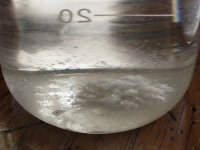
So I added oxalic acid to my concentrated tea and a precipitate formed. From the very dark purple it turned to a dark red. After a while the dark purple color returned and there is a precipitate layer on the bottom.

Will be a mix of oxalates I’ll filter off and test if DMT was removed by basing with lye and pulling with hexane.

Are all oxide alkaloids inactive?

Crude concentrated tea is too thick for reliable precipitation...a lot of gunk will also precipitate to... I actually cooked my botanical source with oxalic acid and when tea is dilute only mineral oxalates (calcium, magnesium etc) precipitates out but the actives remain in solution... No loss of yield was recorded. But i didn't try to reduce the tea too much... I tested the mineral precipitate it wasn't bitter at all suggesting no alkaloids has precipitated out.

Once i based with sodium hydroxide, pulled with chloroform and dried the freebase extract i dissolved it back into a concentrated solution of oxalic acid.. initially nothing happened but as I'm transferring the salted polar layer it started to crystalize inside the syringe and in the collecting jar...even the salted portion inside the extraction jar was also crystallizing...crystals everywhere.. these crystals were definitely not calcium oxalate and they had poor solubility in water.. upon basing these crystals with sodium hydroxide solution instantly got cloudy ...pulled with chloroform again and got this very clean transparent light yellowish oil that was pure 5-meo-dmt from bioassay.

If i had used hexane instead of chloroform for the final extraction i might have got crystals.
 
With a concentrated tea (right before it starts to get too syrupy thick) I would estimate only 1/4th the dmt present precipitated.
 
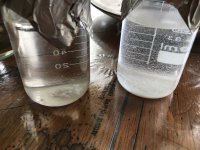
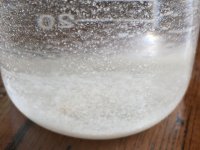
So the oxalate is 'cleaner' since had an extra acid base step. The benzoate on the right with more crystals has an oil like yellow contaminate which @Jan e Kharabat mentions it here TEK - The benzoic acid tek. The original tea visually had I'd estimate 3/4 or 4/5 of the dmt still in solution. I added quite a lot of oxalate (didn't weigh) so maybe added a great excess would precipitate more? Original tea had an excess of citric acid to do the acid pulls. This is hexane with benzoic acid precipitating the dmt. I like this salt form since I use for oral dosage. This amount is from 100ml of concentrated tea from 1L which was reduced quite a lot.

5x pressure cooker pulls and acid overnight rests didn't pull all the dmt but did pull most. Enough to not attempt to use bark anymore since I left it in lye soup for a lot time already.
 

Attachments

  • IMG_1879.JPG
    IMG_1879.JPG
    2.5 MB · Views: 3
  • IMG_1880.JPG
    IMG_1880.JPG
    1.4 MB · Views: 3
  • IMG_1881.JPG
    IMG_1881.JPG
    1.6 MB · Views: 3
Not enough dmt precipitated for me to further test this idea. I guess I'll always need to just use a NP solvent. Drying a tea completely causes problems at the end once a syrup consistency due to the sugars and carbs I'd guess. And adding the sodium carbonate causes issues as well so Isopropanol isn't ideal either.
 
Back
Top Bottom