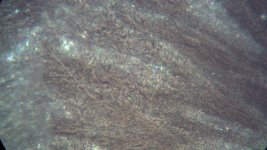
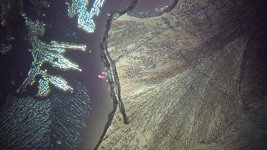
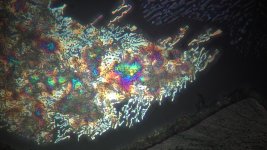
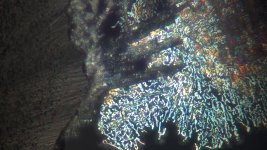
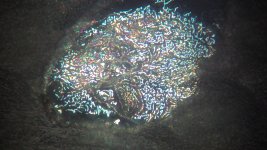
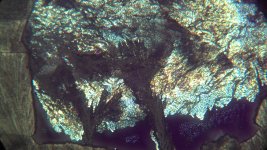
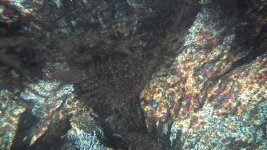
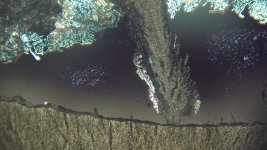
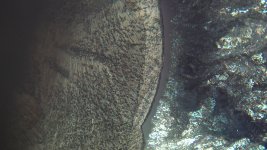
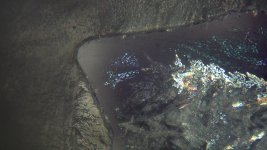
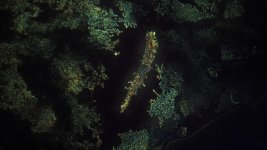
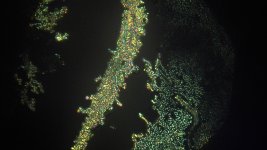
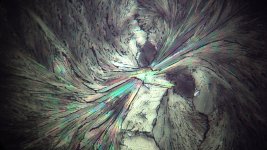
 Making a thread to post all the photos and videos that I will be taking. I don't want to overload the server with a seemingly infinite fountain of beautiful alien landscapes so I'll try to focus on just the most captivating visuals. Ever since putting the first slide under the microscope a couple days ago I've been obsessed and fascinated like I'm meeting DMT for the first time again. It's a very cool way to look at the crystal, I highly recommend it. Microscopy and crystallography is just a hobby for me, and I'm a beginner, so I can't yet explain why things look the way they do, beyond some basics.
Microscopes:
Polariscope - A small standalone scope with no magnification. It transmits plane polarized light through a sample. A second polarizer above, called the analyzer, can be rotated. The angle that the analyzer is relative to the polarizer changes which light passes through. When the analyzer is perpendicular to the polarizer, this is called cross polarization. Under cross polarization, all of the transmitted light gets blocked by the analyzer, creating an astonishing effect where a transparent sample appears to be glowing of its own light. For the crystal to glow it must bend some of the polarized light as it travels through the mineral, changing color and brightness depending on the composition and angle of the crystal. Gemologists use these to help distinguish gemstones.
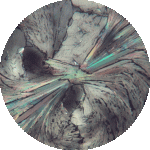
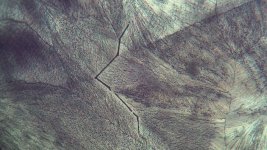
Amscope ME1400T - A reflective light microscope. Instead of transmitting light through the sample, it bounces light off the surface. It's used in metallurgy to inspect the crystal grains within metallic solids, or in petrography to identify mineral grains in thin section. In petrography, a very useful tool is to use polarized light, which creates interference patterns in minerals that indicate how light moves through them, helping to identify them. I bought this scope for petrography, but the application applies well to crystallography. It has a polarizer & analyzer built into it. The photo at the header was taken through the ME1400T.
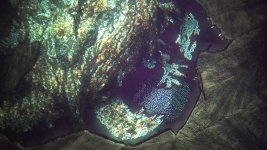
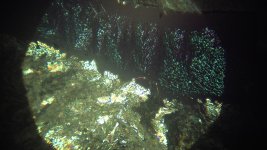
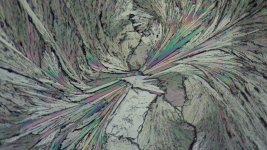
Amscope SM-1T - A stereo zoom microscope. Basically just a big magnifying glass. Also uses reflected light, but with less magnification. Great for looking at objects larger than a slide, like actual crystals. The polariscope can be placed under the SM-1T to view specimens in polarized light. Below is an image of the same crystal, photographed through the SM-1T + Polariscope.
Camera:
Amscope AF408N - Both microscopes have trinocular ports for the camera that I swap between them. It can transmit a 4K live feed to my TV, which looks amazing in OLED. I haven't figured out how to calculate the magnification through the camera yet, but once I do I will be able to add a scale bar to the photos. It also takes great video. I'm really happy with this camera and being able to share what the microscope reveals.
Right now it's more of an art form, but I think with enough observation and some informed explanations we could learn a lot from watching DMT grow on a slide. I invite anyone that is more experienced with this to help with that

This video through the SM-1T + Polariscope illustrates what it looks like when rotating the polarizers relative to the sample. When grains go black it's called extinction. When they're colorful it's called birefringence. When shadowy bands of extinction wash over the entire crystal structure, it's called an interference figure. It all has to do with how light slows or splits when traveling through materials. A smarter person could use all this information to determine not only what mineral they're looking at, but also what axis of the crystal structure they're looking down. It apparently could also be used to analyze purity, or polymorphism. As we can see, there are pure solid transparent shards in this sample, that fan out into a wave of less ordered formations.
View attachment Rotating Polarizer.mp4
I've seen more formations in these slides than I believed DMT could exhibit. I'll introduce more of them as I get time to write amateur descriptions for them. How freakin' psychedelic is polarized light tho?!
Last edited: