Mass Spec doesn't Lye 8)
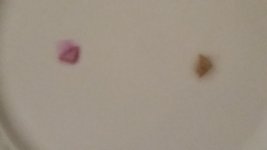
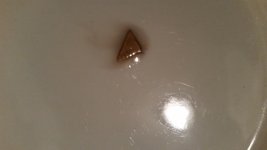
Judging from your preliminary results, it appears as though there most likely is LSD in those blotters, as I have gotten similar results when testing blotter paper infused with LSD in the past. As thus, I would argue that it's extremely likely that your results were positive for LSD.
Ehrlich reagent testing alone, IMO, is a great spot test for molecules containing tryptamine/indole moieties, but isn't a sure-fire means of determining which tryptamine/indole is present, as the color range for reactions with indoles is very hard to discriminate against for various tryptamines. Psilocybn and Alpha-methyltryptamine may produce very similar results/colors when tested with ehrlich reagent, too. The narrow differences in the color range for this reagent, although serving as a good spot-test for indole-containing compounds, it isn't enough in order to ensure that it most certainly is LSD.
My suggestion is as thus: if you are concerned about the validity of simple colorimetric reagent tests, feel free to invest in a TLC kit. IDK which eluent mixture would keep d-LSD from degrading, so that is up to you to research into, as I am lazy as hell, and your problem is not mine.
As one final point: a simple UV lamp (dirt cheap when compared to other fluorescence & other UV-based analytical methodology equipment), when turned on and exposed to the white blotter paper in question under ambient/low light conditions, should result in the blotter paper fluorescing (LSD fluoresces in the visible range when exposed to UV radiation, whereas NBOMES do not). This simple & cheap test can help compliment your preliminary (& most likely correct) reagent tests, which both produced a result akin to that commonly seen when testing LSD. If you feel like going an extra dozen kilometers or so, I'd suggest expanding your arsenal of analytic methodologies to include TLC and simple UV lights, alongside expanding your collection of colorimetric reagents with which to test these substances in question.
If you have any further inquiries, I'd suggest you read-through this webpage from the UNODC, which discusses common & cheap means of testing LSD in the field:
Tests for the detection of lysergic acid diethylamide (LSD) are not always specific; to cope with this problem the authors have developed a fluorimetric apparatus and technique for the detection and identification of LSD in samples seized from illicit traffic in drugs. The fluorimeter is not...

www.unodc.org
Hope this helped,
God