• Members of the previous forum can retrieve their temporary password here, (login and check your PM).

First extraction: d-limonene does not separate ?

Migrated topic.

monomind

Rising Star
I am in the midst of my first extraction. Decided to do a full spectrum BLAB ( The Big Leisurely A/B).
- Used 125g of mhrb ( Not exactly powdered but a mix of very thinly shredded + powder).
- Soaked in vinegar for few days
- Added lye solution. Mixed and left it over night. Got a black gooey soup.
- Added d-limonene and gently mixed.

Last stage took place 2 hours ago and I was expecting the limonene to separate and float to the top so I can pull.
No separation occurred. Black soup still looks the same.
Any tips of what might have gone wrong here ?

Thanks and blessings.
 
I used something called "Orange Terpenes" and I am not sure now if this is the same as d-limonene or not.
Any thoughts ?
 
I was going to ask, and you answered without me asking! "Orange terpenes" will be less pure than D-limonene. If it has been pressed from orange peel it may even have an orange colour. Pure limonene should be colourless. Anyhow, several of these impurities can increase the likelihood of emulsions. I had a hard time working with some expressed - and very orange - orange oil once, with cactus.
 
Apparently it is not that easy to get in the UK and most vendors sell "Orange terpenes" or "Dipentene".
The one I got was from ebay and arrived in a non-branded container. It is a transparent liquid btw.

Tek: I had around 1L of basic soup for which I added 30ml of the orange terpenes. No visible separation after 12 hours.
Is it possible I just need to add more of the d-limonene/orange terpenes ?
The BLAB uses 100ml of d-limonene for around 3.6 litre of soup so I just used the proportional amount.
Any further thoughts ?

Thanks!
 
Dipentene is (or should be) racemic limonene and should do the job. From what I've heard, limonene should be available for use with 3-D printers.

30mL was a pretty small amount of solvent, no wonder it got lost in the soup. Scaling does not always work out as a direct proportion - adding a bit more solvent shouldn't do any harm, but I'd suggest mixing some with NaOH solution first to see if there's a colour change.

If all else fails, you could try chucking in some naphtha or toluene.
 
downwardsfromzero said:
Dipentene is (or should be) racemic limonene and should do the job. From what I've heard, limonene should be available for use with 3-D printers.

That was a pretty small amount of solvent, no wonder it got lost in the soup. Scaling does not always work out as a direct proportion - adding a bit more solvent shouldn't do any harm, but I'd suggest mixing some with NaOH solution first to see if there's a colour change.

If all else fails, you could try chucking in some naphtha or toluene.

Thanks. Getting these kind of answers saves a lot of trial&error... also the 3d printing proved relevant :)
What color should the lye solution change to after mixing with the limonene ?
Should it separate as well after a while ?

Also, is the temperature making any difference ? I keep it in a relatively cold room ( 17 C ) ?
 
Ideally, mixing limonene with lye should not produce any reaction, and it should separate cleanly. A colour change with lye would suggest excessive presence of other, more reactive terpenoids. In these circumstances soap-like substances could be formed, as well as polymers. Both of these will increase the likelihood of emulsions.

As far as the temperature of your room goes, colder liquids are almost exclusively more viscous than they would be if they were warmer. This again has practical implications for the separation of emulsions - hence the previous suggestion of heat to help bring the phases apart.
 
I've added 20ml more limonene to the soup and now phase separation takes place. Hooray :lol:
Not sure what happened to the initial 30ml of limonene.
Either linear scale-down was not right to start with or something else happened along the way.
I will also move my soup indoors now to a warmer environment.

Thanks for all the help :thumb_up:
 
Now that's a relief!

Basically, too much of a that small an amount of limonene will just stick to the particulates in the soup and refuse to budge. Surface area and volume do not scale in the same way.
 
:)
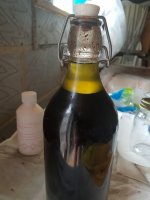
I figured that using a bottle rather than a jar will make decanting much easier.
 

Attachments

  • 20200612_124910+-+Copy.jpg
    20200612_124910+-+Copy.jpg
    102.7 KB · Views: 0
In a moment of clumsiness I managed to pull a little bit of the lye soup together with the limonene and now the bottom of the jar with all my limonene pulls have visible black stuff on it.
Any idea how to get rid of it ?
Should I just decant, leaving the black drops behind or maybe filter ?

Will appreciate some more hand holding here guys :)
 
Using a bottle is definitely much more practical then jars.

Do not try to filter limonene, just decant clear layer for salting and put lye water with some limonene back to the bottle.

Would be better to fill whole neck of the bottle with limonene.
 
doubledog said:
Using a bottle is definitely much more practical then jars.

Do not try to filter limonene, just decant clear layer for salting and put lye water with some limonene back to the bottle.

Would be better to fill whole neck of the bottle with limonene.
Thanks, that's very helpful.
BTW, I did not fill it to the brim to allow some space for the liquids to mix better when agitating.
 
Back
Top Bottom