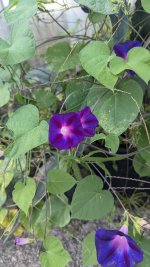
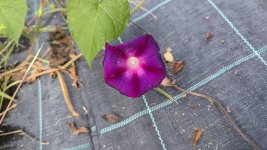
Until a sage comes along I can make a guess and say I think you are correct.
It appears to be a member of the Ipomoea nil species complex that includes I. nil, I. hederacea and Ipomoea purpurea, which are all rather closely related and that it is most likely Ipomoea purpurea.
Grandpa Ott. Ipomoea nil, for "nil" alkaloids.
Actually, I think I might have read somewhere that it has low levels of ergines and more levels of nasties. Anyway, likely of no use.
The easiest way to identify Ipomoea species in the I. nil complex is with images of the flowers and fruit that include the calyx. Images of the seed can also help.
In fact, in general images of flowers, fruit and seeds of any type of morning glory can be used to identify them fairly well with a few exceptions of lookalike species.
The easiest way to identify Ipomoea species in the I. nil complex is with images of the flowers and fruit that include the calyx. Images of the seed can also help.
In fact, in general images of flowers, fruit and seeds of any type of morning glory can be used to identify them fairly well with a few exceptions of lookalike species.
Grandpa Otts make lovely plants for the flowers, foliage and overall form, even if they're of little interest psychopharmacologically. I grow them for this reason alone, although they do produce prolific amounts of seed if anyone was planning on keeping them for chemical analysis.
This site uses cookies to help personalise content, tailor your experience and to keep you logged in if you register.
By continuing to use this site, you are consenting to our use of cookies.