Hailstorm said:
Syragote, heptane itself cannot degrade DMT - it is chemically inert for all practical purposes.
What can react with DMT molecules is oxygen, carbon dioxide and other chemicals (if I am not mistaken, 100g heptane can dissolve up to 0.035g molecular oxygen or 0.619g carbon dioxide). Much more is present in the atmosphere - albeit more slowly, atmospheric gases also react with DMT at the surface of the solvent.
Two things to give particular consideration are dissolved water and traces of base contamination. More on this in a moment.
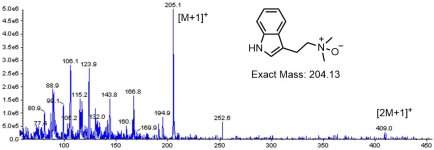
Molecular oxygen does not react with DMT directly. However, when the two oxygen atoms split apart, each will carry an unpaired electron. Such free radicals can react with the nitrogen in DMT to form DMT N-oxide, a yellow oil.
Experimentally, it has proven difficult to generate DMT-N-oxide without the use of hydrogen peroxide or a peroxy acid. The current thinking, based on limited analytical evidence, is that DMT, in the presence of moisture, undergoes a base-catalysed oligomerisation at the indole ring. In my view, oxygen molecules are likely to act as an electron acceptor in this mechanism.
Molecular oxygen exists as a diradical in its ground (lowest energy) state, with two unpaired electrons. Thus it is not necessary for the oxygen molecule to be split apart in order for it to react with pretty much any source of vaguely spare electrons. This property is behind the peroxide formation which occurs readily with a numerous types organic molecules - ranging from polyunsaturated fatty acids, to (certain) ethers, to alkenes. The oxidation of DMT, and indeed many other oxidisable substances, need not involve the addition of one or more oxygen atoms. Loss of one or more electrons is also a form of oxidation.
Carbon dioxide reacts with that same nitrogen to form carbamate esters. That reaction (unless followed by further transformations) is luckily reversible and even modest heating will split CO2 off. However, unlike freebase amines, carbamates have different solubility properties, which may lead to some DMT loss in handling, purification, etc.
Amine auto-carbamates only form with primary and secondary amines. DMT is a tertiary amine and thus won't react with CO2 in this way. This is exploited in the CO2 method for separating NMT from DMT.
Converting DMT to a salt (hydrochloride, fumarate, benzoate) binds the lone pair on the nitrogen to a proton from the acid, making the nitrogen far less reactive and more stable in air.
The other thing that happens with salt formation is that it eliminates the great majority of the basicity of the amine. This means that the freebase DMT can't act as its own catalyst in the above-mentioned base-catalysed oligomerisation.
Dissolving any chemical compound drastically increases its surface area - the molecules, instead of sticking together like male penguins, disperse and become exposed to whatever reactants are there. This is one of the reasons chemists use solvents - to dramatically accelerate reactions through large contact surface areas. Unfortunately, it also means that whatever can degrade DMT can have an easier time doing so.
If you want to experiment with storing DMT in a solvent, the following should work (but is probably an overkill):
1) Degas the solvent (bubble argon through it, pull a vacuum, etc.) before dissolving DMT in it.
2) Cover the DMT solution with some argon, or hang some oxygen absorbers in the headspace of the container.
3) Close the container and keep it airtight.
4) Shield the container from light (amber glass, aluminum foil, ...) to reduce formation of free radicals.
5) Store the container in a good medical freezer to slow down whatever reactions may still occur.
6) Warm it up before opening to minimize water vapor condensation.
All good stuff. The degassing should remove the majority of water contamination but if this is perceived as being critical then the solvent can be dried with a compatible drying agent or a chemical drying method, the nature of which is dependent on the solvent being used.
After removing a storage container from cold storage, there is the problem of condensation which forms on the outside of the cold container. It is therefore prudent to package the storage container in a secondary container which also contains at least some desiccant if not an inert atmosphere. The whole package can then be allowed to warm to room temperature without condensation forming on the outside of the primary storage container, which would otherwise risk compromising the pains taken to ensure the integrity of the sample. [Sorry, too much coffee

]