• Members of the previous forum can retrieve their temporary password here, (login and check your PM).

lopho crestation after bug infestation?

Migrated topic.

tribo

Esteemed member
Joined
Mar 9, 2011
Messages
41
Merits
42
So a friend has a lopho grafted atop a t. pachanoi rootstock 8 cm in diameter, and recently noticed a strange growth pattern on one of the lopho's pups. The lopho had experienced some sort of bug infestation (help with the id of the yellow bug please!) which was treated with a home-made aqueous solution using limonene as an insecticide and mild liquid soap as an emulsifier (theres a US patent this method). The bug's population was quickly reduced, although not completely eliminated. Pictured below, the pup with strange growth patterns is in the foreground. The strange growth appears to have the most tender tufts and is thought to be the new growth area and has furrows running nearly horizontally. In contrast, the center of the pup seems to have stopped or slowed in growth. This friend has observed double headed lopho seedlings, as well as pupping, which first appears as an eruption at an areole, and this growth pattern doesn't resemble either growth pattern. Has anyone observed a grafted lopho become crested and/or confirm the crestation in this scion? If the lopho is a crest, is there any reason the cactus might stop the crested growth and resume its normal habit? Thanks!

 

Attachments

  • crest_origin.JPG
    crest_origin.JPG
    194.2 KB · Views: 0
tribo said:
So a friend has a lopho grafted atop a t. pachanoi rootstock 8 cm in diameter, and recently noticed a strange growth pattern on one of the lopho's pups. The lopho had experienced some sort of bug infestation (help with the id of the yellow bug please!) which was treated with a home-made aqueous solution using limonene as an insecticide and mild liquid soap as an emulsifier (theres a US patent this method). The bug's population was quickly reduced, although not completely eliminated. Pictured below, the pup with strange growth patterns is in the foreground. The strange growth appears to have the most tender tufts and is thought to be the new growth area and has furrows running nearly horizontally. In contrast, the center of the pup seems to have stopped or slowed in growth. This friend has observed double headed lopho seedlings, as well as pupping, which first appears as an eruption at an areole, and this growth pattern doesn't resemble either growth pattern. Has anyone observed a grafted lopho become crested and/or confirm the crestation in this scion? If the lopho is a crest, is there any reason the cactus might stop the crested growth and resume its normal habit? Thanks!

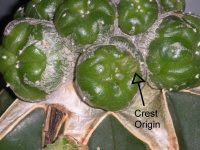
doesn't look like it is cresting, likely just the mite or thrip(i dont see anything at a glance to id...) damage/healing process
time will tell/wait and see if a crest forms

as for the bug issue/spray multiple sprays, 3 days apart for a week and a half with mild insecticidal soap should do the trick, i recommend staying away from anything oily for tender grafts(unless they are in shade for a while after spraying

Good luck :)
 
dg- thanks for the reply! I asked my friend to keep an eye on the lopho with strange growth, and will post some pics in the next few weeks/months to illustrate healing from the insect damage. There may be a yellowish insect in a furrow in the pup above and to the left of the pup in question. The pests are about 1 to 2 mm in length and quite thin so as to 'hide' between the cactus ribs, slightly yellow in color, and have been observed with slightly larger winged insects. Could these pests be some sort of larvae feeding on the new growth of the cactus?

I asked this friend with the lophos about the insecticidal soap vs. the dilute limonene spray. He assured me he originally tried insecticidal soap some years back, but the 'safe' spray he used caused some dark weeping blisters on a tricho clone. Since this 'allergic' tricho clone was the fastest growing rootstock housing several different lohpo clones, he decided to try the dilute limonene solution. Over the last year or so, the solution (1-2% limonene, 1% baby shampoo, balance H2O) has been tested on peres, lophos, and trichos, as well as many fully healed graft combinations without any obvious oily residue or adverse reaction. Sprayed plants are kept out of direct sunlight until the solution is fully dried. Although he currently sprays weekly and foliar feeds weekly at night which may reduce the overall effectiveness of insecticidal sprays.
 
if they are persistent it might be mites, but your description is more thrip like
ime, mites love tender grafts, and cause that kind of damage
 
Back
Top Bottom