• Members of the previous forum can retrieve their temporary password here, (login and check your PM).

Mimosa Pudica

Migrated topic.

Grower

Rising Star
I have this Mimosa pudica that i have raised from seed.
Here they call it "Don´t touch me" because the way it fold its leaves and even small branches as it is physically touched (or misted), quite funny to see.
Anyway, it have now become over half a meter high and are showing its first flowers.
I just wonder as it is a Mimosa, can it contain any spicy alkaloids?
Never heard anything about any extractions from this one so im sceptical but i thought i might ask if anyone have done any testing?
Wiki says nothing about spice.
Its a common plant grown for its looks and it grows like a weed in many parts of the world as Thailand for example.

Grower
 
Grower said:
I have this Mimosa pudica that i have raised from seed.
Here they call it "Don´t touch me" because the way it fold its leaves and even small branches as it is physically touched (or misted), quite funny to see.
Anyway, it have now become over half a meter high and are showing its first flowers.
I just wonder as it is a Mimosa, can it contain any spicy alkaloids?
Never heard anything about any extractions from this one so im sceptical but i thought i might ask if anyone have done any testing?
Wiki says nothing about spice.
Its a common plant grown for its looks and it grows like a weed in many parts of the world as Thailand for example.

Grower

I don't believe so, but I also have one and it is a very cool plant!
 
i believe the issue with pudica lies in isolating mimosine from your product...

on a less related note: i am growing hostilis, which is reported NOT to be a sensitive plant, but i noticed that when the plant is misted/watered/vigorously fondled, it does indeed behave as a sensitive plant (folding its leaves, and drooping its branches).

the seedling doesn't do this when its really young (Except when you water it), and it might not do it when it is fully mature, but when it is a young sapling, it most definitely behaves as a sensitive plant (so much so that i have seen the wind cause some branches to fold up)
 
so regarding the Mimosa Pudica findings in your thread endlessness, do you know if any nexians have tested this plant? interesting that the alkaloids were isolated from fairly young plants - I would be interested to know if the alkaloid types and their levels increase with age, as is the case with a lot of acacia
 
Thanks for the link.
So it isnt very active at least in young stage of growth.
I also wonder about this:
- DMT did not start to show up in assays until after second year, at which time it was present in leaf and root. (ref trout's Notes)
Maybe it can be a source when they are older.

Grower
 
I'm not sure if any nexian tested it, but k. trout is around, maybe he can give more details on these TLC tests.

In a couple of months when I'm more settled I can try to gather samples and test it.

In the meanwhile I think it would be worth a try for others, to test with TLC or at least a small extraction and testing with ehrlich . If results are promissing, great, if not, at least we learn some more about this plant :)
 
I'm not sure if any nexian tested it, but k. trout is around, maybe he can give more details on these TLC tests.

In a couple of months when I'm more settled I can try to gather samples and test it.

In the meanwhile I think it would be worth a try for others, to test with TLC or at least a small extraction and testing with ehrlich . If results are promissing, great, if not, at least we learn some more about this plant :)
Have you tested mimosa pudica? I have almost 30kg of pudica foliage and roots and wish to extract atleast 6grams of spice but, all my research says it doesn't contain any dmt. I just don't wanna waste very expensive chemicals.
 
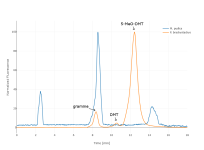
I extracted some leaves of my Mimosa pudica and analyzed with the same method that I developed for my Phalaris grass. The plant was around two years old when I sampled, grown from seed. Here's the chromatogram, along with P. brachystachys for a reference:

mp-chrom.png

We see a peak at the expected retention time for gramine. I don't know if that's actually gramine, since I haven't otherwise confirmed. The other two peaks are unidentified, and definitely not DMT or 5-MeO-DMT. My plant was thus inactive. It was very pleasing to grow, but troublesome as a houseplant because of its natural prostrate growth habit, sprawling everywhere. I also found it hard to keep healthy, perhaps due to my dry climate, completely overtaken by spider mites without frequent sprays of Avid. I moved it outside, but I think to an excessively shaded spot and it died.

It's possible that one of those peaks is mimosine, a non-proteinogenic amino acid. Mimosine doesn't have the indole fluorophore that tryptamines do. It's thus probably less fluorescent (or absorbing), so its peak height may understate its abundance by mass. Mimosine has been studied as a potential cause of livestock poisoning.

Trout reports "an alkaloid that co-chromatographed with DMT and showed the same color reaction with Xanthydrol (purple)" in Appleseed's M. pudica. I guess that language reflects their uncertainty on the identification. It's too bad that I didn't run TLC myself, to see if my known inactive plant had a spot with Rf near DMT (since if yes that would strongly suggest theirs was false positive too).
 
Back
Top Bottom