• Members of the previous forum can retrieve their temporary password here, (login and check your PM).

Morning glory data

Migrated topic.

Loveall

Titanium Teammate
Donator
Senior Member
Great find Loveall! Haven’t had a lot of luck with getting pods from the “heavenly blues” in my climate. Hopefully one of the others would be more adaptable or maybe even my local variety would be worth trying.
 
Anybody else notice that this cites Ipomoea tricolor as having the most LSH (=LAH) of all species? Sitting at 150 ug/g total mixed LSH & LSA. Compared to Argyreia nervosa at 10 ug/g.

I haven't read the whole paper yet so I'm wondering why they found this. Usually A. nervosa is supposed to be more potent. Perhaps it was the wrong variety.
 
It's hard to know, I don't think anyone has taken purified LSH because it's supposedly so unstable.

Chemically it looks more like LSD than LSA, I think it's more non-polar as well.

Albert Hoffman said his trials with pure LSA led to a sedated and not very psychologically engaging experience.

From my own experience taking hawaiian baby woodrose I found some were extremely psychically potent (the fresher looking, fuzzier ones) and others caused very little psychedelia with a lot of bodyload and sedation. My best experiences HBWR were more productive than LSD to me, but with a higher initial bodyload price tag. After a while the seed unpleasantness gave way to beautiful euphoria.

We also know that the Periglandula spp. in Ipomoea tricolor at least do not produce LSA, only LSH, which then breaks down into LSA over time.

Given that, I'm kind of hypothesizing that LSH is probably what we're after in morning glories. Certainly fresh morning glories are reputed to be the best and most acid like generally.
 
I read the whole thing and i'm a bit confused
How to read this table ? HBW has 0% LAH ... so either this data is wrong, or they actually produce LSA directly , and this hasn't been measured?

Other important question : Is there any alkaloids that are toxic/ dangerous?
how risky is it to try any ipomeas?
I ask, because for a reason that elude me (please help resolve the mystery), all the heavenly blue that i see around (and that i grew myself) don't give any seeds ...
But i got other ipomeas that give plenty of seeds, next to the Tricolor. But they are hard to identify, there's so many of them looking quite similar...

BTW, i eat plenty of time HBW that were 2 or 3 years old at least, and i absolutly loved the trip. LSA (is it LSA at the end?) is maybe my favorite psychedelic, in the way it is so subtle, fine, yet magnificient ... Eric Satie of the psychedelic.
 
Quetzal7 said:
I read the whole thing and i'm a bit confused
How to read this table ? HBW has 0% LAH ... so either this data is wrong, or they actually produce LSA directly , and this hasn't been measured?

Other important question : Is there any alkaloids that are toxic/ dangerous?
how risky is it to try any ipomeas?
I ask, because for a reason that elude me (please help resolve the mystery), all the heavenly blue that i see around (and that i grew myself) don't give any seeds ...
But i got other ipomeas that give plenty of seeds, next to the Tricolor. But they are hard to identify, there's so many of them looking quite similar...

BTW, i eat plenty of time HBW that were 2 or 3 years old at least, and i absolutly loved the trip. LSA (is it LSA at the end?) is maybe my favorite psychedelic, in the way it is so subtle, fine, yet magnificient ... Eric Satie of the psychedelic.
It is a bit hard to tell what is going on because we're looking at data from one set of analyses and this cannot always be extrapolated to whatever seeds we've eaten because it's living organisms we're dealing with. This being especially the case when trying to differentiate between LSA/LSH in HBWR, all I can do is relate my experience with some moderately old baby woodrose seeds that were consumed at the end of a booze-fueled evening and ended up producing a highly memorable and significant psychedelic experience for me the following morning. This has been described briefly elsewhere in the forum.

As far as toxicity goes, it is always strongly recommended that you research as much as possible about any plant you plan to consume. This would include looking into the pharmacology and toxicology of each of the alkaloids mentioned in the Nature study, as well as searching for any known traditional usage of the species concerned. Of course, it should go without saying that you must definitively identify the plant before consumption.

Bear in mind, too, that some species of Ipomoea can have a drastic purgative action.

The paper also states:
"A distinct heritable fungal symbiont that produces the toxic indolizidine alkaloid swainsonine occurs in I. carnea, I. costata and other species in the Jalapae and related clades"
"Poisoning of livestock following grazing on EA+ morning glory species has also been reported"

Proceed with care; you may want to look into extraction and subsequent chemical testing before proceeding with any species of uncertain composition.
 
Nice find Loveall, read all of the microbial microchemistry article, thanks!

LSH or Lysergic acid hydroxyethylamide appears to be one of the main actives in the seeds (along with penniclavine), and not LSA (a decomposition product of LSH) as commonly thought.

downwardsfromzero said:
all I can do is relate my experience with some moderately old baby woodrose seeds that were consumed at the end of a booze-fueled evening and ended up producing a highly memorable and significant psychedelic experience for me the following morning. This has been described briefly elsewhere in the forum.
downwardsfromzero's excellent report which I have read many times, can be found here on post #5:
thread "Potent LSH & penniclavine fresh from morning glory vine & relation to ancient Greece"
hxxps://www.dmt-nexus.me/forum/default.aspx?g=posts&t=94737

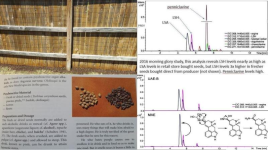
2016 Polish morning glory study found 3x higher amounts of LSH in MG seeds direct from grower/producer vs retail (note 7):
fresh black seeds from vine: likely 5.00 LSH to 5.00 penniclavine ratio
seeds direct from growers: 1.71 LSH to 5.08 penniclavine ratio
seeds off retail racks: 0.54 LSH to 4.75 penniclavine ratio
2016 Polish MG study:
Alkaloids abundance in all 3 HB cultivars is comparable, with most significant difference for LSH (Lysergic acid hydroxyethylamide), which varies from 0.54 to 1.71 compound to IS ratio. As has been demonstrated in this study, LSH is a labile compound, and therefore the variances in its concentration may be due to different age and storage conditions of the seeds rather than difference in plant metabolism. Indeed, seeds IT-HB2, which express highest concentration of LSH, were bought directly from the producer, whereas seeds IP-HB1 were purchased in retail stores.
LSH has not yet been found in HBWR according to studies in link above, but it is found in good levels in morning glory seeds, but with HBWR, it can possibly form in wine high in acetaldehyde, such as Sherry wine, as wine has the correct ph of 4.0 and the acetaldehyde boils off at 70 degree F, so must keep cold in fridge at all times, see LSA adducts paper with pics on post #18 with 8 other pics in link above. Add morning glory or HBWR extract to fridge cold just opened sherry wine (acetaldehyde converts to vinegar after 7 days unless wine is sealed with a ten dollar wine preservation canister high in argon), shake or stir for 1 minute every hour for 3 hours, then drink wine.

Vecktor (advanced chemist):
Ava69, You have probably rediscovered something that has long been a curiosity, for example on the now defunct blacklight site there was TLC posted of morning glory seed extract treated with methanol, acetaldehyde-methanol or with acetaldehyde-methanol-water, the extract treated with acetaldehyde-methanol showed a clear difference in the alkaloid profile, with a shift to several new non polar spots which couldn't be identified. IIRC Erhlichs was used to develop the plates so these were indole compounds.
Note hxxps://www.ncbi.nlm.nih.gov/pmc/articles/PMC49935/ Page 8441 "Reaction of Indole with Acetaldehyde: A 0.2% solution of indole in equal amounts of water, ethanol, and acetaldehyde formed a product with 60% yield after 1 hour of reaction at ambient temperature. Omitting the ethanol (50% acetaldehyde in water mixture) had no effect. Decreasing the concentration of acetaldehyde to 0.1% increased the reaction rate and percent yield of product." See pic of the researchers's indole + acetaldehyde adduct product formed ---> ie before (page 8439) and after (page 8441). The researchers achieved a new product with or without the use of ethanol, it made no difference, you only need acidic water and around a 0.1% acetaldehyde solution.

Norman said on 16 September 2019:
Years ago I stumbled across a simple method for dosing HBWR.
Grind the seeds and cover them with white wine, let sit in the fridge for a day or so, shaking occasionally, decant, filter and drink.
No nausea no aches no vasoconstriction.
I am now off alcohol completely so I’m thinking of an alternative method short of a full on extraction.
I’m convinced that something in the wine besides water and alcohol is what makes the trip so clean. I’ve tried twelve percent water alcohol mixes in the past and still had the nasty side effects and at the same time the trip is not as strong.
I’m thinking acetaldehyde and or tartaric acid may be involved or at least a good place to start.
Any thought on what chemically may be going on?
Chemist Peter Webster (who spoke at the LSD Symposium):
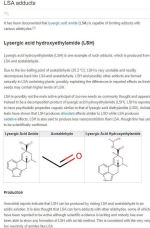
LSH is a labile adduct of LSA + acetaldehyde
fastandbulbous (chem wizard from bluelight):
Apparently N-(1-hydroxyethyl)lysergamide (LSH) is an adduct compound formed from lysergamide (lysergic acid amide, LSA/LAA, LA-111) and acetaldehyde. This hints towards the idea that isn't the most stable of compounds, but would be pretty easily formed by the combination of lysergamide (LSA) & acetaldehyde under physiological conditions (ie a way to get much more & better psychedelic activity from any lysergamide extracted from seed sources).
LSH can easily form but is unstable, can keep stable in low PH wine, and cold at all times. Even LSD Chemist Todd Skinner extracted ergot into wine:

Krystle Cole from the book "Lysergic":
"Isn't Ergot what Socrates used to take at Eleusis?" I thought it was kind of cool to be taking something that the founders of our democracy used to take, but that our current democracy has made illegal.

LSD chemist Todd Skinner replied "Yes, except for he did a water infusion of the ergot, instead of alcohol." Todd had prepared 6 jugs of ergot wine and stored them for many years.

Krystle Cole's "ergot wine" experience (several pages long) in the book "Lysergic", reported that she saw constantly rotating holographic Sanskrit or Arabic & Zodiac symbols, floating in a circle around Todd's head.
Pic: LSA adducts, and 2016 Polish morning glory study, note how LSH converts back to LSA if extracted into plain water instead of acidic water (such as wine). LSH only remains stable in low acidic water, wine is good for this. This is how the Aztec and Mayan extracted the seeds, into low ph solutions: alcohol, wine, see photo. Wine has the advantage of containing acetaldehyde.
--------------------------------------------------------------------------------
Pics for guest who can't log in:

part 8: New research: Morning glory contains 5 stimulating LSD-like drugs, soluble only in wine/alcohol, only sparingly soluble in water

hxxps://mycotopia.net/topic/111610-hpbcd-dmt-sublingually-active-under-tongue/page-1

Post #10 in link above shows 9 morning glory study pics and brand new 2020 receptorome chart which compares LSD with LSH from morning glory seeds.

 

Attachments

  • LSA+adducts.PNG
    LSA+adducts.PNG
    445 KB · Views: 0
  • LSH+morning+glory+study+pics.PNG
    LSH+morning+glory+study+pics.PNG
    426.7 KB · Views: 0
Please keep in mind that HBWR has high levels of ergometrine, causes cramping and vasoconstriction, ergometrine levels in morning glory for comparison is very low. Also, HBWR has no history of Shamanic use, whereas morning glory seed usage goes back several hundreds of years. HBWR only has history of medicinal use. HBWR also has high levels of LSA, very sedating and not really all that psychedelic at all. But yes, all studies published after 2011 indicate that no LSH has been found yet in HBWR.

Interestingly, when a boy was found dead at the bottom of his apartment building (he jumped out, apparently this really does happen), they detected levels of LSH or Lysergic acid Hydroxyethylamide in his blood, he had also been drinking heavily and taking HBWR seeds that night. Here is the actual toxicology study:

hxxps://pubmed.ncbi.nlm.nih.gov/20018470/

Remember, LSH is just a labile (unstable) adduct of LSA + acetaldehyde which can remain stable in acidic solutions, for example: outside the body in ph=4.0 cold fresh just opened sherry wine solution (under 70 degree F so the acetaldehyde does not boil off), and sherry is high in acetaldehyde. And you have to seal off the wine with a ten dollar wine preservation canister of inert argon gas (from *mazon with enough gas to last years of sealing) you shoot into the bottle, before placing back into the fridge, to keep the acetaldehyde from decomposing to vinegar via oxidation. Keep cold at all times. Whether this forms outside the liver as well as within is a whole nother discussion.

This is the paper that shows the alkaloid content of HBWR is vastly different from the alkaloid content of morning glory: Paulke A, Kremer C, Wunder C, Wurglics M, Schubert-Zsilavecz M, Toennes SW. Identification of legal highs—ergot alkaloid patterns in two Argyreia nervosa products. Forensic Sci Int. 2014;242:62–71.

No high levels of stimulating LSH, agroclavine, elymoclavine, chanoclavine, penniclavine found in HBWR seeds, only in morning glory seeds. A 2014 forensics paper from Paulke found no LSH in HBWR seeds, but only found LSA & iso-LSA (83-84%) & ergometrine (10-17%) & rest minimal: lysergol, elymoclavine & chanoclavine.

Sandgrease: "HBWR has more of a sedative effect compared to MG."

Nogal: "HBWR is more body related while MG seeds have effects more similar to LSD."
 
The clavines like agroclavine, isopenniclavine, elymoclavine and chanoclavine and even lysergol are worth considering in terms of psychedelic effects.

I'm not saying LAH isn't psychoactive, but I suspect it isn't even responsible for the majority of desired effects.

In particular I look for clavine content, which incidentally forms lysergic acid as a breakdown product, if I am not mistaken.

There is an absurd amount of speculation and numerous unverified claims (are) made about the activity of ergine alkaloids and their pharmacology, that can be found online. I remain unconvinced that LSA and LAH are the primary psychedelic alkaloids of Ipomoea and allies.

Edited to add:

The study is also annoying as that it doesn't replicate tests.
Different varieties of the same species can vary, take Hawaiian Baby Woodrose for example, the alkaloid content of this single species can vary significantly. Moreover many of the tests involved herbarium specimens and not fresh material. The levels listed are not definitative or even indicative of actual alkaloid concentrations or averages, but rather serve to indicate a + or a - for the specific alkaloids tested for.

Agroclavine is a Periglandula made precursor for other clavine products and their lysergic breakdown products, including chanoclavine. This test was a bit wonky and didn't consider a lot of variables but it did raise awareness that ergine + and ergine - forms can be found for single species and that no single test is authoritative when it comes to Ipomoea.

If anything the study shows that we have a lot to learn.

(*edited to add elymoclavine to initial sentence)
 
kerelsk said:
It's hard to know, I don't think anyone has taken purified LSH because it's supposedly so unstable.

I wouldn't let "supposedly" stop me if I were researching it. I have a sneaking suspicion, that people have done experiments and came up with results that, perhaps, would not have been arrived at many times, had such experiment been done many times.

Once Terrence McKenna mentioned one tradition, in Meso America. He said that they would make a tea of Morning Glory seeds with water, then after straining, would discard the water, then they would discard the water, create a tortilla like thing with the rest, then bake it in the sun to form a cracker-like thing.

Yet, "supposedly," heat destroys the active compounds.
 
While fresh seeds are much more LSD-like, it is not so that old seeds are completely lacking in psychedelic effects. But they are less like LSD and more dissociative in nature.

They have a very wide range of effects that changes with the dosages taken.
 
Back
Top Bottom