

[Disclaimer: this is the Info I have gathered based off my first 6 extractions and my attempt to try and give back some of the Info I've learned. It is more of a theory that is still subject to change and I am learning from. I do not have access to equipment to be able to confirm nor deny the presence of plastic contamination in my end product i can only share my experiences in hopes to learn.]
What is PTFE?
"Polytetrafluoroethylene (PTFE) is a fluoropolymer and is commonly known by its trade name, Teflon®. Unique properties of PTFE include nonreactivity, hydrophobicity, a low coefficient of friction, and good insulating properties. It is most commonly used as a nonstick coating for cookware. PTFE is also used in the manufacture of semiconductors and medical devices; as coatings for bulk chemical containers, eyeglasses, and shaver blades; and as an inert ingredient of pesticides. PTFE is among the most chemically inert, nontoxic, and nonflammable substances tested under normal usage conditions, and is not metabolized. Although PTFE is not a skin irritant in rabbits or humans, or a skin sensitizer in humans, the major safety concern with PTFE is workplace exposure to its pyrolysis products, which may be irritating to the eyes, skin, and mucous membrane. PTFE pyrolysis products can also produce influenza-like symptoms (also known as ‘polymer-fume fever’). In nonclinical studies, no toxicologically significant effects were observed in rats administered 25% PTFE in the diet for 90 days. A persistent chronic inflammatory reaction that exhibited progressive tissue growth was noted at the injection site in mice, rabbits, and dogs administered a single injection of PTFE particulate in a glycerine carrier for up to 1 year. Localized fibrosarcomas have been reported with subcutaneous injection of PTFE sheets or discs in mice and rats. However, the International Agency for Research on Cancer has concluded that insufficient data exist to assess the carcinogenic risk of human exposure to PTFE. There are no known ecotoxicological effects of PTFE."
So I found PTFE sheeting to be a possibly cheap wonderful solution for lining the cap of your extraction vessel and for this tek im using a GL45 thread media bottle cap as these are the only caps I have to work with for now but I imagine that you could substitute PTFE sheeting for many other caps if you wished to get creative with it. I also notice when looking around to purchase prelined media bottle caps they tend to get pricey. I also understand that the GL45 media bottle caps are PP (polypropylene) but according to everything I've read it seems that PTFE is stronger than PP due to having a higher thermal range.
[Edit: However I am not honestly entirely sure and I wonder if cheap PTFE from amazon would be different than ordering lab grade PTFE sheeting from some other source.]
The process:
what i do is place a cap down onto a piece of PTFE sheeting and score it with a razor knife on a piece of cardboard or if you are using on a surface other than cardboard that you dont want to scratch, you can use a paper clip to scratch a line around the cap, you could also use a pen or pencil but for some reason scoring speaks to me.
score or trace around the outside of the media bottle cap (or whatever cap you plan to use) after placing onto PTFE sheeting then simply cut to fit the inside of the cap.
Even easier I have found is to cut a square bigger than the cap and to place the cap down onto the square of PTFE while it is resting on the opening of the bottle and press down to leave an imprint of the circle then cut.
If using a GL45 media bottle cap, you just want to make sure that the small inner circle of the media bottle cap is being covered with PTFE and blocking the base solution from making contact with the plastic cap.
Like this:
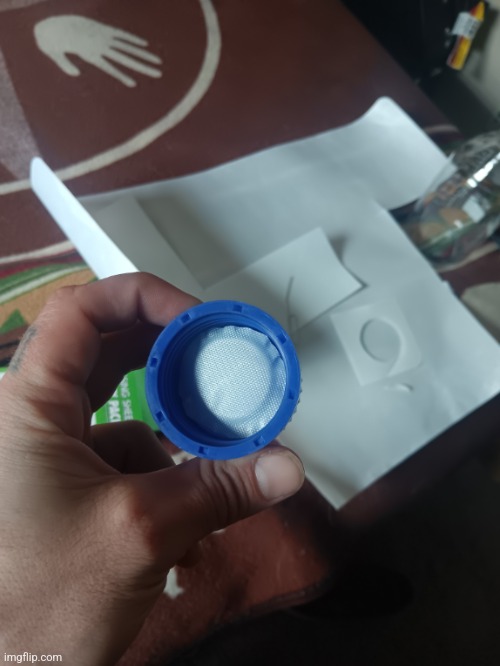
To test to see if you have done it right fill your media bottle with water and act as if you are mixing your base then lift the PTFE liner up making sure not to spill any drops of water onto the blue cap and see if any water made it underneath. If it is dry then you were successful. If not try to cut a better fitting circle.
here are some more photos to show how it works:
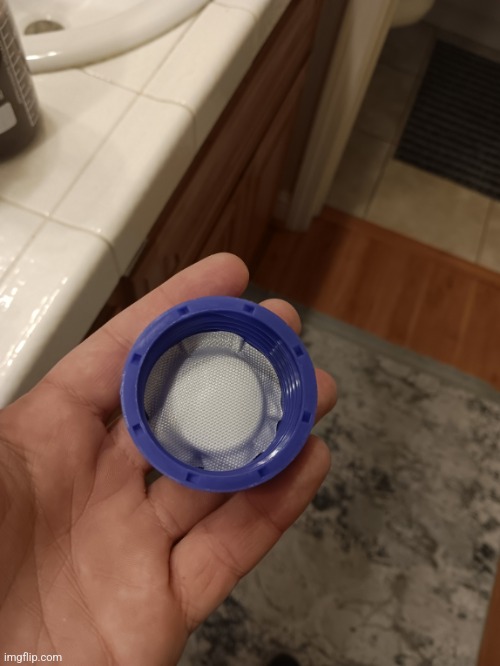
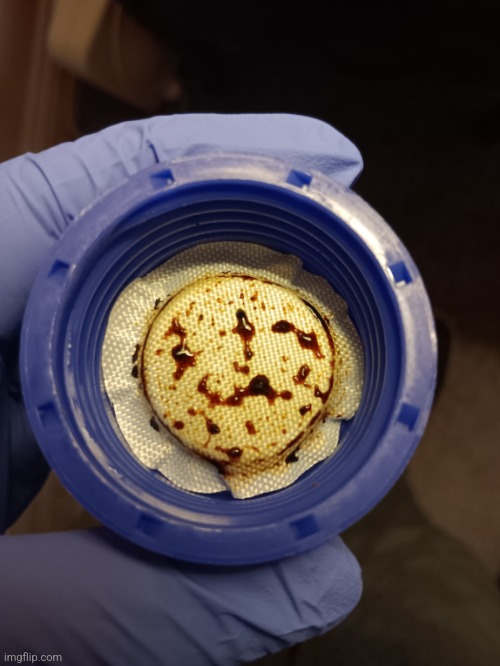
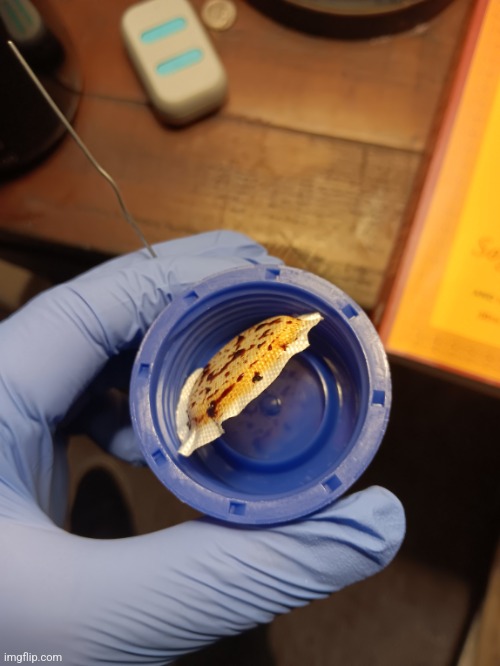
[Also if you are using this PTFE substitute method for a GL45 media bottle cap, remove the blue ring that comes with the media bottles]
Here are some links I found helpful for PTFE:
PTFE sheeting from amazon
What is PTFE?
Benzyme's comment on PTFE
Phthalates: Warning to those using plastic containers/instruments in extractions
Chemical Resistance Information for Plastic Bottles, Containers & Safety Cans
Polypropylene chemical compatibility chart
PTFE chemical compatibility chart
(Notice B rating for naptha but from my experiments I didn't notice any corrosion or degradation occur under the temperatures and times of exposure used in this extraction process. I imagine if kept to minimal contact exposure during the mixing and separating phase and keeping temperatures at a reasonable level that one would not see any changes in the PTFE, of course I have not been able to test this any other way than physical appearance meets the eye so obviously I am not sure exactly just how resistant PTFE Is to naptha but I personally haven't seen any issues with it yet but assess this risk for yourself to proceed forward.)
The different colors of PTFE in a nutshell
(Also make sure to get the white PTFE sheeting and not brown or black or any other color but white.)
[Disclaimer: if ordering any lab glassware/ equipment/ chemicals, make sure you are familiar with the laws in your area. You don't want to accidentally get yourself on a watchlist or invite unwanted trouble into your life. This disclaimer isn't necessarily in reference to PTFE sheeting but more so just as a reminder at large to keep the discretion alive for yours and others safety.]

What is PTFE?
"Polytetrafluoroethylene (PTFE) is a fluoropolymer and is commonly known by its trade name, Teflon®. Unique properties of PTFE include nonreactivity, hydrophobicity, a low coefficient of friction, and good insulating properties. It is most commonly used as a nonstick coating for cookware. PTFE is also used in the manufacture of semiconductors and medical devices; as coatings for bulk chemical containers, eyeglasses, and shaver blades; and as an inert ingredient of pesticides. PTFE is among the most chemically inert, nontoxic, and nonflammable substances tested under normal usage conditions, and is not metabolized. Although PTFE is not a skin irritant in rabbits or humans, or a skin sensitizer in humans, the major safety concern with PTFE is workplace exposure to its pyrolysis products, which may be irritating to the eyes, skin, and mucous membrane. PTFE pyrolysis products can also produce influenza-like symptoms (also known as ‘polymer-fume fever’). In nonclinical studies, no toxicologically significant effects were observed in rats administered 25% PTFE in the diet for 90 days. A persistent chronic inflammatory reaction that exhibited progressive tissue growth was noted at the injection site in mice, rabbits, and dogs administered a single injection of PTFE particulate in a glycerine carrier for up to 1 year. Localized fibrosarcomas have been reported with subcutaneous injection of PTFE sheets or discs in mice and rats. However, the International Agency for Research on Cancer has concluded that insufficient data exist to assess the carcinogenic risk of human exposure to PTFE. There are no known ecotoxicological effects of PTFE."
So I found PTFE sheeting to be a possibly cheap wonderful solution for lining the cap of your extraction vessel and for this tek im using a GL45 thread media bottle cap as these are the only caps I have to work with for now but I imagine that you could substitute PTFE sheeting for many other caps if you wished to get creative with it. I also notice when looking around to purchase prelined media bottle caps they tend to get pricey. I also understand that the GL45 media bottle caps are PP (polypropylene) but according to everything I've read it seems that PTFE is stronger than PP due to having a higher thermal range.
[Edit: However I am not honestly entirely sure and I wonder if cheap PTFE from amazon would be different than ordering lab grade PTFE sheeting from some other source.]
The process:
what i do is place a cap down onto a piece of PTFE sheeting and score it with a razor knife on a piece of cardboard or if you are using on a surface other than cardboard that you dont want to scratch, you can use a paper clip to scratch a line around the cap, you could also use a pen or pencil but for some reason scoring speaks to me.
score or trace around the outside of the media bottle cap (or whatever cap you plan to use) after placing onto PTFE sheeting then simply cut to fit the inside of the cap.
Even easier I have found is to cut a square bigger than the cap and to place the cap down onto the square of PTFE while it is resting on the opening of the bottle and press down to leave an imprint of the circle then cut.
If using a GL45 media bottle cap, you just want to make sure that the small inner circle of the media bottle cap is being covered with PTFE and blocking the base solution from making contact with the plastic cap.
Like this:
To test to see if you have done it right fill your media bottle with water and act as if you are mixing your base then lift the PTFE liner up making sure not to spill any drops of water onto the blue cap and see if any water made it underneath. If it is dry then you were successful. If not try to cut a better fitting circle.
here are some more photos to show how it works:
[Also if you are using this PTFE substitute method for a GL45 media bottle cap, remove the blue ring that comes with the media bottles]
Here are some links I found helpful for PTFE:
PTFE sheeting from amazon
What is PTFE?
Benzyme's comment on PTFE
Phthalates: Warning to those using plastic containers/instruments in extractions
Chemical Resistance Information for Plastic Bottles, Containers & Safety Cans
Polypropylene chemical compatibility chart
PTFE chemical compatibility chart
(Notice B rating for naptha but from my experiments I didn't notice any corrosion or degradation occur under the temperatures and times of exposure used in this extraction process. I imagine if kept to minimal contact exposure during the mixing and separating phase and keeping temperatures at a reasonable level that one would not see any changes in the PTFE, of course I have not been able to test this any other way than physical appearance meets the eye so obviously I am not sure exactly just how resistant PTFE Is to naptha but I personally haven't seen any issues with it yet but assess this risk for yourself to proceed forward.)
The different colors of PTFE in a nutshell
(Also make sure to get the white PTFE sheeting and not brown or black or any other color but white.)
[Disclaimer: if ordering any lab glassware/ equipment/ chemicals, make sure you are familiar with the laws in your area. You don't want to accidentally get yourself on a watchlist or invite unwanted trouble into your life. This disclaimer isn't necessarily in reference to PTFE sheeting but more so just as a reminder at large to keep the discretion alive for yours and others safety.]
Attachments
Last edited:


 and now i am curious. That is something I certainly should have thought about a little more but referring back to benzymes comment about the fear mongering of Teflon being a marketing scheme also was a good point and something to consider.
