• Members of the previous forum can retrieve their temporary password here, (login and check your PM).

TEK Primitive A/B

This topic contain a TEK

Icon

Titanium Teammate
Donator
I was brainstorming a primitive extraction path and a couple people expressed interest so I've started a thread we can collaborate in.

I like those survival shows where the expert gets dropped off in the middle of nowhere with just a knife and has to bushcraft his own shelter, fire, water, food, etc.

I'm not that person haha, but I do enjoy camping and getting my hands dirty. The indigenous tribes that live off the land, harvest and prepare ayahuasca are the true experts.

It's rewarding enough just to extract DMT yourself, especially getting it from nature vs synthesis. So the goal is to extract freebase with stuff you can collect in nature.

We need an acid, a base, a DMT source, and a non-polar solvent. Finding water and building a fire should be easy. I'm leaning toward modern vessels and utensils though, does that defeat the purpose? Maybe I could learn pottery.

Acid:
I was thinking berry juice. I recently juiced some raspberry/blackberry/blueberry and it was more acidic than vinegar! about 3.0 pH. Idk what acid is responsible exactly, but I don't think it matters? The only catch might be what else in the berry juice could get freebased and pulled into the non-polar.

Base:
I think potassium hydroxide comes from wood ash. Simply adding a handful of ashes from the fire to the berry juice could work to freebase it. A more refined solution or even crystalline lye could be prepared separately, but I don't think it's necessary.

Non-polar:
This is going to be the tricky part. Options I've come across so far are d-limonene from citrus peels, or turpentine from pine resin. Could also get methanol from distilling wood, but since that's miscible with water I don't think it'd be useful for extraction. D-limo is kind of a pain in my experience. I've never worked with turpentine, but I have pine trees in my area so this is what I plan to try.

This video outlines the process.

It seems like you can get lighter and heavier spirits out of pine material. Turpentine (lighter, clear) is traditionally made from the resin; and pine oil (heavier, dark) from needles or fat wood. I think you can also get turpentine out of needles and fatwood, but it might take a second distillation of the pine oil. I love hunting for fat wood and resin so that part will be fun.

Right now the idea is to distill it with modern cookware and condensers, unless anyone has an idea how to do that primitively.

I'm also not sure if DMT would freeze precipitate out, or if I'd be comfortable evaporating for a yield.

And I'm way behind on the phalaris research, so at the moment I'm leaning toward imported plant material. But that would be a great experience to cultivate and harvest your own DMT source.
 
have you ever done this type of . thing ?

if not , i strongly sugest you find a respected simple tek and follow it exzactly ,

samall batchs ...please no inspector gaget reinventing the wheel stuff

but do as you like .....................

good luck ..... please follow all safety proticals look them up please
 
Last edited:
I'll do some controlled experiments at home before whipping it up in the woods. Failure remains an option.
 
For base, you can also get lime from limestone.

I think this book has some info on how to do that (not difficult, other than getting to the required temperature) and also how to get potassium hydroxide from wood ash (apparently, a lot of ash is necessary): Caveman Chemistry : Hands-on Projects in Chemical Technology

Methanol and ethanol aren't viable if you want crystal as an end product, but with 40% ethanol and calcium hydroxide you can easily do @Transform 's TnT tek. The end result is either a tincture or an oily liquid, it has a lot of DMT but seems to be broad spectrum.

If you want/need acid, making vinegar is not too difficult, and you can always reduce it to make it more acidic.

I like the idea of this project :)
 
I was brainstorming a primitive extraction path and a couple people expressed interest so I've started a thread we can collaborate in.

I like those survival shows where the expert gets dropped off in the middle of nowhere with just a knife and has to bushcraft his own shelter, fire, water, food, etc.

I'm not that person haha, but I do enjoy camping and getting my hands dirty. The indigenous tribes that live off the land, harvest and prepare ayahuasca are the true experts.

It's rewarding enough just to extract DMT yourself, especially getting it from nature vs synthesis. So the goal is to extract freebase with stuff you can collect in nature.

We need an acid, a base, a DMT source, and a non-polar solvent. Finding water and building a fire should be easy. I'm leaning toward modern vessels and utensils though, does that defeat the purpose? Maybe I could learn pottery.

Acid:
I was thinking berry juice. I recently juiced some raspberry/blackberry/blueberry and it was more acidic than vinegar! about 3.0 pH. Idk what acid is responsible exactly, but I don't think it matters? The only catch might be what else in the berry juice could get freebased and pulled into the non-polar.

Base:
I think potassium hydroxide comes from wood ash. Simply adding a handful of ashes from the fire to the berry juice could work to freebase it. A more refined solution or even crystalline lye could be prepared separately, but I don't think it's necessary.

Non-polar:
This is going to be the tricky part. Options I've come across so far are d-limonene from citrus peels, or turpentine from pine resin. Could also get methanol from distilling wood, but since that's miscible with water I don't think it'd be useful for extraction. D-limo is kind of a pain in my experience. I've never worked with turpentine, but I have pine trees in my area so this is what I plan to try.

This video outlines the process.

It seems like you can get lighter and heavier spirits out of pine material. Turpentine (lighter, clear) is traditionally made from the resin; and pine oil (heavier, dark) from needles or fat wood. I think you can also get turpentine out of needles and fatwood, but it might take a second distillation of the pine oil. I love hunting for fat wood and resin so that part will be fun.

Right now the idea is to distill it with modern cookware and condensers, unless anyone has an idea how to do that primitively.

I'm also not sure if DMT would freeze precipitate out, or if I'd be comfortable evaporating for a yield.

And I'm way behind on the phalaris research, so at the moment I'm leaning toward imported plant material. But that would be a great experience to cultivate and harvest your own DMT source.
This is the kind of stuff I've daydreamed about for decades. Basically, it's a whole load of work but I'm sure it would be fun to attempt. If you've got the skills and the materials there's a plausible chance of success.

It sounds like you'll need to be buiding a lime kiln if you want to make quicklime. You'll need an enclosed fire with a forced draught to burn limestone using forest materials.

Check out the Primitive Technology yt channel. He's not burning lime but his iron smelting experiments are in a very similar vein (and would benefit from using limestone, come to mention it).
 
I used turpentine ( probably some technical grade type from wood proccessing, not original one from sap) for dmt extraction, ime it is quite similar to toluene in its properties, it's better than limonene for extraction. Its distillation from pine sap could be fun and quite easy, but you would just need lot of sap.
You cannot freeze precipitate freebase from it.
 
Base:
I think potassium hydroxide comes from wood ash. Simply adding a handful of ashes from the fire to the berry juice could work to freebase it. A more refined solution or even crystalline lye could be prepared separately, but I don't think it's necessary.
Wood ash contains mainly potassium carbonate and some other salts, unfortunately no (or minimal) hydroxide.
 
Wood ash contains mainly potassium carbonate and some other salts, unfortunately no (or minimal) hydroxide.
Potassium hydroxide results, in a rather impure and dilute form, from mixing the recrystallised wood ash tea with slaked lime suspension and filtering out the resulting calcium carbonate ('precipitated chalk'), leaving a solution of potash lye.

Sodium hydroxide can similarly be obtained by using shoreline plants such as glasswort to produce the ash. Glasswort ash was a historic source of sodium carbonate (mixed with a considerable amount of potassium hydroxide) and its name should give a massive clue to its use.

The best soda or potash comes from boiling down settled and filtered ash tea, calcining the resulting solid in an iron pan, and repeating the dissolve/settle/filter/crystallise process several times using the purest water, such as dew collected from the leaves of Lady's Mantle leaves - their generic name Alchemilla deriving from this practice.

For some more ideas in a handy format, try Guy Ogilvy's The Alchemist's Kitchen, published by Wooden Books.
 
I think this book has some info on how to do that (not difficult, other than getting to the required temperature) and also how to get potassium hydroxide from wood ash (apparently, a lot of ash is necessary): Caveman Chemistry : Hands-on Projects in Chemical Technology
Thanks for kicking things off @blig-blug I love the term "caveman chemistry".
This is the kind of stuff I've daydreamed about for decades. Basically, it's a whole load of work but I'm sure it would be fun to attempt. If you've got the skills and the materials there's a plausible chance of success.
Maybe someday we can coordinate a cavemen chemistry retreat :) I was gonna tag you cuz I've seen your posts on turpentine so I figure you've thought about this a bit.

Yea I see this is going to be more work than I thought, but that's okay. It can be split up into smaller projects with the final ceremony waiting patiently. I agree that primitive technology channel is very inspiring (y)
I used turpentine ( probably some technical grade type from wood proccessing, not original one from sap) for dmt extraction, ime it is quite similar to toluene in its properties, it's better than limonene for extraction. Its distillation from pine sap could be fun and quite easy, but you would just need lot of sap.
You cannot freeze precipitate freebase from it.
I was gonna tag you too cuz you're the only person I've seen mention they've actually used turpentine in the context of DMT chemistry. Great you found your way here :)

What did you do with the turpentine after pulling with it, then? To get DMT out.

@PedroSanchez @Toshido

Ball's rolling :)
 
Last edited:
Thanks for tagging me and thank you even more for committing to starting this thread!!! CLOSELY following this thread like I said... as I off grid camp 4 times a year and am also going to make this a goal for myself. Let's gooooo.
 
Great post, and hi @Icon :)

First and foremost, I'd skip the acid part unless you have access to apples in the wild and would like to make vinegar. DMT generally should occur as a tannate in plant material derived from trees (psychotria may be different) which is very water soluble. Either way, it will be in salt form with the vast majority of plants so water extraction is fine.. if you are boiling your solution then that will be more than enough. Making some kind of cleanish acid (like vinegar or citric) will aid in later steps potentially though.

For base it is very easy to make lye.. I've done quite a few extractions with lye that I've made from ash and its very effective. If you live in a cold climate your in luck and can save your ash from the fireplace. Then put in a barrel and soak in water for a week. Strain and filter.. and its good to go. Or you can reduce it down to a solid if you really want. Of course, crushed shells is also fine.. but lye is way better to use in extraction in my opinion.

Solvent.. that really is the hard one. It's not entirely essential but helps a lot. If you are really wanting to keep it hunter gatherer style then, and I know this may seem barbaric but, I'd use rendered animal fat.. if you are hunting animals in the wild .. especially anything the size of a boar and upwards, you'll be able to get plenty of fat to render down over heat into a liquid. I have little doubt DMT is soluble in animal fats. Then you can use it for your pulls and salt the alkaloids out with an acidic solution,. Trying to get a decent amount of oil from a plant without a decent setup could be frustratingly time consuming. But if you got the right plants around you then that would be preferable.

If you don't want to make solvent you could always just strain your precipitates out of your basified solution and proceed to tinker with the solids to leave as pure an extract as possible. You can rinse the lye residue off with water and the alkaloids shouldnt dissolve in the water just yet.. too many rinses and you might risk dissolution if the water is at all acidic. Try rinsing with water of different temps to see if some things dissolve and some don't.

Extracting smokable freebase DMT in a hunter gather style setup is a tall task.. a very cool one to attempt. The more strict you are the harder obtaining a clean smokable extract will be.
 
Last edited:
What did you do with the turpentine after pulling with it, then? To get DMT out.
Extract alkaloids into acidic (vinegar) water by mixing and separating, reduce water to small volume (~30ml), add some alkali to precipitate freebase, filter it out, wash it with neutral water. Collect and dry. Product was waxy light brown.

You can reuse your precious solvent afterwards, there is no evaporation.
 
Great thread!

One could also refer to this channel for potential ideas on how to approach things.

What you are trying to do is approach this extraction the way the alchemists or chimysts of old would approach it. Indeed there is beauty and lots of aestetics in preparing the basic materials and chemicals by your own and that I applaud.

One could learn to do basic fermentation to obtain alcoholic bewarage from which vinegar rich in acetic acid via acetobacter can be obtained. Both ethanol and acetic acid can be further purified and concentrated from these bewarages via simple distilations or freezing out water.

One can obtain potash or potassium carbonate by purifying ashes of various plants and that can be used as a base.
 
Last edited:
I used turpentine ( probably some technical grade type from wood proccessing, not original one from sap)
Do you recall if it smelled like pine or if it was odorless?

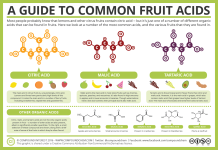
Came across this infographic on fruit acids. Surprised they didn't include acetic or ascorbic acids. But I was excited to see benzoic acid listed (cranberry).
Acrobat_2025-12-10_11-06-08.png

Entertaining and informative video on cranberries:

Since benzoic acid is mostly non-polar, it might be easier to isolate than other acids? Then a turpentine solution of benzoic acid could be added to the pulls to instantly precipitate solid dmt-benzoate.
 
Great post, and hi @Icon :)
Solvent.. that really is the hard one. It's not entirely essential but helps a lot. If you are really wanting to keep it hunter gatherer style then, and I know this may seem barbaric but, I'd use rendered animal fat.. if you are hunting animals in the wild .. especially anything the size of a boar and upwards, you'll be able to get plenty of fat to render down over heat into a liquid. I have little doubt DMT is soluble in animal fats. Then you can use it for your pulls and salt the alkaloids out with an acidic solution.

Wow. That's about as primitive as you can get! Imagine the joy in finally accomplishing this quest. To do an extraction using only nature and then breaking through would be an incredible achievement. As long as you have plenty of time and aren't in a giant rush you can totally do this. Would definitely be a badge to wear with honor, and make for a great story too! I'd put that on my resume even if I was just applying for a job at Subway.
 
Hehe yeah it would be a cool achievement @Toshido .. personally I have slightly wierd feelings about my spirit crumbs being carried by animal fat.. but why? I mean if all is ethically done is it any worse than using industrial solvent with a likely bigger environmental footprint? Who's to say. Also I'd hope anyone using animal fat would only be using it as a by-product.. not slaughtering it for sole purpose of extracting alkaloids.. if your killing an animal to extract DMT then.. well I don't really know what to say about you.

But yeah, at this point.. still.. solvent is toughest part of the puzzle to crack in this 'bushman' extraction style. With certain species, I do believe that filtering the precipitate and washing in water several times could be sufficient .. maybe get it to being smokeable - however some species will precipitate truckloads of other stuff that your filter will catch.

Name of the game I think would be to spent a lot of time tinkering with differen't pH 'windows'.. try and find the perfect pH window where alkaloids are solid and other 'impurities' remain dissolved. Don't forget temperature is also a tool to be wielded by the aspiring alchemist. Things need certain things to be dissolved in a solution or to not be dissolved.. repeated tinkerings will likely earn you some useful tricks.
We might not have our beloved hardware stores around forever if we continue on our destructive path on this earth.. so these kind of teks may become very important in the future,
 
Last edited:
Animal fat is a good primitive suggestion. I agree it would be pretty extreme to hunt animals just for fats, but I do have relatives that hunt deer for equally dumb reasons. I think roadkill could be an ethical option, but I have zero experience processing animals.

Here's another video on processing pine resin to turpentine, with a few different small-scale still designs.

This video shows another person distilling turpentine. Episode 9 covers the historical industrial method.

One safety point he mentions is stills of turpentine occasionally explode from pressure, sending hot resin everywhere that used to start forest fires and burn towns down in the 1800's. I saw at least one comment cautioning doing this indoors, as they nearly burned their house down.
 
I think if at the point of distilling you could also try and make some ethanol too.. then you could do a dry tek.. boil plant material in water, strain, reduce liquid to a resin.. massage base through it and let react for a while.. pour ethanol over the top and allow to sit .. pour off ethanol.. evaporate. Then pour water over the top to remove any water solubles. The DMT being freebase won't dissolve.. but any other ethanol soluble stuff probably will.. especially if the water is hot.

diethyl ether is also not too many steps away from ethanol if you have distillation apparatus.. and aside from obvious safety risks (EXTREMELY FLAMMABLE) its a very effective solvent. The safety risks are of course crucial to be aware of if you ever went that path. Not recommending this to a novice but just something I thought I'd add. Once your in the realm of distillation it would be kinda wierd to stop at turpentine as there are much better solvents.
 
Back
Top Bottom