• Members of the previous forum can retrieve their temporary password here, (login and check your PM).

Rue Tea acid base [pictures and a couple questions ]

Pumpy

Titanium Teammate
IMG_20251006_174628305.jpgI will eventually figure this out from reading nexus posts but if any one has any thoughts pls share :)
IMG_20251006_211522454.jpg

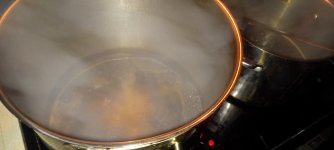
I 've graduated from drinking rue tea to making this extract.. This is my current effort : I made rue tea with 200 grams of whole peganum harmala seed, did 5 boils with water with 12 oz total vinegar (too much ?), combined and reduced them to a volume of a quart of concentrated tea , tossed the seeds and filtered the tea with cheesecloth 2x. I made 16ish oz of a solution of 5 to 1 water to sodium carbonate by weight and based the tea with that. In the past i've let this based tea pass through a coffee filter and collected the remaining dry solids but i think i'm doing something wrong because my yield isn't very good and my end product of harmala powder isn't as strong as rue tea (still good and way less nasty tho )
IMG_20251007_011442434_HDR.jpg

Here is another thing
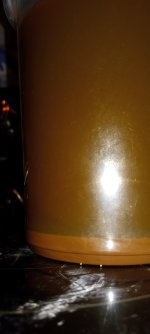
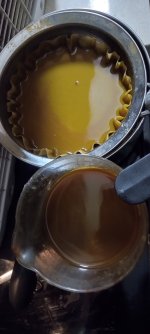
I don't understand. I separated this batch of tea into two parts
and the 1/2 of the batch that I froze and let thaw before I based is a different color
than the other 1/2 [that i did not freeze] ------------------------->
these two containers have the same batch of rue tea and they're both based with the same sodium carbonate , in this pic

Also not seeing anything collect at the bottom of the based solution, it's still seems homogenous after a few hours.
 
Last edited:
reduced them to a volume of a quart of concentrated tea
Sometimes having too high a concentration can bring problems, possibly through pectins inhibiting precipitation.

The difference between the frozen and unfrozen batches could be baffling, unless it was the earlier boils which went in the freezer. They'd have a darker tone and should contain more alkaloids.

A quick bit of arithmetic shows that you've used plenty of sodium carbonate. How fresh was your sodium carbonate, though? It will slowly convert into sodium bicarbonate in the course of time, which won't really get the job done.

[Side note: It would be better to express your volumes in milliliters since this will eliminate an unnecessary step when calculating reaction amounts. Ounces are too vague and crappy a unit for science :D]
 
My guess is too concentrated tea.
How much sodium carbonate did you use?
"16-ish oz" [=~500mL(?)] at 1:5 w/v works out at around 100g Na₂CO₃, off the top of my head. That's enough to neutralise maybe 60g AA [== 1200mL 5% vinegar, far more than 12oz], although it's a weak acid/weak base reaction and it produces CO₂ so there are complications as I'm sure you'll appreciate.
 
In the past i've let this based tea pass through a coffee filter and collected the remaining dry solids but i think i'm doing something wrong because my yield isn't very good and my end product of harmala powder isn't as strong as rue tea (still good and way less nasty tho )
What you can do is let the freebase settle, decant and discard the dirty water, then top with water and let settle again and decant (water wash), you can do it a couple more times. This is a very easy and effective way for cleaning up the harmalas and making filtration later easier. Then you can reacidify, filter and discard any undisolved material, then base again and do water washes, and finally collect the freebase with a filter.
For the washes you can use water with a pinch of sodium carbonate dissolved in it to minimise losses.

Here is another thing
I don't understand. I separated this batch of tea into two parts
and the 1/2 of the batch that I froze and let thaw before I based is a different color
than the other 1/2 [that i did not freeze] ------------------------->
these two containers have the same batch of rue tea and they're both based with the same sodium carbonate , in this pic

Also not seeing anything collect at the bottom of the based solution, it's still seems homogenous after a few hours.
At least in the pic it seems one of them is being filtered so the color is that of the harmalas while the other is the tea. During the inital basification step the color change is not so obvious, the main difference is the milky harmala freebase precipitate. But from what you describe it seems the other solution did not produce any harmala freebase, but which one is it the frozen one? I am not sure but one time I noticed that if the solution is dilute and the base is barely enough it takes a while for the precipitate to form. Another thing is that with sodium carbonate I noticed that when it reacts with the acid in the harmala solution it produces bubbles, but not immediately, only when the solution is stirred, so have you mixed the solution well after adding the sodium carbonate?
 
Last edited:
Sometimes having too high a concentration can bring problems, possibly through pectins inhibiting precipitation.

The difference between the frozen and unfrozen batches could be baffling, unless it was the earlier boils which went in the freezer. They'd have a darker tone and should contain more alkaloids.

A quick bit of arithmetic shows that you've used plenty of sodium carbonate. How fresh was your sodium carbonate, though? It will slowly convert into sodium bicarbonate in the course of time, which won't really get the job done.

[Side note: It would be better to express your volumes in milliliters since this will eliminate an unnecessary step when calculating reaction amounts. Ounces are too vague and crappy a unit for science :D]
Concentration being too high , i didn't know that could be a problem. Good problem easy to fix :) Now that you mention it I think your intuition that the batches are actually slightly different is right, i think the darker one didn't go through the cheesecloth. The sodium carbonate was probably too old because I made it a month ago, thanks for that too.

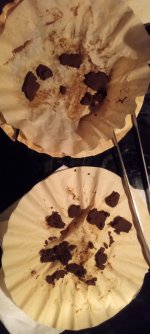
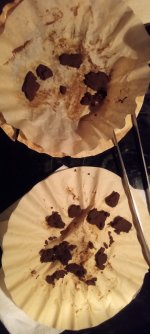
Here is what I ended
up with this time -->
IMG_20251007_204619658.jpg


[future posts will be in metric :)
 
What you can do is let the freebase settle, decant and discard the dirty water, then top with water and let settle again and decant (water wash), you can do it a couple more times. This is a very easy and effective way for cleaning up the harmalas and making filtration later easier. Then you can reacidify, filter and discard any undisolved material, then base again and do water washes, and finally collect the freebase with a filter.
For the washes you can use water with a pinch of sodium carbonate dissolved in it to minimise losses.
I will add this step thanks, and the pinch of sodium carbonate with water washes

At least in the pic it seems one of them is being filtered so the color is that of the harmalas while the other is the tea. During the inital basification step the color change is not so obvious, the main difference is the milky harmala freebase precipitate. But from what you describe it seems the other solution did not produce any harmala freebase, but which one is it the frozen one? I am not sure but one time I noticed that if the solution is dilute and the base is barely enough it takes a while for the precipitate to form. Another thing is that with sodium carbonate I noticed that when it reacts with the acid in the harmala solution it produces bubbles, but not immediately, only when the solution is stirred, so have you mixed the solution well after adding the sodium carbonate?
The cause of the color difference : I forgot to filter one of the halves through my cheesecloth setup andIMG_20251007_170753446.jpg
that one is much darker.

You rightly noticed that one half was being filtered but that is due to me wanting to start filtering some of my batch while letting precipitate collect in the rest, which, I did say was not producing harmala freebase seemingly.

Well good news :) Precipitate did eventually collect at the bottom of darker half after more stirring and waiing a few more hours.IMG_20251007_204619658.jpg
 
Finished with this and having started with 200 g seed I now have around 18 g of harmala mud. 9% minus some small amount of water weight isn't horrible i think. Next thing is to find a better place to get seeds or grow them. Thank you !

<edit> Also @Sakkadelic thank you for your writeup I used that when I first tried this
❤️
 
Last edited:
Finished with this and having started with 200 g seed I now have around 18 g of harmala mud. 9% minus some small amount of water weight isn't horrible i think. Next thing is to find a better place to get seeds or grow them. Thank you !

<edit> Also @Sakkadelic thank you for your writeup I used that when I first tried this
❤️
Since you mentioned the extract not being as strong as the tea, you probably have up to 50% impurities, 9% yield is rather high. I would still dissolve in acid, filter, then base again.
 
Since you mentioned the extract not being as strong as the tea, you probably have up to 50% impurities, 9% yield is rather high. I would still dissolve in acid, filter, then base again.
I will do that tonight and next time i'll make sure i have fresh sodium carbonate and i won't use apple cider vinegar :LOL:
 
Last edited:
Instead of getting new sodium carbonate, you can easily convert the supposed bicarbonate into carbonate. Check this out: How to Turn Baking Soda Into Washing Soda (Sodium Bicarbonate to Sodium Carbonate)
That's one way of doing it. I've converted bicarb to SC by toasting it in a (spotlessly clean) stainless steel frying pan on a high heat on the the hob ("cooktop") until it stops levitating and emission of water vapour ceases. Either method is best done with the bicarb in a thin layer - 5mm maximum.
 
Back
Top Bottom