• Members of the previous forum can retrieve their temporary password here, (login and check your PM).

Separation funnel

CokFLHX

Esteemed member
I apologize if this isn’t the correct place to post this question.

Using Vivek tek and it calls for a separation funnel. I wanted to go by the letter so I get one.

After the NPS and base solution separate, and I open the pet cock to drain off the solution, is it normal for the base soution and the NPS to mix when it is almost drained.

I cannot cut it offf to separate the NPS without either letting a decent amount of the NPS draining as well, or there being base solution in the NPS in the dish.

To combat this I’ve been tipping the pan so the NPS collects at one end, leaving the base bark solution drops stuck to the baking dish. I then take a small piece of paper towel and wipe it up.

I plan to water wash three times with the first wash water having a pinch of sodium carbonate.

Is this normal? I feel like it’s defeating the entire purpose of the separation funnel, but still it’s much less of a pain than siphoning with the 10ml pipette I had used.

I think some of the issue is I wasn’t able to filter the solution as well as the tek described. I had a glass Buckner filter that was made of glass sinter I think it’s called. The glass filter material was much too fine to filter the bark. Pulled full vacuum and nothing would come through.

I tried to drill holes in the sinter so I could use filter paper disks but I broke the filter.

So I ordered a ceramic Buckner filter with a seal and a flask with a vacuum nipple and some assorted filter disks.

I’m hoping that if I filter the bark and pant matter out better it may make a difference when draining the separated solution.

Any advice or tips? Absolutely zero formal training or education around lab equipment. Self taught. So this resource is excellent for people like me.

Thanks in advice for the replies
 
Somebody will have to explain exactly what the "Vivek tek" entails, but it sounds like a typical A/B with the addition of a piece of lab equipment.

It sounds like you have a bit of an emulsion layer. Rather than draining this directly into your crystallisation dish, you could collect it in some other container - ideally a pyrex jug or beaker - and keep the emulsion part separate.

If droplets of basic aqueous solution are making their way into the NPS - they do tend to stick to the sides of the sep funnel a bit - collect your NPS in its own jug as well, or even add a bit of water to the funnel to wash out more of the droplets before separating the NPS.

It's best to avoid this situation in the first place by not shaking the funnel so hard that the solutions break up into droplets. A more gentle, swirling, rocking action will be enough to bring the two phases into sufficient contact, and while it may take a little longer to reach equilibrium this should be paid back in reduced levels of frustration (or so one might hope, at least 😁 )

Buchner funnels, especially ones with glass frits, are not intended ftr filtration of large amounts of plant material. Furthermore, MHRB brews tend to precipitate tannin in the form of a sludge as they cool which will clog just about anything. Rapid, coarse filtration through a piece of t-shirt while hot, followed by standing overnight to settle, then decanting in the morning, will give better results. You may then be able to filter with your ceramic Buchner (with the holes) along with some filter paper, although if you allowed it to settle for long enough this shouldn't be necessary.
 
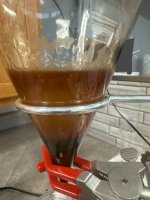
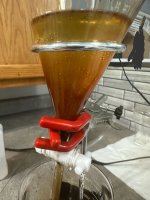
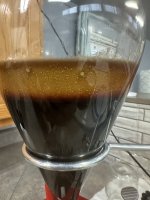
Here is a picture of what I mean. Is this something that just needs to set awhile?
 

Attachments

  • IMG_7367.jpeg
    IMG_7367.jpeg
    605.4 KB · Views: 16
  • IMG_7368.jpeg
    IMG_7368.jpeg
    600.8 KB · Views: 16
  • IMG_7366.jpeg
    IMG_7366.jpeg
    1.1 MB · Views: 18
Somebody will have to explain exactly what the "Vivek tek" entails, but it sounds like a typical A/B with the addition of a piece of lab equipment.

It sounds like you have a bit of an emulsion layer. Rather than draining this directly into your crystallisation dish, you could collect it in some other container - ideally a pyrex jug or beaker - and keep the emulsion part separate.

If droplets of basic aqueous solution are making their way into the NPS - they do tend to stick to the sides of the sep funnel a bit - collect your NPS in its own jug as well, or even add a bit of water to the funnel to wash out more of the droplets before separating the NPS.

It's best to avoid this situation in the first place by not shaking the funnel so hard that the solutions break up into droplets. A more gentle, swirling, rocking action will be enough to bring the two phases into sufficient contact, and while it may take a little longer to reach equilibrium this should be paid back in reduced levels of frustration (or so one might hope, at least 😁 )

Buchner funnels, especially ones with glass frits, are not intended ftr filtration of large amounts of plant material. Furthermore, MHRB brews tend to precipitate tannin in the form of a sludge as they cool which will clog just about anything. Rapid, coarse filtration through a piece of t-shirt while hot, followed by standing overnight to settle, then decanting in the morning, will give better results. You may then be able to filter with your ceramic Buchner (with the holes) along with some filter paper, although if you allowed it to settle for long enough this shouldn't be necessary.
Thanks for taking the time to explain that too me. I said Vivek tek a couple times like an idiot. What I meant was Vovan’s tek.

I’m the kind of guy who knows just enough to get into stuff I shouldn’t? Does that make sense? The Vovin tek laid it out in a way that made it really easy for me to follow and understand. Tip O the hat to Vovin….

I said follow to the letter and I’m not really. I don’t have hydrochloride acid so I just substituted vinegar. I don’t think that will make any difference but like I said about knowing just enough to…….
Yeah.

You say that unless I do it rather quick and while it’s hot through cheesecloth or a tee shirt, it’ll have a real hard time getting through a filter disk under vacuum?

Thanks again
 
You say that unless I do it rather quick and while it’s hot through cheesecloth or a tee shirt, it’ll have a real hard time getting through a filter disk under vacuum?

Thanks again
Yes, I've tried filtering mimosa brew through an Aeropress which is practically the same as a vacuum filter (in fact, it keeps the brew warmer than vacuum filtration would) and the moment it cools down a little bit the tannins start to form a leathery layer of sludge. It's far preferable to let this settle out at a leisurely pace, possibly after decanting or straining out the main bark particles. A sieve might prove useful here, with or without a scrap of t-shirt.

Thanks for the clarification on Vovin, that makes a lot more sense now :D
 
i have no issue vacuum filtering tannins or tannates, i think the real issue is that tap water, or the rearrangement of calcium and silicates in the bark, form a micro-particulate that clogs the crap out of filter paper. i can take like 20g of copper sulfate dissolved in 500ml of tap water and it will struggle to finish filtering in my vacuum filter at a vacuum strong enough to boil the water, that otherwise pure blue clear solution because of the, presumably calcium sulfate, forming.

I found strategic heating, cooling, precipitation or avoiding precipitation, and especially, dilution with 10% or so of distilled/demin water, prevented emulsion scum, and enabled easy filtration. Besides also avoiding rinsing with tap water, im pretty sure the main issue is the fluoride causing inconvenient shaping of certain precipitates, or possibly liberating natural silicates found in plant matter, it would react with those quickly, as well as chlorine oxidizing iron, manganese and similar group metal salts, high ox state iron often forms particles of exactly the size and shape needed to clog a vacuum filter with mere milligrams of the stuff. most metal hydroxides are no fun for filtration either though.

As an example, when i am solvent pulling from base soup in my sep funnel, ill get horrible emulsions for hours on solutions that also clog the filters bad. if i re-filter it cold, then add distilled water,, and try to shake it up again, the emulsion breaks down in minutes and theres no waxy skin either floating around.
not adding the distilled water makes the difference here. if i were to run it through the filter again it would flow cleanly.

I also had some somewhat positive results by just applying the same methodology as for seperating manganese and iron oxides, which is to cycle boiling and cooling a few times, though i forget if its for the hydroxide or the oxalate, but, one of them, cycling the temperature causes the small crystals to dissolve and crystalize on the surviving ones, forming larger crystals that are otherwise quite easy to filter. this converts a mass where a tablespoon could clog a filter, instead allowing the entire funnel to be filled.


I think this might be an unintended consequence of doing things like chill-precipitating out tannic acid/tannates at various stages, and choosing to saturate, or keep the solution dilute, for others. cold-crashing solids from your acid soup after its concentrated to your working conc, gives you an unsaturated solution unlikely to precipitate solids in quite the same way
 
To be honest, I can’t see the benefit of filtering. It’s always a huge pain in the ass and it takes forever. I’ve been skipping the filtration. I add salt by making a saline solution with RO water and add to the acidified bark before I add the base solution made from lye dissolved in more RO water. Then I just add the solvent. It’s all done in the same vessel. The only downside is having to pipette the solvent out instead of using a separation funnel, and when you’re trying to get the last bit, the pipette tends to suck up bark material and clog the end of the pipette. But it’s still much more efficient. I also don’t have to have the nagging feeling that there is still spice left in the filtered out bark.
 
Back
Top Bottom