MachineCogElf
Rising Star
I have been working on simulating the binding of various ligands with a number of neuroreceptors. I won't post all of the data at this point as organising it in presentable form will take a while. Please let me know if there are any ligands / receptors you are particularly interested in.
After trying DMT while on mushrooms I have wondered what causes the potentiation. My initial thoughts were that psilocin acted as some sort of MAOI to avoid the breakdown of DMT. I theorized that psilocin would bind more strongly to MAOA preventing DMT from binding and being oxidized. I'm still unsure why psilocin takes so much longer to be oxidized. Is it just due to the administration method? Please see my post about Oral DMT without an MAOI for real world "testing".
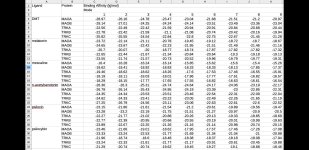
I am also interested in DMT and psilocins neurogenerative and neuroplastic effects. I have found some documentation that N-acetylserotonin binds to TRKB, an important receptor in neurogenesis, but have not found any information about DMT or psilocin binding to this receptor. I provide below a table of binding affinities showing DMT and psilocin likely bind to this receptor quite strongly, even more strongly than n-acetylserotonin.
I can also provide photos of docked ligands if anyone is particularly interested in them. It seems the hydroxy group has a significant impact on the ligands orientation when binding.
+-------------------+---------------+---------------+
| Compound | MAOA affinity | TRKB affinity |
| | (kcal/mol) | (kcal/mol) |
+-------------------+---------------+---------------+
| DMT | -5.0 | -4.9 |
+-------------------+---------------+---------------+
| 5-MeO-DMT | -4.9 | -4.7 |
+-------------------+---------------+---------------+
| Psilocin | -4.8 | -4.7 |
+-------------------+---------------+---------------+
| Psilocybin | -4.1 | -4.8 |
+-------------------+---------------+---------------+
| N-acetylserotonin | -5.3 | -5.0 |
+-------------------+---------------+---------------+
After trying DMT while on mushrooms I have wondered what causes the potentiation. My initial thoughts were that psilocin acted as some sort of MAOI to avoid the breakdown of DMT. I theorized that psilocin would bind more strongly to MAOA preventing DMT from binding and being oxidized. I'm still unsure why psilocin takes so much longer to be oxidized. Is it just due to the administration method? Please see my post about Oral DMT without an MAOI for real world "testing".
I am also interested in DMT and psilocins neurogenerative and neuroplastic effects. I have found some documentation that N-acetylserotonin binds to TRKB, an important receptor in neurogenesis, but have not found any information about DMT or psilocin binding to this receptor. I provide below a table of binding affinities showing DMT and psilocin likely bind to this receptor quite strongly, even more strongly than n-acetylserotonin.
I can also provide photos of docked ligands if anyone is particularly interested in them. It seems the hydroxy group has a significant impact on the ligands orientation when binding.
+-------------------+---------------+---------------+
| Compound | MAOA affinity | TRKB affinity |
| | (kcal/mol) | (kcal/mol) |
+-------------------+---------------+---------------+
| DMT | -5.0 | -4.9 |
+-------------------+---------------+---------------+
| 5-MeO-DMT | -4.9 | -4.7 |
+-------------------+---------------+---------------+
| Psilocin | -4.8 | -4.7 |
+-------------------+---------------+---------------+
| Psilocybin | -4.1 | -4.8 |
+-------------------+---------------+---------------+
| N-acetylserotonin | -5.3 | -5.0 |
+-------------------+---------------+---------------+


 . I'm still trying to figure all this out myself.