• Members of the previous forum can retrieve their temporary password here, (login and check your PM).

Soap Making w/ Leftover Soup From Dmt Extr.

Has anyone successfully made soap with the "soup" that's left over from an extraction?

Talk about sustainable living!

I'm just curious to know if it's even possible.

If it is, I need a little guidance.
I'm on-line, searching soap calculators to find out the ratios for the mixture of water:lye:eek:il/fats to make bar soap.

My only issue is knowing how much lye I added already for the extraction, and if it's going to affect the hardness of the soap in the end.

Thanks,
celestial.body1234
 
I have made soap with lard and lye, but not with mimosa basic soup. The proportion of lye you need depends on the fat you use, you need to look up the saponification ratio. However, the lye in basic soup will have been at least partially neutralized (or so I believe, some chemist will correct me if not ;) ), so you would need to add either more basic soup or more lye in general.
I'd be worried about it not being able to congeal due to the mimosa material in it. It's something that can even happen using only lye if you don't do it right. But unless there's someone with experience with it that can tell us how it worked, the only way to know would be to try it.
If it does work, it would be very good not only for sustainability: mimosa is highly astringent due to its tannins, so the resulting soap would probably be astringent as well.
 
This person claims to have at least added pH 13 basic soup to soap in the process, not clear if it was the only base: Using mimosa hostilis in soap—advice? - r/soapmaking
I can imagine that the tannin content would bring benefits in a soap since skin care's a major use of stuff like tepescohuite, and artificial "tannin" mimics are used to treat certain skin problems even in mainstream western medicine, on account of astringent effects.
 
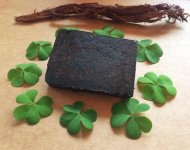
Yes! I've done it a few times with great success. Been wanting to create a post dedicated to this but it's been difficult to be active here lately.
The extraction should preferably be done with limonene, that way any solvent residue won't be detrimental for the formula, since it is also used for cosmetic purposes and cleaning products.
I like to use vinegar in the acid phase, since most of it will evaporate and not mess up the the proportions of lye needed. Also don't use salt.
I need to dig into my notes to get the exact procedure, since it's been a while but I remember the trick that made me get it always right is to reduce the brew a lot and have a volume of 450 ml after basification. That will assure that the amount of lye you need for the extraction iss less than the amount needed for saponification, and also keep the water/lye/oils ratio in a relatively manageable amount.
From there on you go to soapcalc and start the formula with around 2kg of oils, hit calculate and check the water volume given for that amount of oils, tweak it a bit untill you find the right ratio, adjust the amount of lye and voila, happy soaping!
 

Attachments

  • FB_IMG_1758946507006.jpg
    FB_IMG_1758946507006.jpg
    47.4 KB · Views: 11
Yes! I've done it a few times with great success. Been wanting to create a post dedicated to this but it's been difficult to be active here lately.
The extraction should preferably be done with limonene, that way any solvent residue won't be detrimental for the formula, since it is also used for cosmetic purposes and cleaning products.
I like to use vinegar in the acid phase, since most of it will evaporate and not mess up the the proportions of lye needed. Also don't use salt.
I need to dig into my notes to get the exact procedure, since it's been a while but I remember the trick that made me get it always right is to reduce the brew a lot and have a volume of 450 ml after basification. That will assure that the amount of lye you need for the extraction iss less than the amount needed for saponification, and also keep the water/lye/oils ratio in a relatively manageable amount.
From there on you go to soapcalc and start the formula with around 2kg of oils, hit calculate and check the water volume given for that amount of oils, tweak it a bit untill you find the right ratio, adjust the amount of lye and voila, happy soaping!
Soapmakingfriend.com allows you to add salt as an additive 💁 I just discovered it and I like it a lot so far.
 
The issue is that with salt, as soon as you blitz the mixture, it will harden very fast.. that makes it more difficult to pass it to a mold, it gets messy, and even after you manage to do it with some effort you will find out after unmolding that there where a lot of air bubbles trapped, and the soap will be quite uneven.. you can even see layers created between each scoop you added to the mold. In my experience excluding salt makes the whole process way easier and cleaner.
 
@YuxibuSounds that soap looks so good. If you can make a more detailed post with your procedure I'd be very thankful. I have many skin issues in my scalp and it benefits a lot from tannins (I sometimes wash it with an oak decoction). Making some soap with mimosa leftovers would be perfect in every way :)

I like to use vinegar in the acid phase, since most of it will evaporate
The water from the vinegar will evaporate, but the acetic acid won't, its boiling point is 118C.
 
Last edited:
@YuxibuSounds that soap looks so good. If you can make a more detailed post with your procedure I'd be very thankful. I have many skin issues in my scalp and it benefits a lot from tannins (I sometimes wash it with an oak decoction). Making some soap with mimosa leftovers would be perfect in every way :)


The water from the vinegar will evaporate, but the acetic acid won't, its boiling point is 118C.
Of course! I'm restoring my studio space atm so my desktop is disassembled, but I should finish somewhere next week. When that's done I'll dig it up for you
 
Back
Top Bottom