• Members of the previous forum can retrieve their temporary password here, (login and check your PM).

Space Cat's straight-to Lim-O

TheSpaceCat

Rising Star
Hey first post here, long time limonene advocate elsewhere! I'm going to post a more detailed version of this Tek when I have more plant matter and better pictures. The Tek is the simplest limonene extraction I've ever heard of.

The picture is 7g samples added straight to Lim-O with no denaturing processes prior. The samples sat for one day before the picture

---------------

Start by mixing glacial acetic acid with D-Limonene to create what I call Lim-O, limonene acetate. A 50/50 mix is good enough although I don't know the perfect ratio yet

Add the Lim-O to your plant matter and stir. Let settle

Decant your saturated Lim-O from the plant matter. My favorite tools is a 100ml glass syringe for this

Perform a distilled reduction on your Lim-O. I run this at 85⁰C in the mantle then evaporate the last splash of solutions on a Pyrex dish over a pot of heated water at around 170⁰F

Dry paste freebase the resulting acetate goo in an excess of sodium carbonate. Moisten slightly to get the exothermic reaction started.

Stir occasionally then let sit overnight

Dehydrate your paste in the oven on a Pyrex dish at 170⁰F and crush into powder

You can tell it's fully dehydrated when a spoon full of sodium carbonate dropped onto the plate creates a drifting dust cloud

Wash your carbonate powder with pure acetone then let settle completely

Separate acetone then evaporate on pyrex dish over hot water
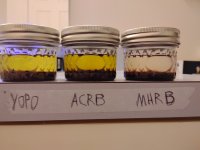
 

Attachments

  • IMG_20250111_182932839.jpg
    IMG_20250111_182932839.jpg
    2.3 MB · Views: 12
This seems rather overcomplicated and confused to me (although it might just be that I'm confused), with the use of glacial acetic acid, solvent reduction via distillation (specialized equipment compared to typical kitchen chemistry), and limonene evaporation (major headache, imo) before you even get to basification.

Also, what is the solubility of DMT tannate in acetic acid saturated limonene? Is that solvent actually effective at pulling alkaloid salts from plant material?

Maybe I'm not understanding, but I don't see how this is less complicated than:

-Make tea
-Base tea
-Add NPS
-Either freeze precipitate or salt out (depending on NPS)
-Collect precipitate or convert to freebase (depending on NPS)

I don't mean any offense, I just don't understand the advantages of the process outlined or what the picture demonstrates. Can you elaborate?
 
Last edited:
Yeah, it does seem a little over complicated to me as well.. but if it works for you that's great. What would you say are the advantages of this method over other more straightforward methods. I'm guessing your chasing a very full spectrum extract?
 
This seems rather overcomplicated and confused to me (although it might just be that I'm confused), with the use of glacial acetic acid, solvent reduction, and limonene evaporation (major headache, imo) before you even get to basification.

Also, what is the solubility of DMT tannate in acetic acid saturated limonene? Is that solvent actually effective at pulling alkaloid salts from plant material?

Maybe I'm not understanding, but I don't see how this is less complicated than:

-Make tea
-Base tea
-Add NPS
-Either freeze precipitate or salt out (depending on NPS)
-Collect precipitate or convert to freebase (depending on NPS)

I don't mean any offense, I just don't understand the advantages of the process outlined or what the picture demonstrates. Can you elaborate?
The advantage is that it's a non toxic Tek with a full spectrum. Everything is food grade besides the acetone, but even that's non toxic. A lot of people object to carcinogenic solvents like NPS and a lot of people have distillation apparatuses which makes this and recovering the solvents a piece of cake. A lot of teks use acetic acid as a presoak denaturing process on plant matter utilizing heat baths, freeze cycles, or both. This is strong enough to skip all that and acetic acid works great at converting tannins
 
Yeah, it does seem a little over complicated to me as well.. but if it works for you that's great. What would you say are the advantages of this method over other more straightforward methods. I'm guessing your chasing a very full spectrum extract?
Yes a full spectrum and a non toxic Tek. Most limonene teks are a double AB but this is a single AB and greatly reduces the effort necessary to get very saturated pulls. I've been working with limonene for years and this is the pinnacle of limonene teks in my experience
 
The advantage is that it's a non toxic Tek with a full spectrum. Everything is food grade besides the acetone, but even that's non toxic. A lot of people object to carcinogenic solvents like NPS and a lot of people have distillation apparatuses which makes this and recovering the solvents a piece of cake. A lot of teks use acetic acid as a presoak denaturing process on plant matter utilizing heat baths, freeze cycles, or both. This is strong enough to skip all that and acetic acid works great at converting tannins
Again, there seems to be a lot of confusion here (and now I don't really think it's on my end) while claiming there are advantages to this approach. Here are a few thoughts:

-NPS isn't a "carcinogenic solvent," it's an abbreviation for "non-polar solvent." D-Limonene is a NPS, naphtha is a NPS, olive oil is a NPS. In fact, olive oil is a non-toxic NPS for use in delicious kitchen chemistry extractions of various herbs.

-Glacial (anhydrous) acetic acid is different than commonly used acetic acid (vinegar).

-The average kitchen chemist likely isn't using distillation gear and heating mantles.

As you pointed out, many people use non-glacial acetic acid in the aqueous (polar) phase of their extractions. But as I understand your write-up, you have added anhydrous glacial acetic acid to your NPS, D-Limonene. This is why I asked "what is the solubility of DMT tannate in acetic acid saturated limonene? Is that solvent actually effective at pulling alkaloid salts from plant material?"

If you read some of the "ancient" Tek(t)s (sorry, bad pun, couldn't resist) on Erowid or elsewhere, you'll see some of them include an NPS "defat" step, where the plant matter (maybe the tea) is "washed" with a non-polar solvent. It's not necessary for the more commonly used source plants (people used to bring it up with phalaris grass in particular), but the reason you can use a NPS for such a defat is because DMT salts are soluble in polar solutions, and insoluble in non-polar solutions. DMT freebase is soluble in NPS, some of which require salting out, others allow for freeze precipitation and/or evaporation.

In the case of this write-up, I'm still not sure how/why the DMT tannate would initially migrate into the acetic saturated limonene, before basification. I'm no chemist, so maybe I'm missing something obvious.

I'm also unsure about the focus on "full spectrum," "food grade," and "non-toxic" as they seem like buzzwords in the context of the method presented, but maybe I misunderstand. You can use "food grade" lye, that doesn't mean it's safe to eat. As to "full spectrum," if this approach (soaking plant matter in limonene) does extract DMT, what other alkaloids are extracted with it? Are those alkaloids psychoactive? I realize it's a lot of questions, I'm just trying to understand.
 
Last edited:
Full spectrum?

Again, there seems to be a lot of confusion here (and now I don't really think it's on my end) while claiming there are advantages to this approach. Here are a few thoughts:

-NPS isn't a "carcinogenic solvent," it's an abbreviation for "non-polar solvent." D-Limonene is a NPS, naphtha is a NPS, olive oil is a NPS. In fact, olive oil is a non-toxic NPS for use in delicious kitchen chemistry extractions of various herbs.

-Glacial (anhydrous) acetic acid is different than commonly used acetic acid (vinegar).

-The average kitchen chemist likely isn't using distillation gear and heating mantles.

As you pointed out, many people use non-glacial acetic acid in the aqueous (polar) phase of their extractions. But as I understand your write-up, you have added anhydrous glacial acetic acid to your NPS, D-Limonene. This is why I asked "what is the solubility of DMT tannate in acetic acid saturated limonene? Is that solvent actually effective at pulling alkaloid salts from plant material?"

If you read some of the "ancient" Tek(t)s (sorry, bad pun, couldn't resist) on Erowid or elsewhere, you'll see some of them include an NPS "defat" step, where the plant matter (maybe the tea) is "washed" with a non-polar solvent. It's not necessary for the more commonly used source plants (people used to bring it up with phalaris grass in particular), but the reason you can use a NPS for such a defat is because DMT salts are soluble in polar solutions, and insoluble in non-polar solutions. DMT freebase is soluble in NPS, some of which require salting out, others allow for freeze precipitation and/or evaporation.

In the case of this write-up, I'm still not sure how/why the DMT tannate would initially migrate into the acetic saturated limonene, before basification. I'm no chemist, so maybe I'm missing something obvious.

I'm also unsure about the focus on "full spectrum," "food grade," and "non-toxic" as they seem like buzzwords in the context of the method presented, but maybe I misunderstand. You can use "food grade" lye, that doesn't mean it's safe to eat. As to "full spectrum," if this approach (soaking plant matter in limonene) does extract DMT, what other alkaloids are extracted with it? Are those alkaloids psychoactive? I realize it's a lot of questions, I'm just trying to understand.
Sorry I replied hastily and that's my mistake about NPS, I'm just always so used to hearing about naphtha and forgot NPS's meaning. But acetic acid is great at converting the tannins and this is an alteration of a vinegar/calcium hydroxide/D-Limonene/diluted glacial acetic/sodium carbonate/acetone double AB and the full spectrum pulled is gooey enough for cartridges without any additives and it still breaks through on a 50mg single hit.

Freebase alkaloids dissolve in D-limonene and the acetic acid readily converts alkaloids to acetates and the Lim-O isn't picky about what it pulls because it's all miscible. If you're curious about the Tek i was first inspired by to learn more, check out q21q21's non toxic limonene and vinegar Tek as it has all the answers you're looking for in depth. And often times what people call oils or fats is really NMT, which is a psychoactive brown oil in freebase form at room temp


EDIT: also the chemistry group I'm in on Facebook that I post to a lot has many chemists with more equipment than me and I have lots of equipment. I always disliked how the Nexus is biased against distillation equipment, they're really not that expensive
 
If you’re really intent on using limited resources and ease of extraction with limonene, the easiest way is to mix up your bark with lime and a bit of water to make an paste and then just pour the limo in, manipulate the mixture and repeat two more times, then shake the limo with water to remove any base and back salt with a bit of water and vinegar, evaporating this will give you some nice DMT acetate. You can skip the GAA and not have to do the distillation.

Having a glass distillation setup might be nice but I don’t think it’s necessary and for untrained people it’s a serious safety concern, if used improperly it might explode, also if in the unfortunate event of law enforcement being involved in your life it might pose a serious risk.
 
Sorry I replied hastily and that's my mistake about NPS, I'm just always so used to hearing about naphtha and forgot NPS's meaning. But acetic acid is great at converting the tannins and this is an alteration of a vinegar/calcium hydroxide/D-Limonene/diluted glacial acetic/sodium carbonate/acetone double AB and the full spectrum pulled is gooey enough for cartridges without any additives and it still breaks through on a 50mg single hit.

Freebase alkaloids dissolve in D-limonene and the acetic acid readily converts alkaloids to acetates and the Lim-O isn't picky about what it pulls because it's all miscible. If you're curious about the Tek i was first inspired by to learn more, check out q21q21's non toxic limonene and vinegar Tek as it has all the answers you're looking for in depth. And often times what people call oils or fats is really NMT, which is a psychoactive brown oil in freebase form at room temp


EDIT: also the chemistry group I'm in on Facebook that I post to a lot has many chemists with more equipment than me and I have lots of equipment. I always disliked how the Nexus is biased against distillation equipment, they're really not that expensive
Please forgive me, but this doesn't really clarify.

Your first steps in the OP are:

"Start by mixing glacial acetic acid with D-Limonene to create what I call Lim-O, limonene acetate. A 50/50 mix is good enough although I don't know the perfect ratio yet

Add the Lim-O to your plant matter and stir. Let settle

Decant your saturated Lim-O from the plant matter. My favorite tools is a 100ml glass syringe for this"

At this point, the DMT hasn't been freebased, it's just plant matter in acetic saturated limonene, but your last post says:

"Freebase alkaloids dissolve in D-limonene and the acetic acid readily converts alkaloids to acetates and the Lim-O isn't picky about what it pulls because it's all miscible."

I don't understand how freebase alkaloids are doing anything when no alkaloids have been freebased.

You also claim to be distilling limonene at 85⁰C, which seems way too low.

This is all rather different than the various dryteks I've seen. I'll leave the nmt claim for another time as there's more basic stuff to address first I think.

Leaving aside the still unanswered question of how this approach would work, I think what I'm secondarily confused by is how your OP claims this is the simplest limonene extraction out there, but it requires a distillation setup, heating mantle, glacial acetic acid, etc. Meanwhile, you can do a limonene extraction without any of that, using only things available at the grocery store (minus the limonene and source material), which seems to be simpler by definition.

Of course, that's a different matter than how much equipment one can purchase or how cheap/expensive it is to do so. But I'd be lying if I said that I'm not curious about why someone who's talking about how cheap lab equipment is and how much they've got seems to be using mason jars 😉
 
Last edited:
Each to their own of course, but if set on using limonene why not just make a basic paste with the bark from the beginning as @Varallo suggested? Using acetic acid for this first step doesn’t make a lot of sense to me.. in fact I’m not sure whether you have made a mistake in the OP or whether I am missing something but I am struggling to understand the first couple steps.

You are mixing your glacial acetic acid with limonene, mixing with the bark and then proceeding to distill off the limo before even freebasing/pulling the alkaloids into it. So why are you using limonene in this step? Isn’t DMT acetate insoluble in limonene? Unless of course you are defatting: but then if you are distilling the solution you are just depositing the inactive impurities back together with the alkaloids. So what is the purpose of using limonene during the acidic stage, if not for defat? Or have I had it wrong all this time and DMT acetate is soluble in limonene?

Have I missed something here? I’ve gone over the OP a few times and can’t figure it out. Am I just tired and missing something obvious here?

I’m curious how long you let the bark soak in the acidic solution to pull all of the alkaloids? Do you find it faster than boiling?

What I don’t like about limonene is that it leaves behind an orangey smell in the extract after you backsalt with vinegar.. and I find it very difficult to remove because its soluble in both water and non polar solvents. While it might be food safe, the introduction of third party impurities is really off putting for me. When I do a plant extraction, the last thing I want is artifacts left over from the chemicals I’ve used.. even if I do love the smell of oranges. I love the smell of DMT even more and limonene robs my nose of that..

@Memberberries with plants that have decent levels of other alkaloids present, the desire to use a less selective solvent is warranted as they can modulate the experience significantly. And they can be present in quite high amounts and are worth keeping for a lot of people. With mimosa though it seems like a lot of extra work for no real gain since “jungle spice” is almost pure DMT.. unless you are hoping to keep plant fats/other stuff in there.
 
Last edited:
Each to their own of course, but if set on using limonene why not just make a basic paste with the bark from the beginning as @Varallo suggested? Using acetic acid for this first step doesn’t make a lot of sense to me.. in fact I’m not sure whether you have made a mistake in the OP or whether I am missing something but I am struggling to understand the first couple steps.

You are mixing your glacial acetic acid with limonene, mixing with the bark and then proceeding to distill off the limo before even freebasing/pulling the alkaloids into it. So why are you using limonene in this step? Isn’t DMT acetate insoluble in limonene? Unless of course you are defatting: but then if you are distilling the solution you are just depositing the inactive impurities back together with the alkaloids. So what is the purpose of using limonene during the acidic stage, if not for defat? Or have I had it wrong all this time and DMT acetate is soluble in limonene?

Have I missed something here? I’ve gone over the OP a few times and can’t figure it out. Am I just tired and missing something obvious here?

I’m curious how long you let the bark soak in the acidic solution to pull all of the alkaloids? Do you find it faster than boiling?

What I don’t like about limonene is that it leaves behind an orangey smell in the extract after you backsalt with vinegar.. and I find it very difficult to remove because its soluble in both water and non polar solvents. While it might be food safe, the introduction of third party impurities is really off putting for me. When I do a plant extraction, the last thing I want is artifacts left over from the chemicals I’ve used.. even if I do love the smell of oranges. I love the smell of DMT even more and limonene robs my nose of that..

@Memberberries with plants that have decent levels of other alkaloids present, the desire to use a less selective solvent is warranted as they can modulate the experience significantly. And they can be present in quite high amounts and are worth keeping for a lot of people. With mimosa though it seems like a lot of extra work for no real gain since “jungle spice” is almost pure DMT.. unless you are hoping to keep plant fats/other stuff in there.
@acacian it seems you've come to a similar conclusion as me 😂

I would caution people not to follow this approach as written. It's unlikely to result in successful extraction.

As far as other alkaloids, what's being discussed? NMT? Is there any evidence this method extracts it? Is there any evidence NMT is actually psychoactive?
 
Last edited:
I was more broadly speaking to the virtues of using non selective solvent for full spectrum extract as opposed to the efficacy of this tek for broad spectrum.

But yes, limonene pulls a broader range of alkaloids than naptha. It’s a very low selectivity solvent and I believe it holds up pretty well compared to other solvents in this regard.. but it introduces impurities that lab grade DCM, toluene or xylene don’t so I avoid it. As I said it’s largely irrelevant with MHRB.. as DMT is more or less the only alkaloid present. I believe NMT is soluble in naptha. And yeah it appears to be psychoactive.. but not visual like DMT. There’s all sorts of betacarbolines like harman, tetrahydroharman or norharman that have mild effects and frequently pop up in Acacia species.. harmine has even been found in an Australian tryptamine species. There’s lots of strange trace alkaloids that no one really knows anything about the activity of. So it’s it’s important to use a solvent with low selectivity to preserve these weird and wonderful profiles.

It’s not that other alkaloids present are especially potent on their own.. but even small amounts of some compounds can modulate the effects of DMT and alter the overall space. Even compounds that are not psychoactive can modulate the effects of DMT.. subtle physical effects can contribute to the overall entourage effect.

Of course suggestion can also play a role.. but after working with many different acacias in Australia I’ve really noticed the differences in effects in some

This thread discusses the psychoactive effects of NMT if your interested.
 
Last edited:
I mean, the concept of of using 50/50 limonene/GAA as an alkaloid extraction solvent is certainly an interesting one that I wouldn't dismiss out of hand. GAA has rather different solvent capabilities than its weak aqueous solutions, so it appears plausible that acetates of DMT and other plant alkaloids may be soluble in it.

Ignoring the dubious optics of calling the mixture "Lim-O" for the time being, the problems start to arise when claims about simplicity and safety appear against a background of serious misconceptions about some of the chemistry, and important parts of it at that. @Memberberries has made a good job of highlighting pretty much all of this already, so there's no need for repetition. Calling the mixture "limonene acetate" is also plain wrong, no matter what.

The main thing I'd like to know is, how do you distill off the limo/GAA at only 85°C? I can only assume you've used reduced pressure to achieve this - another complication - or have you stumbled upon a remarkably low-boiling azeotrope of the two solvents? I seriously doubt it, because Azeotrope.info
shows the limonene/GAA azeotrope to have a BP of 116.877°C at 1.01hPa,

Azeotropic data table


ComponentsPure compound boiling pointAzeotropic temperatureAzeotropic compositionType of azeotropic point
---
°C

°C

mol fract.
---
limonene
acetic acid
178.245
117.754
116.8770.0498457
0.950154
Minimal boiling point
@acacian - yeah, limonene can be a pain since it oxidises at an appreciable rate to give intractable oxygenated terpenoids that hang around smelling funny, much as you say. Perhaps the GAA helps slow this reaction, though?

In summary, heating mantle + vacuum distillation + corrosive, lachrymatory solvent detracts quite substantially from the simplicity of the initial extraction process from the plant material. Worth a try if you've the lab for it, not really a kitchen-friendly tek, tho.
 
Yes a full spectrum and a non toxic Tek. Most limonene teks are a double AB but this is a single AB and greatly reduces the effort necessary to get very saturated pulls. I've been working with limonene for years and this is the pinnacle of limonene teks in my experience
I also like working with d-limonene compared to some of the other NP solvents.... have you tried the d-limo + benzoate method? It's a normal A/B or STB with d-limo but instead of freeze precipitating or evaporating, the DMT laden d-limo is backsalted by adding an excess (~3-4%) of benzoic acid saturated d-limo. DMT Benzoate crashes out, which seems to have a good shelf-life and is easily vaporized. As others have said, it carries the citrus scent over, which I actually enjoy.
 
I was curious, so I wandered over to Facebook and it looks like OP hasn't actually successfully completed this extraction, doesn't have yield numbers, etc. and is making various claims based on visual appearance of the solvent.
 
I was curious, so I wandered over to Facebook and it looks like OP hasn't actually successfully completed this extraction, doesn't have yield numbers, etc. and is making various claims based on visual appearance of the solvent.
The "boiling off solvent at 85°C" bit was one massive red flag among several others, and appears to be a major stumbling block for the method. I wonder if it was developed with the 'assistance' of 'AI'?
 
Back
Top Bottom