• Members of the previous forum can retrieve their temporary password here, (login and check your PM).

Science paper TAAR1 papers

Pure science papers to share and discuss.
TAAR1 is the trace amine receptor and numerous psychedelics and stimulants have some affinity for it or their effects involve it to some degree. It is relevant to harm reduction and to some of the somatic effects of psychedelics.

I suspect that agonism at the receptor relates to euphoric sensations, as that it appears that substances which act as agonists are strongly associated with euphoric and what are sometimes termed entactogenic effects. Some of the substances that bind well and act at the receptor are also strongly addictive, like amphetamines.

To begin here are two papers relative to TAAR1 that relate to both stimulant addiction and the head twitch response in mice caused by psilocybin:

Role of 5-HT2A, 5-HT2C, 5-HT1A and TAAR1 receptors in the head twitch response induced by 5-hydroxytryptophan and psilocybin: Translational implications.

And

TAAR1 and Psychostimulant Addiction

This paper is more about how some molecules known to be addictive involve TAAR1 receptors either directly or indirectly than it is about the role of TAAR1 in addiction. It mentions how amphetamines including MDMA appear to be active at the receptor.

To discuss the papers and their relevance, nearly all of the amphetamines including MDMA can cause a dose dependent euphoria. It is my suspicion that things like alpha-methylation of tryptamines and N-methylation of phenethylamines, as well as of amphetamines, increases the affinity of the molecules for TAAR1 and also potentially decreases their affinity for 5HT2a, resulting in increased euphoria and increased physical sensation while causing a decrease in visual phenomena associated with psychedelic effects. Nevertheless nearly all psychedelics also have some affinity and effect at the receptor and are also known to also cause some euphoria and sensory effect. When people describe body sensations in a psychedelic fashion I suspect they are, in at least some cases, speaking about sensory effects related to TAAR1. However at this point the euphoria and physical sensory effect associations with TAAR1 affinity and agonism is a correlation as opposed to causation. It does appear that stronger affinity and agonism of TAAR1 is associated with stronger euphoria.

For those unfamiliar with the receptor and its agonists the wikipedia page here is useful.
 

Attachments

  • Role of 5-HT2A, 5-HT2C, 5-HT1A and TAAR1 receptors in the head twitch .pdf
    3.6 MB · Views: 3
  • TAAR1 and psychostimulant addiction.pdf
    455.7 KB · Views: 3
Okay, so more along these lines:

Elucidating the molecular pharmacology of trace amine-associated receptor 1 to advance antipsychotic drug discovery


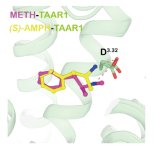
And to discuss it and how it relates to the binding affinity I mention in regard to N methylation of phenethylamines and amphetamines: In this paper figure 1C shows a close up of the binding pattern in the enzyme of the stronger isomers of both amphetamine and methamphetamine, superimposed over one another.
Here is that image extracted from this paper:
TAAR1-propylamines-binding image.jpg

This image shows how the amine and the N-methylated amine fit, which is relevant to the binding of other molecules with similar phenolic and propylamine groups. Molecules with such groups include but are not limited to phenthylamines, tryptamines, tyramines and amphetamines. Those familiar with molecules like 4-methyl-aminorex can also see how its structure fits this binding pattern. Even methyphenidate has the phenolic group and the propylamine skeleton in its structure with the same basic location for the amine that occurs in amphetamine. One can see that nearly all psychedelics and certain types of well known stimulants all have a structure that fits this receptor to some degree and one can see from the image how the extension of the methylgroup potentially decreases the distances from the binding residues of the enzyme, thus increasing affinity.


In terms of the relationship to structure and function of psychoactive amines I suspect TAAR1 plays a key role in euphoric effect. I may be wrong, but I think it is an interesting topic nonetheless. I believe that this also relates to the difference of activity of the different optical isomers of the N-methyl amphetamine analogs. One can see from the image above how the difference of direction of the amine and methylgroups of said isomers can alter the binding pattern, though it would be nicer to obtain several different angles and perspectives to make this more apparent.
 

Attachments

  • Clinical Translational Med - 2024 - Yu - Elucidating the molecular pharmacology of trace ami...pdf
    1.2 MB · Views: 0
Last edited:
To discuss one of the concepts above in terms of the role of TAAR1 and addiction, it is my suspicion that the addiction patterns for substances like amphetamines relates strongly to cortisol, which is a stress hormone and it appears that TAAR1 agonists can trigger a cascade of catecholamine related effects including increases in blood pressure and body temperature, as well as heart rate. This appears to trigger a stress response and alters cortisol levels, which rise and fall in a cycle daily, accumulating in the largest amounts right before waking up.

Indeed, it appears that the stress of waking up correlates to literal stress chemicals in the body. Moreover cortisol has anti-inflammatory effects and puts the body into a defensive state, it ceases certain types of nutrient absorption including calcium deposition in things like bones and teeth.

When a drug is taken frequently that triggers a stress response the body also then associates cortisol with the drug and alters the cortisol cycle patterns in relation to the drug. This appears to make withdrawal cravings worse as that upon cessation of the drug involved the cortisol cycle patterns of the body are then out of balance without the trigger molecule that it was using, so to speak. Then withdrawal hits and causes another literal stress response, but without the drug that is normally used and this appears to increase cravings dramatically. It is also notable that drugs like amphetamines trigger a much stronger stress response in those unaccustomed to them and that as tolerance builds the amount of cortisol released diminishes. I suspect this directly relates to the emergent chemical dependency that can develop with things like amphetamines. So while TAAR1 does appear to play a role in addiction I suspect that cortisol levels and cycles are more relevant to dependency than the receptor activity itself. I speculate somewhat here but there is a clear link between cortisol levels and addiction.

It appears that some of the relief of discomfort experienced by stimulant addicts is related not to the molecules so much as is is related to the anti-inflammatory effects of cortisol itself. This appears to be a negative feedback loop, where the stimulant causes body systems to go into distress and causes it to experience nutrient deficiencies while at the tame time the stress causes a chemical release that makes the user feel less pain and have more energy. So theoretically each time the material is ingested the body is harmed further by the same mechanisms that afford relief, this appears to be a potential explanation for the decline of health associated with methamphetamine dependency. This also, incidentally, appears to relate to other types of addiction including addition to anger and rage, as that anger relates to dopamine release, which is related to TAAR1 function and such emotions then trigger fight or flight and stress responses, providing an increase in perceived energy or a type of high and then resulting in a cortisol release, which can afford relief for discomfort with the result being cortisol release pattern alteration resulting in patterns of behavioral dependency. This type of chemical response also has sexual applications where pain and humiliation and jealousy trigger similar chemical responses and their use in relation to sex can be strongly habit forming. Interestingly such activities are often combined with drugs like amphetamines, and or psychedelic which increases the intensity of sensation via the pathways and mechanisms I have been discussing in this thread.

Note as well that cortisol plays a major role in wakefulness as mentioned above and the TAAR1 agonists associated with cortisol release are known for preventing sleep. I suspect this aspect of wakefulness associated with TAAR1 is cortisol related and that the ability of psychedelics to interfere with sleep may relate to their partial agonism and binding affinity for TAAR1 and related cortisol response.
 
Last edited:
Another TAAR1 paper.

Trace Amines and the Trace Amine-Associated Receptor 1: Pharmacology, Neurochemistry, and Clinical Implications
An interesting quote from the introduction of that paper:
TAAR1 is uniquely positioned to exert direct control over DA and 5-HT neuronal firing and release, which has profound implications
DA is dopamine.

TAAR1 influences the dopamine receptors and the 5HT receptors, including 5HT2a.
I suspect that it plays a major role in psychoactive effects of well known drugs that have amine groups, like propylamine, though I could easily be wrong or mistaken in regard to my current impressions of how this works and what it results in. In the paper it is also mentioned how the TA receptors are involved in the sensation of euphoria caused by certain drugs, but the mechanism is not exactly clear, to me at least.
 

Attachments

  • Pharmacology, Neurochemistry, and Clinical Implications of Trace Amine Receptor.pdf
    654.5 KB · Views: 0
Last edited:
Another good TAAR1 paper.
Pharmacology of human trace amine-associated receptors: Therapeutic opportunities and challenges

Check out page 168, it contains Table 3.

It is a bit older so doesn't have all the Ki binding data for the molecules, particularly for human TAAR1, but it does have info about Ki binding data to rat and mouse TAAR1 for numerous interesting molecules including but not limited to DMT, LSD and mescaline, among others.

Remember that the lower the Ki, the less of the molecule that is needed for agonism, however do consider that metabolism alters the rates that the molecules reach the receptor at, thus a molecule with a lower Ki, which is metabolized rapidly by MAO, like DMT or tyramine: does not typically result in signifigant TAAR1 agonism upon ingestion.
 

Attachments

  • Pharmacology of human trace amine-associated receptors: Therapeutic.pdf
    1,019.5 KB · Views: 2
Back
Top Bottom