Yeah. The USA is tightly restricting DCM now, I think primarily due to fatalities among improperly trained users of DCM paint strippers. The classic accident there was for a worker to spread the solvent on the bottom of a bathtub they're refinishing, which fills with fumes. The worker leans into the bathtub and inhales, passes out, falls forward, and dies. Competent laboratory use presents very little risk, though. I think the special restrictions are due to that specific history of dangerous use, not due to inherently special danger.
That
Brazilian paper found much higher yield with DCM than with any other solvent. Ethyl acetate yielded only 34% as much, and n-hexane yielded 6% as much (Table 2). My own
experiment used a somewhat different method: Phalaris and not MHRB, A/B and not STB, weaker solutions, two pulls. The result still seemed surprisingly different, though. The chromatogram below shows the alkaloids remaining in my water after extraction, so less is better. DCM and ethyl acetate are both near zero, so almost 100% of the alkaloids got pulled. Scaling roughly, limonene pulled 94%, hot naptha 83%, room-temperature naphtha or hot mineral oil 65%. Assuming a constant partition coefficient, that would imply yield with a single pull of 75%, 59%, and 41% respectively.
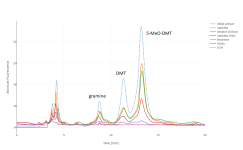
Their solutions were more concentrated than mine, but they seem well below reported solubilities. Perhaps the partition coefficient still varies significantly with concentration, though? Or perhaps the additional constituents (my sample also contained 5-MeO-DMT, plus the inactive stuff in both cases) interact? I can't currently explain this big difference.
In any case, DCM is good if available and correctly handled. Ethyl acetate is less toxic but more flammable. Isopropyl acetate might have most of ethyl acetate's good properties plus lower solubility with water, though I've never tried it. Limonene is a weaker solvent and hard to evaporate, but barely flammable and almost nontoxic. Hexanes, heptanes, and related mixtures (e.g. naphtha) seem less desirable to me, highly flammable, toxic (especially n-hexane), and the weakest solvents.
The easiest way to debug low yield is often to pull again, then somehow quantify the alkaloids in that last pull alone, like by evaporating and weighing separately. If that's much lower (e.g. <10%) than the previous pull(s), then the method has probably extracted almost all the alkaloids. If not then try more pulls, a stronger solvent, better mixing, heat, etc.