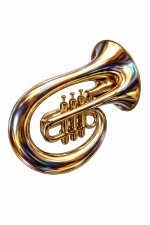
Trip Log: The Trumpet That Refused to Decide Where It Was
Location: M's place
Time: 11 a.m., September 29th, 2025
Vehicle: N,N-DMT, same cart as before (which, it should be noted, had opinions of its own)
Dose: 11-12 secs @4.2V + 9=10 secs second hit Yocan Uni 3.0
The experience arrived with all the subtlety of a freight train that had recently learned teleportation. No gentle ramp-up, no polite knocking. One moment I was presentable, the next I was being enthusiastically reintroduced to a familiar entity who appeared to recognize me in the way one recognizes a regular customer—cordial, but already halfway through the demonstration.
There was the finger again. Or rather, the finger motif, which seems less like a gesture and more like a recurring punctuation mark in this particular grammar of reality. This time, however, the entity appeared to interpret it not as a point of instruction but as a thumbs-up, which was acknowledged with what can only be described as posing. The entity struck a stance. Presentation mode engaged.
Once more, the shape resolved into something archer-like: a multidimensional figure, arrow aimed directly into the finger itself, as though cause and target had decided to stop pretending they were separate concepts. The aim, notably, was behind me and to my left—an orientation that felt extremely precise while offering absolutely no explanation as to why.
Then the object began to change.
It became a trumpet.
Picture a trumpet that has forgotten the social contract of three-dimensional space.
At first glance, your visual cortex tries to do something sensible. You see a familiar brass instrument: valves, tubing, a flared bell. The metal has that impossible DMT sheen—polished, but not reflective of this room, more like it’s reflecting a higher-resolution version of reality that hasn’t fully loaded yet.
Then the lie reveals itself.
The bell does not open outward into space. Instead, as your eyes follow the flare, the bell curves back through itself without a seam, without a kink, without ever crossing a boundary you can point to. The horn narrows again, threading impossibly through its own interior volume, and resolves—calmly, inevitably—into the mouthpiece. The output is the input. The breath you imagine leaving the bell is already arriving at the embouchure before you can think “feedback loop.”
Topologically, it behaves like a Klein bottle wearing a trumpet as a disguise. There is no inside or outside—just continuous surface. No beginning, no end. If you were an ant crawling along the brass, you would eventually reach the mouthpiece without ever turning around, without passing an edge, and without violating your local sense of forward motion. Only later would you realize you’d completed something that should have been illegal.
Visually, the instrument cheats. Parts of it appear simultaneously nearer and farther than themselves. The bell seems larger than the space it occupies, as though it’s borrowing volume from a neighboring dimension. Highlights slide the wrong way. The reflections don’t agree on where the light source is, because the light source is, in some sense, the instrument itself.
Functionally—and this is where the image clicks—the trumpet is always already playing. There is no external breath. The act of sounding is self-sustaining. Tone generates tone. Cause and effect have collapsed into a single loop of intention. The musician is implied but absent, like a missing variable that the equation no longer requires.
Symbolically, it reads as a perfect closed circuit: expression feeding perception feeding expression. A universe inhaling its own exhalation. The sound is not traveling outward; it is folding inward, thickening, becoming structure. Music as topology. Meaning as resonance chasing itself around a surface that never lets go.
In ordinary waking life, this would be a sculptural paradox. In the DMT space, it feels obvious—almost instructional. Of course the trumpet plays itself. Of course the bell returns to the mouthpiece. Where else would it go?
At this point, perception began to malfunction in a very specific way. Every time I thought I was looking at the outside of the object, it became clear—immediately and without apology—that I was actually looking at the inside. Which was, inconveniently, the same thing. Focusing on it only made the problem worse. Attention caused further transformation, as though the object were responding to scrutiny by saying, “No, you’re still thinking too locally.”
There was no vocalization. Not because sound was unavailable, but because amazement had occupied all available bandwidth. The system was saturated. The mouth was offline.
Afterward, a second attempt was considered. The cart, however, displayed a decisive message: short circuit. No ambiguity. No encore. The seller was contacted and sent a replacement, which suggests that even in encounters with ineffable geometries, customer service remains undefeated.
Which, frankly, felt consistent.
End of trip.
Location: M's place
Time: 11 a.m., September 29th, 2025
Vehicle: N,N-DMT, same cart as before (which, it should be noted, had opinions of its own)
Dose: 11-12 secs @4.2V + 9=10 secs second hit Yocan Uni 3.0
The experience arrived with all the subtlety of a freight train that had recently learned teleportation. No gentle ramp-up, no polite knocking. One moment I was presentable, the next I was being enthusiastically reintroduced to a familiar entity who appeared to recognize me in the way one recognizes a regular customer—cordial, but already halfway through the demonstration.
There was the finger again. Or rather, the finger motif, which seems less like a gesture and more like a recurring punctuation mark in this particular grammar of reality. This time, however, the entity appeared to interpret it not as a point of instruction but as a thumbs-up, which was acknowledged with what can only be described as posing. The entity struck a stance. Presentation mode engaged.
Once more, the shape resolved into something archer-like: a multidimensional figure, arrow aimed directly into the finger itself, as though cause and target had decided to stop pretending they were separate concepts. The aim, notably, was behind me and to my left—an orientation that felt extremely precise while offering absolutely no explanation as to why.
Then the object began to change.
It became a trumpet.
Picture a trumpet that has forgotten the social contract of three-dimensional space.
At first glance, your visual cortex tries to do something sensible. You see a familiar brass instrument: valves, tubing, a flared bell. The metal has that impossible DMT sheen—polished, but not reflective of this room, more like it’s reflecting a higher-resolution version of reality that hasn’t fully loaded yet.
Then the lie reveals itself.
The bell does not open outward into space. Instead, as your eyes follow the flare, the bell curves back through itself without a seam, without a kink, without ever crossing a boundary you can point to. The horn narrows again, threading impossibly through its own interior volume, and resolves—calmly, inevitably—into the mouthpiece. The output is the input. The breath you imagine leaving the bell is already arriving at the embouchure before you can think “feedback loop.”
Topologically, it behaves like a Klein bottle wearing a trumpet as a disguise. There is no inside or outside—just continuous surface. No beginning, no end. If you were an ant crawling along the brass, you would eventually reach the mouthpiece without ever turning around, without passing an edge, and without violating your local sense of forward motion. Only later would you realize you’d completed something that should have been illegal.
Visually, the instrument cheats. Parts of it appear simultaneously nearer and farther than themselves. The bell seems larger than the space it occupies, as though it’s borrowing volume from a neighboring dimension. Highlights slide the wrong way. The reflections don’t agree on where the light source is, because the light source is, in some sense, the instrument itself.
Functionally—and this is where the image clicks—the trumpet is always already playing. There is no external breath. The act of sounding is self-sustaining. Tone generates tone. Cause and effect have collapsed into a single loop of intention. The musician is implied but absent, like a missing variable that the equation no longer requires.
Symbolically, it reads as a perfect closed circuit: expression feeding perception feeding expression. A universe inhaling its own exhalation. The sound is not traveling outward; it is folding inward, thickening, becoming structure. Music as topology. Meaning as resonance chasing itself around a surface that never lets go.
In ordinary waking life, this would be a sculptural paradox. In the DMT space, it feels obvious—almost instructional. Of course the trumpet plays itself. Of course the bell returns to the mouthpiece. Where else would it go?
At this point, perception began to malfunction in a very specific way. Every time I thought I was looking at the outside of the object, it became clear—immediately and without apology—that I was actually looking at the inside. Which was, inconveniently, the same thing. Focusing on it only made the problem worse. Attention caused further transformation, as though the object were responding to scrutiny by saying, “No, you’re still thinking too locally.”
There was no vocalization. Not because sound was unavailable, but because amazement had occupied all available bandwidth. The system was saturated. The mouth was offline.
Afterward, a second attempt was considered. The cart, however, displayed a decisive message: short circuit. No ambiguity. No encore. The seller was contacted and sent a replacement, which suggests that even in encounters with ineffable geometries, customer service remains undefeated.
Which, frankly, felt consistent.
End of trip.