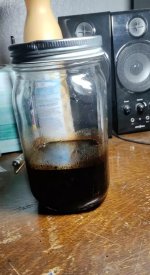
fink said:Post a picture please
Homo Trypens said:Is it just liquid, or is the bark still in there? Bark sometimes likes to soak up solvent. If this is what happened, you might have to strain through a cloth and squeeze the bark in the cloth until it releases most of the solvent.
Adding salt water and applying a bit of heat often helps, too.
Ego said:Yeah, a buddy of mine who I got the soup from told me to boil some water in a jar slightly bigger and place it in there for a bit. What is the salt water thing you're talking about? How much should I add? Also it doesn't seem that there's any chunks of it in there. Maybe just some very small pieces if anything.
Homo Trypens said:Ego said:Yeah, a buddy of mine who I got the soup from told me to boil some water in a jar slightly bigger and place it in there for a bit. What is the salt water thing you're talking about? How much should I add? Also it doesn't seem that there's any chunks of it in there. Maybe just some very small pieces if anything.
Usually people use powdered bark, so it would be very small particles.
The salt water thing is exactly what it sounds likeDissolve a lot of table salt in water (ideally distilled) and add that to the jar. I think i'd go for 50-75% of the current soup volume - enough to make the soup as thin as possible, but leave some space in the jar.
I don't remember why it works but it helps clear up emulsions, assuming that's what your problem is.
How do you perform the pulls? Do you heat, and if so, how much and for how long? Heating increases efficiency, but if you do it too strong or too long, all your naphtha might evaporate. How much naphtha do you use per pull?

fink said:What is strange about your photo is that there doesnt seem to be any emulsions nor any sign of solvent. For experimental purposes could you try adding another dose of solvent and without shaking see if it stays separate from the soup.
What solvent did you use? Was it in a purchased container or in a non descript jar? I know this sounds mental but it almost looks like you might have added pure water by mistake instead of NPS. I know, it sounds insulting. But I'm trying to figure out how there could be absolutely no trace of solvent even around the meniscus of the soup.
The only other thought I have is that your jar is not airtight and the solvent evaporated.
Max Ion Tek said:Ionic strength is essentially a measure of how much charge is present in a solution. It has a value that is calculated by taking the concentration of every solute in solution, raising that concentration to its charge, and then adding these all together. This means that molecules with more than one unit of charge have a much greater effect on the ionic strength.
Calcium and Magnesium both have a charge of +2, while sulphate and phosphate ions have varying charges based on the pH of the solution, but at the high pH's that we run the extractions at they carry a charge of -2 and -3 respectively. pH plays an important role in ionic strength for reasons we will get into momentarily.
I don't like to encourage the use of distilled water, I prefer filtered water and for this reason alone, distilled water has had its ionic strength lowered to the lowest possible level intentionally, what you are buying is de-ionized water. With filtered or spring water you have removed anything that might be harmful to the process and are left with a plethora of ions such as sodium, potassium, chloride, magnesium, calcium, and many, many more. I understand the desire to start with distilled water but from a chemists perspective it is not really necessary and may actually decrease your yield if a high enough ionic strength has not been reached.