• Members of the previous forum can retrieve their temporary password here, (login and check your PM).

Trichocereus, Lophophora, etc. Mescaline Workspace

Migrated topic.

Cosmic Spore

☠ ⚡ ☣ ⚠ ☢
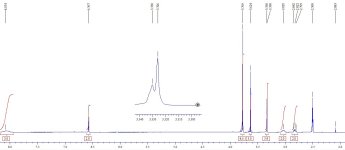
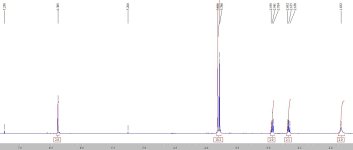
Ower a time of searching I did not manage to finde deacent NMR of mescaline so hear are two of them:
1) 400MHz, d6-DMSO, mescaline*HCl*H2O

As you can see water signal is distorted, but if you integrate each water signals seperatly one of them is exacly 2. By the way I was concerned about that distorted water signal thinking that is some impurity, That why I made free amine from that salt and take NMR one mrore time.

2)400MHz, CDCl3, mescaline as free amine

As it turns out, it was water. And there is a little bit of CH2Cl2 as residue.

Oh! And LCMS-liquid chromatography mass spectrometry showed that The HCl salt was 100%
 

Attachments

  • Untitled.jpg
    Untitled.jpg
    74.8 KB · Views: 0
  • Untitled2.jpg
    Untitled2.jpg
    52.1 KB · Views: 0
Hi and welcome to the Nexus - it is always nice to see more chem-oriented people around!

Now, could you please explain further your post? what did you do, why did you do it and why is it helpful? Your post is very cryptic to be of any use; I believe many would benefit (yes, even amateur kitchen chemists!) if you could explain what we see, where should we point our attention and what it all means.
 
I think we could benefit from a Trichocereus Analysis Thread... The idea for this started here. I'm sure we will rely heavily upon the information that has been put together by Keeper Trout.

I would really like to see a Trichocereus Analysis Thread on the nexus. :love:


I could eventually contribute cuttings from specimens within my cactus collection.

Named types, named variants, different extraction procedures of specific Trichocereus types, and Lophophora types.


I am hoping for GC-MS analysis.

I have seen some pdf's by Keeper Trout :thumb_up:

I really like the one linked here but this one is my favorite. <-- Support Keeper Trout's efforts.

I want to learn which types of these cacti have the most mescaline, without any question.

endlessness said:
There is no better collection of analysis info on San Pedro and related species than both the links you posted from Trout.

At the moment I still haven't done any thorough GC/LC-MS analysis on cacti, and not aware if others have done. Actually burnt did test some peyote already (link) , though peaks are not quantified.

I did test with TLC some extraction from a mix of pedro, peruvianus and tercheski, and it only shown mescaline. Maybe there are other trace alkaloids that didn't appear due to being under limit of detection, which probably means if there is anything else in such small quantities they wouldn't affect the trip much anyways. Same was true when me trav and infundibulum tested a bridgesii extract which only showed mescaline. We didn't quantify alkaloids.

Cosmic Spore, if you want, what would be great would be to start a new thread on the collaborative research subforum called "San Pedro / Peyote and related species Workspace" or something similar. Then you could try to extract the most relevant information from trout's book (giving due credit) and post there. Then we could all start adding information there regarding historical use, geographical location, etc etc.. And once I/we do any further analysis, we could post there too.

How does that sound? :)


Cosmic Spore said:
That sounds like a plan. :)

I hope to find out exactly which variants have the most mescaline, and confirm/check potencies some of the most interesting variants.

I am perhaps most interested in Trichocereus peruvianus variants, Trichocereus pachanoi variants, and Trichocereus validus variants.
 
Pages 245 and 246 of Trout's Notes on San Pedro and Related Trichocereus Species pdf mentions Trichocereus validus (Monville) Backeberg has been reported to have "over 50 mg of alkaloids per 100 grams of fresh plant, of which: Mescaline formed over 50%"

^ interesting stuff.


Like I said "I am perhaps most interested in Trichocereus peruvianus variants, Trichocereus pachanoi variants, and Trichocereus validus variants."
 
There's so many different clones and species and cultivars. And even different individual plants of the same clone can have completely different potency. It would take a TON of testing to get a good idea on the alkaloid profiles.
 
I don't doubt this, but IMHO we should start trying.

When my samples are used, I will attempt to list growing conditions.
 
With TLC, such 'tons of test' could be done quite easily considering one had access to the cactus and take very small amounts to test. It could be used to get an idea on best clones and even a decent semi-quantification if one tests next to a standard made with some clean extracted mescaline. Would be quite cheap to do so too.

One could test small samples from a cactus garden to find the one with most alkaloids, or could test within a given cact what part has more or how it varies during the day etc
 
Trichocereus, Lophophora, etc. Mescaline Workspace
Pictures of Specimens Available for Testing in the Trichocereus, Lophophora. Mescaline Workspace

endlessness said:
With TLC, such 'tons of test' could be done easily to get an idea on best clones and even a decent semi-quantification if one tests next to a standard made with some clean extracted mescaline. Would be quite cheap to do so, considering one had access to the cactus and take very small amounts to test.

One could test small samples from a cactus garden to find the one with most alkaloids, or could test within a given cact what part has more or how it varies during the day etc


It would be perfect if our sample size was large, and the specimens were known, labeled, and weighed; all relevant information listed- as long as we could visualize which sample of known origin has the most mescaline.

I can imagine the most optimum going like: a long collection of samples and data, then one very careful set of TLC tests.


any thoughts?
 
Sounds perfect.

There are a few details to work out, like what method of crude extraction from cactus sample (just soak whole pieces ? pound/blend before or lyse cells in some way? ).

Also the samples would have to be standardized in some way, like deciding from what part of the cactus does one take when comparing different cactus? Or what kind of piece size is cut from cactus, how deep , tall or wide?

And then there are questions like, can it be done without doing any potential harm to the cactus? How to care for cact later?

But I see it as a viable project anyways.
 
I'd love to test some of the specimen in my garden. You can take pieces off trichocereus cactus with little to no harm to the plant. Sulphur powder can help protect the wound from any infection.

They are very hardy. I think if we could test a small amount (not sure if that's possible with tlc) Then you could test any cactus without drawback. Other than a small scar.
 
endlessness said:
Yeah just a small amount is necessary, for example 100mg

Oh wow. Yeah, that would be perfect. Just take a small chunk out of a certain area (anywhere but the shoot apical meristem.) Then put some sulfur powder on the wound.

I have a lot of cacti that have no information about the alkaloid profiles. (melted wax bridgesii, monstrose bridgesii, crested pachanoi, ect...) I should look into getting a TLC.
 
Trichocereus pachanoi Britton & Rose

450px-Starr_070320-5799_Echinopsis_pachanoi.jpg

sanpedro1.jpg


Synonyms (Tropicos.org)
Cereus pachanoi (Britton & Rose) Werderm.
Echinopsis pachanoi (Britton & Rose) Friedrich & G.D. Rowley
Trichocereus macrogonus var. pachanoi (Britton & Rose) Albesiano & R. Kiesling


Herbarium Botanical Voucher: Link

Distribution
South America, Andes.


Botanical description

...

Ethnomedicinal use

...


Alkaloid/Chemical content: (mostly from Trout's Cactus Chemistry book)

93.5% water by weight according to Poisson 1960.
95.5% water by weight (Reyna & Flores 2001)

Mescaline. Highly variable.
- 0.310% fresh weight (Gennaro et al. 1996)
- 0.12% fresh (Poisson 1960. Collected in Peru)
- 0.067 - 0.079% fresh: (Bruhn & Lundström 1976a)
- 0.04% fresh (Agurell 1969a)
- 0.025% fresh (Agurell 1969b)

- 4.7% Dry outer green tissues. (Ogunbodede et al. 2010) Harvested at Matucana in Peru.
- 4.5% - Dry outer tissue (Gonzales Huerta 1960)
- 2.375% - 0.109% dry (Helmlin & Brenneisen 1992)
- 2.0 % dry(Poisson 1960)
- 0.94% dry green outer tissue (Cjuno et al 2009) Tocmoche, Chota, Cajamarca, Peru
- 0.67% dry (Agurell 1969a)
- 0.45 dry green outer tissue (Cjuno et al 2009)
- 0.38% dry green outer tissue (Cjuno et al 2009) Yanasara, Sánchez Carrión, La Libertad, Peru.
- 0.331% dry (Crosby & McLaughlin 1973)
- 0.15% dry (Pummangura et al. 1982a) Commercial cuttings propagated in California.
- 0% dry green outer tissues (Cjuno et al. 2009) Cataratas, Otuzco, La Libertad, Peru.
- 0% dry green outer tissues (Cjuno et al. 2009) El Alisal, San Marcos, Cajamarca, Peru

3,4-Dimethoxyphenethylamine
- 0.005% - 0.0005% fresh Agurell 1969b [Obtained via European commercial sources]

3-Methoxytyramine

- 0.005% - 0.0005% fresh Agurell 1969b;
- Under 0.01% fresh Agurell 1969a.

- 0.01% dry (Crosby & McLaughlin 1973 [Obtained via Californian commercial sources]
[Also reported in Agurell & Lundström 1968]

Anhalonidine

- 0.01% of alkaloid content (not of plant) Agurell 1969a
- (trace) Agurell 1969b

3-Hydroxy-4,5-dimethoxyphenethylamine (trace) Agurell 1969b

4-Hydroxy-3,5-dimethoxyphenethylamine (trace) Agurell 1969a and 1969b. Also reported in Agurell & Lundström 1968

Tyramine (trace) Agurell 1969a and Agurell 1969b

Hordenine (trace) Agurell 1969b

β-sitosterol (Flores 2000)

Unidentified lactone-forming acid (tlc by Kringstad & Nordal 1975)

Aglycones isolated after acid or enzymatic hydrolysis of the isolated corresponding sapogenins: Pachanols A & B, Bridgesigenins A, B & C (Kinoshita et al. 1995)


Alkaloid info and pharmacology

Mescaline
qQIaF02.jpg

CAS: 54-04-6
211.257 g/mol
Half life: 6 hours (wikipedia)

Mescaline in the form of Peyote or San Pedro has been consumed for thousands of years. (El-Seedi et al 2005)

Metabolites: 3,4,5-trimethoxyphenylacetic acid; 3,4,5-trimethoxybenzoic acid; 3,4-dihydroxy-5-methoxy-phenyl-lacetyl glutamine; 3-hydroxy-4,5-dimethoxyphenylethylamine; N-acetylmescaline; and N-acetyl-3,4-dimethoxy-5-hydroxyphenylethylamine. (Dart 2004)

(......More pharmacology info)


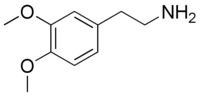
3,4-Dimethoxyphenethylamine (DMPEA)
200px-DMPEA.png

CAS: 120-20-7
181.23 g/mol

In the book PiHKAL, Shulgin describes DMPEA as producing no central effects in humans when tested even with very high doses, such as 1,000 mg orally or 10 mg via intravenous injection. However, DMPEA has been shown to have some activity as a monoamine oxidase inhibitor (Keller & Ferguson 1977)


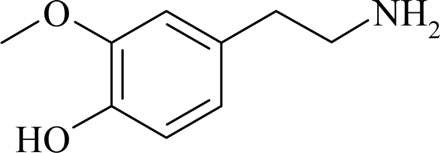
3-Methoxytyramine
inline-graphic-3.gif

CAS: 554-52-9
167.21 g/mol

3-Methoxytyramine (3-MT), also known as 3-methoxy-4-hydroxyphenethylamine, is a metabolite of the neurotransmitter dopamine formed by the introduction of a methyl group to dopamine by the enzyme catechol-O-methyl transferase (COMT). 3-MT can be further metabolized by the enzyme monoamine oxidase (MAO) to form homovanillic acid (HVA), which is then typically excreted in the urine.

Originally thought to be physiologically inactive, 3-MT has recently been shown to act as an agonist of the TAAR1.( Sotnikova et al 2010)


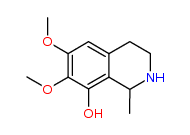
Anhalonidine
pk2230.png

CAS Registry Number: 17627-77-9
CAS Name: 1,2,3,4-Tetrahydro-6,7-dimethoxy-1-methyl-8-isoquinolinol
Additional Names: 6,7-dimethoxy-8-hydroxy-1-methyl-1,2,3,4-tetrahydroisoquinoline
Molecular Weight: 223.27
Properties: Small octahedra from benzene, mp 160-161°. uv max (ethanol): 270 nm (log e 2.81). Strong base. Freely sol in water, alcohol, chlorofom, hot benzene. Sparingly sol in ether. Insol in petr ether. Solns of anhalonidine acquire a reddish color on standing.
Melting point: mp 160-161°
Absorption maximum: uv max (ethanol): 270 nm (log e 2.81)

Anhalonidine in man appears to act in a manner parallel to peyotline (leading to a heavy-headedness and sedation) but with only about one-fourth the potency. At oral levels of between 100 and 250 mg there was a marked sedation, but no sensory changes whatsoever (Shulgin 1972)

Bridgesigenins B, C and Pachanol C
XYSXeL3.jpg

(different modifications on the numbered Rs in each of the mentioned substances)

KINOSHITA et al. 1998 established antinociceptive activity in rodents for Bridgesigenins B & C and for Pachanol C. This means it could present analgesia and/or an antiinflammatory action and/or a decrease in activity/responsiveness and/or a psychological impairment.


Analysis Data
GC-MS spectra

TLC system: ?

Plant vendors:
?

DMT Nexus related threads: ?


Sources:

El-Seedi HR, De Smet PA, Beck O, Possnert G, Bruhn JG (October 2005). "Prehistoric peyote use: alkaloid analysis and radiocarbon dating of archaeological specimens of Lophophora from Texas". J Ethnopharmacol 101 (1–3): 238–42
Keller WJ, Ferguson GG (July 1977). "Effects of 3,4-dimethoxyphenethylamine derivatives on monoamine oxidase". Journal of Pharmaceutical Sciences 66 (7): 1048–50

Sotnikova TD, Beaulieu JM, Espinoza S, et al. (2010). "The dopamine metabolite 3-methoxytyramine is a neuromodulator". Plos One 5 (10): e13452

Shulgin. Mescaline: The Chemistry and Pharmacology of its Analogs (1972)


[Dart, R.C. (ed). Medical Toxicology. Third Edition, Lippincott Williams & Wilkins. Philadelphia, PA. 2004., p. 1706]

 
"Trichocereus taquimbalensis (Mesa Garden)

Reported analysis of Trichocereus taquimbalensis by Agurell et al. 1971 found 10-50mg of alkaloids per 100 grams of fresh T. Taquimbalensis, of which: Mescaline formed over 50% of total alkaloid.Hordenine was present as 1-10% of total alkaloid. 3, 4-Dimethoxyphenethylamine was present in traces. 3-Methoxytyramine was present in traces.
Agurell et al. 1971b”

^ (Quoted from Trout’s Notes on San Pedro and Related Trichocereus Species.pdf page 239)


There is a similarity between T. validus and T. taquimbalensis both in appearance, and description of mescaline concentration. The T. validus (Monville) Backeberg was described as containing "Mescaline over 25mg per 100 grams of fresh plant" page 245, and the following quote is from page 246 "over 50mg per 100 grams of fresh plant, of which: Mescaline formed over 50% of the total alkaloid in Trichocereus validus".

This makes me even more interested.


In my collection is Trichocereus validus, "Trichocereus validus? NL 52509a" as well as several TBM type B's, approximately 8 T. bridgesii, 3 Juul's Giant, and what looks to be a T. pachanoi "Backeberg". Several more types of Trichocereus have been ordered, and have not yet arrived.
 
I have some taquimbalensis growing right now. I'll be interested to see the similarities between that and validus.
 
I would quite gladly donate plant material from the following plants:

Lophophora williamsii v Texensis ( Full plant )
Lophophora williamsii caespitosa ( Full plant )
Lophophora diffusa ( Full plant )
Lophophora fricii ( Offset )
Lophophora koehresii ( Full Plant )
Lophophora decipiens ( Full Plant )
Lophophora jourdaniana ( Offset )
Lophophora diffusa var swobodiana ( Offset )
Lophophora diffusa var kubesai ( Offset )

Any use to you just let me know ( im in the UK btw )
 
Thank you very much Koehres. :d

The workspace is now off to a great start. It might require from 1.5 to 3 months before I can acquire a TLC kit for a reasonable cost, but that's not really that long when cacti are the topic.

I'm very happy that you are joining the effort :d
 
Cosmic Spore said:
Thank you very much Koehres. :d

The workspace is now off to a great start. It might require from 1.5 to 3 months before I can acquire a TLC kit for a reasonable cost, but that's not really that long when cacti are the topic.

I'm very happy that you are joining the effort :d

Thank you not only for kind words but also for the great work you all do here, I think that in the persuit for invaluable knowledge and perhaps help define the relationships between these species of plants to which i devote my spare time (and money sadly) then to donate plant material is the least i can do. I only wish i had more of some of my plants but many i have with habitat data but many are not only small but in single numbers in my collection.
I am new here as you all know but one thing has been bugging me and i do not know if the topic has been covered or taken into consideration and that is that past studies have shown that the alkaloid content of Lophophora and i would assume most cacti is affected but the growing conditions and i think that where and how the plants are grown needs to be taken into consideration (Please do not take this as me trying to teach you how to suck eggs as we say in the UK). From what i remember the more punishment and hardship the plants are subjected to seems to significantly raise the alkaloid levels if my memory serves me rightly. I wish i had the source material for you to read. How you ever heard this before?
Anyhow glad to be aboard and just shout if i can help out further or when you require the plant material ;) Peace and light Koehres
 
Back
Top Bottom