• Members of the previous forum can retrieve their temporary password here, (login and check your PM).

wanting to test Precolumbian pottery for ayahuasca use

Migrated topic.

Charles W

Rising Star
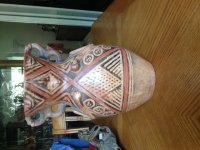
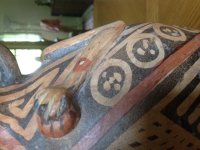
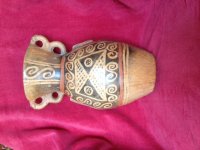
I have a Narin~o, PreColombian?, human figure vase. It is 14 inches high. The face is triangular with geometric designs. His hands are raised toward his neck. In one hand he holds a small cup. In two black bands coming from between his hands there are circles with random dots in them. They resemble slices of ayahuasca. The handles of the vase are two loops on each side and resemble vines. On the back side there are several more circles with random dots and many scrolls or S figures. In the bottom of the vase there is possible residue from whatever may have been in the vase. I would like to have the vase tested for ayahuasca alkaloids, specifically harmine. Prof. Dennis J. McKenna recommended that I contact this site to try to find a lab that can do this test. I would also like to have the vase tested for age. Can anyone recommend such labs. If the vase tests positive, it may be evidence for early ayahuasca use. Narin~o, Columbia, is in the region where ayahuasca was used. Thank you for any help you can give me.

 
Harmalas fluoresce (glow) in the presence of a blacklight. I'd suggest that your first test be to shine a blacklight on the interior of the vase to look for presence of any possible sign of trace harmala alkaloids (it might be worthwhile as well to add some distilled water to the vase and swishing it around the interior before the blacklight test to ensure that any undissolved harmala alkaloids would be in the same place.) This liquid can also be tested for DMT, 5-MeO DMT and similar compounds via reagent testing (simply add a couple drops of reagent of your choice to a small quantity of the fluid you washed vase with and see what happens). Also, how old is the vase in question and how was its age determined? Ayahuasca has been consumed by Amerindians for thousands of years and no one can be absolutely certain when humanity first began its collective journey with it. Also, if I may ask, how was the vase obtained? Was it washed beforehand or has it been uncleaned for millenia (DMT and harmalas are readily soluble in water and any tests for them may be inconclusive or negative if the vase has been washed). I would also love to see a few pictures of the vase! It sounds like an awesome find!
 
thank you all for your replies. i don't have a black light but will find one. i hesitate to rinse the jar; there is some indication of residue at the bottom but i don't want to dislodge it or wash it away. the jar does not have any real provenance or proof of age. I bought it from someone in Highland Park, IL. Oxford TL testing is $400 + but i may have to resort to that. thanks again for your helpful hints. it may be wishful thinking but it would be great to have clear evidence of early use, if i can get proof of its age and possible ayahuasca use. circles with random dots may not sound like much "proof" but, in my experience, they are quite unusual. usually there are one or two concentric circles within a circle. they suggest, to my eyes, cross sections or slices of the Banisteriopsis vine, particularly accompanied by a hand holding a small cup, not unusual in itself, and further combined with vine-like handles, all suggesting ayahuasca to me. the face on this ovoid vase resembles the faces on more recent Shipibo-Conibo circular vases still in use, but the abstract designs are different.
 

Attachments

  • photo-9.JPG
    photo-9.JPG
    136.4 KB · Views: 0
  • photo-10.JPG
    photo-10.JPG
    118.4 KB · Views: 0
  • photo-11.JPG
    photo-11.JPG
    122.9 KB · Views: 0
as you can see, i figured out how to post/download photos
found a black light bulb - regret there was no sign of phosphorescence inside of vase
i tried it on Amaringo's paintings, but they don't seem to be psychedelic under a black light.
Maybe i don't have the right tool; it is just a bulb from Lowes
does no phosphorescence mean no chance of ayahuasca use, or should i pursue other tests?
of course the ayahuasca residue could all be gone.
i have a smaller, more recent Shipibo bowl and it does not show any trace of ayahuasca either.
wonder if there is a cheaper but reliable test for age than the Oxford TL test?

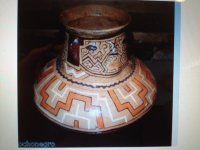
Here is a photo of a contemporary Shipibo ayahuasca bowl with a face,
as seen in some Amaringo's paintings.
It is the same idea (a face) but the style and geometric designs are much different from my vase.
Maybe such bowls were part of ayahuasca ceremonies elsewhere.
The Shipibo bowl/pot seems to have been placed in the center of the ceremony and the mouth of the bowl is wide enough for dipping. I don't think that the vase/jar i have could have worked that way, but who knows?
Marin~o is in Colombia, and not that close to the Shipibo area, and practices may differ. I do not know if ayahuasca is still in use in the Marin~o area, and, if so, what their practice is. There are old vases from Marin~o that closely resemble mine, but none that i've found with the figure holding a cup and circles with random dots. The S scrolls are definitely present. Are they simply decorations? or suggestive of snakes or vines?
 

Attachments

  • photo-12.JPG
    photo-12.JPG
    102.9 KB · Views: 0
I heard a peculiar anecdote while acquiring a Shipibo pot in Peru.

Apparently the woman who makes it has to fast the day she makes the pot or it couldn't be made that thin.

I also learnt these pots were used in various ceremonies, often smashed at the end of the ceremony or sent floating down the river.
 
i thought i had checked my inbox
i will do so again now
thank you for the reminder
i'm still learning how to use this site
 
Back
Top Bottom