• Members of the previous forum can retrieve their temporary password here, (login and check your PM).

White layer

Migrated topic.

JFMJR

Rising Star
Hello all,

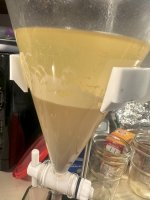
I've done much research about this process over the years. An attempt was finally made and some interesting observations were made. I am stumped by something and can't find any mention of this anywhere I look. I'll attach photos of this issue if I can figure out how :lol:.

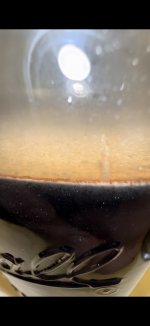
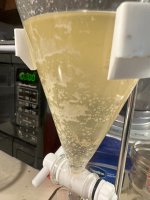
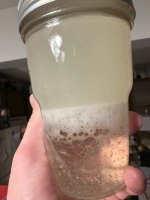
For background, the solvent used in all these photos is D-Limonene. The aqueous layer is either vinegar or basified solution, depending on the color. MHRB and Acacia confusa were used as plant material. The dark material was done using A/B, while the other was STB. All cases have the same issue.

My question/issue is this. What is the milky white layer at the solvent/aqueous interface? It was noticed first on the A/B jars and later on both A/B and STB when vinegar was added to the solvent and mixed. This layer never leaves the interface between the solvent and aqueous layers. It also "sticks" to the separatory funnel and will "smear" down the inside as the fluid exits the funnel.

Can anyone explain what this may be?

Thanks!

-JM
 

Attachments

  • white+layer+at+interface.jpg
    white+layer+at+interface.jpg
    1.1 MB · Views: 0
  • Milky+white+smear+on+sep+funnel.jpg
    Milky+white+smear+on+sep+funnel.jpg
    1.3 MB · Views: 0
  • white+layer+on+base+layer.jpg
    white+layer+on+base+layer.jpg
    291.3 KB · Views: 0
  • white+residue+on+sep+funnel+.jpg
    white+residue+on+sep+funnel+.jpg
    1.4 MB · Views: 0
Looks like emulsion. You can get that from shaking it or mixing it around creating bubbles. A warm water bath helps quite a bit. After the bath wait for a while and emulsion should reduce. It can take a couple of days for a heavy emulsion. If you have a glass rod handy, you can break up some of the emulsion as well.

Patience is key with extractions.

I am no expert so I hope I am not steering you in the wrong direction. Just what I see. Good luck!
 
UnSaNiTy said:
Looks like emulsion. You can get that from shaking it or mixing it around creating bubbles. A warm water bath helps quite a bit. After the bath wait for a while and emulsion should reduce. It can take a couple of days for a heavy emulsion. If you have a glass rod handy, you can break up some of the emulsion as well.

Patience is key with extractions.

I am no expert so I hope I am not steering you in the wrong direction. Just what I see. Good luck!
That would make sense, as the mixture was indeed shaken like mad! It was left to sit for many days but this was at around 60f. This has had me perplexed for the last month or so!

Thanks for the reply!
 
Limonene can be troublesome, especially when it's actually mixed pressed citrus terpenes with a proportion of more reactive, maybe oxygenated, components. Some of these could potentially have a detergent-like effect, especially after oxidation by air and in contact with strong base. Limonene itself is nowhere near as inert as most petroleum solvents and will slowly oxidise to form carvone (and other compounds), so it's best to avoid waiting too long for limonene-based extractions to sort themselves out.

IME, the carvone contamination clings to the extract like proverbial sh..tuff and led to endless amounts of fiddling around. This is all well and good from an educational point of view but I'm also happy to advise that you may be better off cutting your losses and carrying on with whatever clear portion of the solvent or acidic phase you can comfortably separate. You can then experiment with the remaining mayonnaise while receiving inspiration through the batch of product that - fingers crossed - you'll be able to recover initially.

One of the things that may help if you're determined to get every last speck of goodies from the isolated emulsion is dissolving it in IPA and drying it out with anhydrous sodium carbonate before passing it through a filter. Don't be surprised if up to three liquid phases form, though! In that case, the lowest one will be an aqueous phase which solidifies when even more anhyd. SC is added.

Maybe I'm getting ahead of myself there, so for the moment we can just consider how we know where the goods will be in any given case on account of the pH of the aqueous phase: acidic = goods in aqueous, alkaline = goods in NPS. Then, for good measure, we can recite once more the golden rule of extracting, "don't chuck it away until your sure you've got the goods".

If all else fails, take up making mayonnaise as you may have a secret talent there :lol:
 
downwardsfromzero said:
Limonene can be troublesome, especially when it's actually mixed pressed citrus terpenes with a proportion of more reactive, maybe oxygenated, components. Some of these could potentially have a detergent-like effect, especially after oxidation by air and in contact with strong base. Limonene itself is nowhere near as inert as most petroleum solvents and will slowly oxidise to form carvone (and other compounds), so it's best to avoid waiting too long for limonene-based extractions to sort themselves out.

IME, the carvone contamination clings to the extract like proverbial sh..tuff and led to endless amounts of fiddling around. This is all well and good from an educational point of view but I'm also happy to advise that you may be better off cutting your losses and carrying on with whatever clear portion of the solvent or acidic phase you can comfortably separate. You can then experiment with the remaining mayonnaise while receiving inspiration through the batch of product that - fingers crossed - you'll be able to recover initially.

One of the things that may help if you're determined to get every last speck of goodies from the isolated emulsion is dissolving it in IPA and drying it out with anhydrous sodium carbonate before passing it through a filter. Don't be surprised if up to three liquid phases form, though! In that case, the lowest one will be an aqueous phase which solidifies when even more anhyd. SC is added.

Maybe I'm getting ahead of myself there, so for the moment we can just consider how we know where the goods will be in any given case on account of the pH of the aqueous phase: acidic = goods in aqueous, alkaline = goods in NPS. Then, for good measure, we can recite once more the golden rule of extracting, "don't chuck it away until your sure you've got the goods".

If all else fails, take up making mayonnaise as you may have a secret talent there :lol:

Thank you so much for this insight! I have been saving the mayo, just in case. I have thankfully recovered a fair amount of DMT Acetate. I'm going to research a way to convert it to another salt and then try to make it crystalline. I apparently missed the fact that you can't freeze precipitate or evap with limonene so I kinda screwed myself a little :lol:. I was trying to avoid using petroleum products in this process. As a result I have made a fantastic learning experience!

Thanks again for the insight and advice. This kind of effort is part of why I adore this community. People are so willing to help others just for the sake of helping others. You have my deep appreciation, friend!
 
Back
Top Bottom