Th Entity said:
I've explained it like that to myself: (why emulsions form less if we add salt or lye or both) Yes polar(water) and non polar(oil) liquids dont mix but i remember reading that CTM said once that they kinda do just in so small amounts that we dont really see it. So i understanded it like that. If we
dissolve more things in the polar liquid (water) we get it more saturated in this case with NaCL,NaOH and whatever dissolves in the water from the bark, and the water now holds a lot of stuff in it now, and it becomes more saturated so theres not a lot of "space" in the water to hold more stuff so it "pushes" the non polar more easily away from it, this i think results in faster/easier separation of the two layers and less chance of forming emulsion, i think thats why people add salt, so the aq solution gives more easily the alkaloids after basifying and to prevent emulsion at same time.
Is my thinking right? im not a chemist this just makes sense to me i know its more complicated.
And i deffinetly dont explain it very good because of "language barrier". Please tell me if im right or wrong so i can edit/delete this reply so there is no spreading of false information.

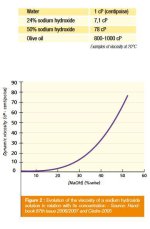
Loveall mentioned above, about the viscosity of an aqueous solution at varying concentrations of NaOH. So, imagine an oil - like cooking oil. It would be considered more viscous than water. I guess a way to explain this may be: if you take 20 mL of DI water, and pour it from a cup, beaker, anything - then it's easily poured, hits the surface, and splatters/spreads at a relatively fast rate. When it was poured, nearly all of the water could readily flow from the vessel to the surface. OK, now, take 20 mL of canola oil, or vegetable oil. Pour it from the same vessel. You'll notice that the movement of the oil is "slower", the splatter/spread pattern is more condensed and does not spread as readily, or at the same rate that the water had spread. It will likely be more uniformed spreading/splattering than the water. It may be difficult to pour all of the oil from the vessel, as it moves "slower."
Though this is not an elaborate "chemistry derived" observation or explanation of viscosity, it may help you understand the difference between a liquid that is comparably less viscous (water) to another more viscous liquid (oil).
If I am interpreting the data correctly, presented by Loveall, then higher amounts of NaOH in an aqueous solution will increase the viscosity of water. This makes sense - especially if you have ever worked with solutions of NaOH that are >20 M in concentration. The solution does become more viscous.
Why is this relevant? It is easier to separate liquids that are less viscous than more viscous. So, if your aqueous layer becomes too viscous, it will potentially create some issues in a hasty separation (this is going to be solvent-dependent). If a person is using a particularly viscous solvent, like d-limonene, then the separation will occur at a decreased rate. It is likely not much of an issue, though it does require additional patience.
And, yes - there are usually "small" amounts of mixing between the organic and the aqueous layers. In a general procedure that you would find in an academic journal, most chemists will use a drying agent, like anhydrous magnesium sulfate or anhydrous sodium sulfate, to remove any water that may have transitioned to the organic layer. Due to lack of the equipment needed to properly dry and filter the organic layer from the drying agent, it does not seem to be a step that is added to the "TEKs" that you'll see on the Nexus. However, the amount of water that is "dissolved" into the organic layer is usually not in sufficient concentrations to negatively impact an extraction.
Take Care,
ACY