• Members of the previous forum can retrieve their temporary password here, (login and check your PM).

A question about an extraction

Migrated topic.

Luz

Rising Star
Joined
Aug 26, 2018
Messages
41
Merits
42
In SyZyGyPSy's Nontoxic Limomene Tek at Nontoxic limonene tek - DMT-Nexus Wiki

I can't figure this one out:

Author of tek says this:

---------------------------
OPTIONAL: If you want smoke-able magick without resorting to petroleum, the best way SWIM has found so far is to add non-denatured lab-grade ethanol to the limo at this point. Some freebase magick will migrate to the ETOH which can then be evaporated and smoked (where legal).

-----------------------------
My non-comprehension:
As ETOH is miscible in D limo, how do you get the ETOH out of the D limo to evaporate the ETOH? (For practical purposes, D Limo is an oil and does not evaporate well at all. The ETOH might evap out of the D Limo, but then your magix would remain behind in the D Limno and you are back where you started from.
 
Hello Luz. I believe you need to add an ethanol/water mix. Perhaps when the TEK says ethanol, it means an ethanol/water mix such as everclear. This way, it will generally separate into two layers. I don't know what the partition coefficient is, but yeah some FB DMT could move into the ethanol/water layer.

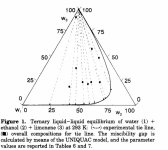
This terniary system is not trivial. A Gibbs triangle may help navigate it. See image below. Top of the triangle is pure limonene, bottom right is pure ethanol, and bottom left is water. The curve in the triangle is the boundarie between having layer separation (left of the curve) and not having it (right side of the curve).

A general water/limonene/ethanol solution is a point inside the triangle.

The sides of the triangle represent binary mixtures. For example the bottom side represents a water/ethanol mixture with no limonene. The right side represents ethanol/limonene. And the left siderepresents limonene water.

See the dashed lines? They show how the solution separates when you are on the left side of the D curve. For example if you have roughly 1/3 limonene, 1/3 water, 1/3 ethanol you are in the middle of the triangle (there is a square near this region, let's focus on it). Since you are to left of the D curve, separtation will occur. Follow the dashed lines coming out of the point in the middle, you can tell one side will go straight up to pure limonene and another side down to ethanol/water (in our example ~47% ethanol).

In practice, pulling the limonene with say 40% to 45% everclear (80 to 90 proof) should work. That's the simple answer (lol). I guess you want enough ethanol so DMT is pulled into the water, but not too much ethanol since limonene will contaminate the water pull. For example, if you pull with 60% ethanol you'll get limonene contamination in the water layer, and if you pull with 75% ethanol or above layers may not form.

Bottom line, if you mix pure ethanol and limonene you get a miscible solution. Instead use 40-45% ethanol to the limonene. Depending on the partition coefficient with enough pulls you may get a bunch of DMT out. You can get an idea of many pulls you need by the ratio of the DMT mass obtained between the second and first pulls (see this). If you measure this pull ratio please report back, would be good to know.

If no one disagrees I'll update the TEK to explicitly call for 40-45% ethanol.

I hope this helps.
 

Attachments

  • IMG_20190119_072027.jpg
    IMG_20190119_072027.jpg
    71.2 KB · Views: 0
The labelling of the axes on that ternary diagram is terrible. Isn't the left 'leg' of the triangle labelled backwards? Something doesn't seem to add up... It's been a long time since I drew one of these, so correct me if I'm wrong!

Would those percentages be molar percentages? That has a massive impact on how the respective volumes of each of the pure solvents would be measured. Although the 40 - 45% ABV everclear/vodka probably will still work: in tests DMT freebase was extremely soluble in 90% ethanol and remained soluble (at room temperature) when diluted down to 50% using 20% aqueous ethanol. Clouding occurred at the point of addition of the 20% alcohol so we can infer that DMT freebase has a much smaller solubility in c. 25% ethanol.

Another possible route would be to add a known (and sensibly calculated) volume of 95% ethanol to the limonene and wash it out with an equal volume of water.
 
Great question: they are mass fractions. So when using volume fractions which is how it is usually reported, adding ~55% volume of ethanol in water (or lower) should keep limonene out of the bottom layer.

Also, good eye, the left axis is not labeled in the standard way. I hadn't noticed that to be honest.

I've attached the original papper too. Note that their limonene wasn't as pure as what we can easily get now.
 

Attachments

Back
Top Bottom