Yeah, it is the most wild thing I've ever tasted.
Cactus is quite acidic, so no added acid is needed. Lot of natural acids there.
Cactus is quite acidic, so no added acid is needed. Lot of natural acids there.



I'll keep an eye for these drinks they look supergood maybe they have it in the shops here. Opuntia is not native to my origin country but it's commonly grown on the edges of property, it is my favorite summer fruit I love it!And drink lots of water the day before and after — MOD: REMOVED LINK
Bridging your final opportunity with Bridgesii feels poetic in itself.
Mescaline is often clear-headed, warm, and connected, with less internal chaos than other psychedelics — but it’s still a powerful teacher.
It is these kind of feelings that I am hoping for, I feel very disconnected from what is within, I sat all alone in the dark on top of a hill and I couldn't feel anything within, I miss what I once felt and loved (myself) and at the same time I hate it, it feels overused, exhausted and worn out, whatever I was feels long gone but nothing replaced it yet, it is very disheartening. and yes I am now at a bridge in life and I don't know what is waiting for me on the other side, I am going home and I still didn't figure out where to go next, I hope the cactus will help me see clearly and set me on a good direction.The cactus has a way of showing us what’s truly rooted within.
Cactus mucilage can be effectively separated using alcohol precipitation. The process involves extracting the mucilage from the cactus, then adding alcohol to the extract, which causes the mucilage to precipitate out of solution. Alcohol is commonly used as a precipitation agent due to its ability to denature proteins and disrupt hydrogen bonds, leading to mucilage aggregation.
Here's a more detailed look at the process:
1. Extraction:
.
Cactus mucilage is typically extracted by macerating the cactus tissue (e.g., cladodes) in water. This can be done by soaking the tissue in water at room temperature or a slightly elevated temperature.
2. Filtration:
.
The resulting extract is then filtered to remove any large particles or cellular debris.
3. Alcohol Precipitation:
.
Alcohol, such as ethanol or isopropanol, is added to the filtered extract. The alcohol's presence causes the mucilage to precipitate out of solution, forming a gel or precipitate.
4. Separation and Washing:
.
The precipitate is then separated from the liquid using filtration or centrifugation. The precipitate can be washed with a mixture of water and alcohol to remove any residual impurities.
5. Drying:
.
The separated mucilage can then be dried to obtain a powdered form for storage and further use.
2.1. Extraction of the mucilage
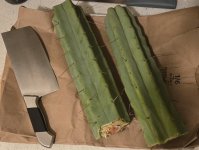
For the extraction of the mucilage in the two trials, the nopal pads were crushed in a blender (Moulinex) with rotative knifes type 320, homogenized with water in the ratio 1:5 and 1:7, and then filtered through a fine cloth and centrifuged in an IEC centrifuge model CS (3560 g). In order to reduce the amount of alcohol used in the precipitation, the mucilage solution was concentrated to a third of its volume in a Büchi evaporator model RE120.

I am wondering if cooking and reducing the mucilage might cause it to brake down and imparting more unwanted material into the water.
now that I realized that the key word is "mucilage" I can see that you have posted about this frequently, and there's a lot about it on the nexus so i'll be reading more. Thanks!@Sakkadelic
Yes, it's commonly used for separation of cactus mucilage.
Various plants extractions can utilize alcohol precipitation, it's not something specific for cactus.
Cactus mucilage is hydrolyzed by boiling, so it losses partially its geling properties. But it's still there.
What I did when I experimented with this approach was that I reduced cactus brew to low volume and added alcohol. No need to be very exact.
Btw. this was already discussed in old nexus in few extraction threads around 2010. One example: Link
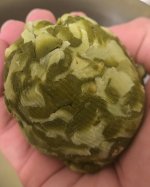
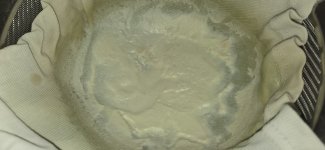
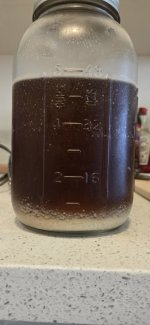
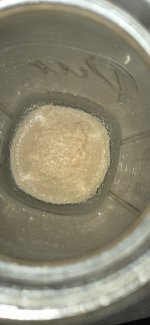
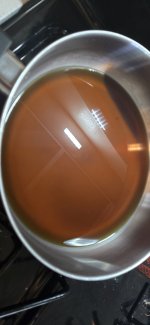
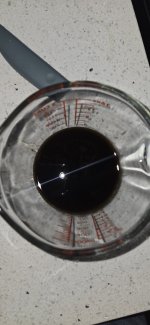
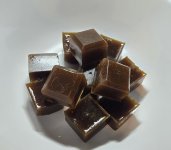
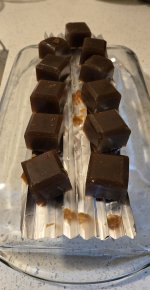


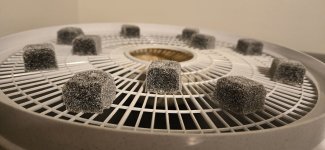
At the end after putting the gummies in a closed container for a couple of days they seem to have wept a bit, some moisture visible at the bottom where the gummies are against the container so i put it in the fridge. maybe sticky gummies are fine and i should've skipped the coating but i thought it would help with preservation and handling, they can be coated right before consuming to improve taste but honestly when swallowed without chewing there's only a little hint of bitterness.Glad the gummies appear to have worked out for you, especially if you perhaps think they were worth the effort.
at 100 ml warm, it was still quite runny but thickened as it cooled and it would coat anything that touches it.How viscous was the brew after reduction?
I wonder how you came to these findings :balthough it's not so bad if you manage to slurp it up your nose instead. It also makes for a great body lotion as well

Thanks! yes, that may be the case, the visual effects where there but quite minor. to be safe, I think we can take 3.5 cubes each, and leave 1 cube each for redosing if it doesn't feel the trip is coming on strong, I saw that it was common to redose with mescaline. and my friend is "tiny" so they might not need as much.Have a great camping trip! (But remember to figure in you might be taking up to 375mg if the first two were, say, 50% stronger than your estimate. Maybe even more, so take it easy…)

regarding the first test, it went quite well, I don't have prior experience but i would say it was a light dose, so above threshold. comparable to 25 mg 1p-lsd, I don't have much experience with acid either but i've had that exact dose before.
I think it's very difficult to compare mescaline and LSD, at least based on my only two mescaline experiences (200mg and 450mg mescaline sulphate, synthetic). LSD seems to have a much stronger headspace that imposes itself on you, whether you want it or not. Whereas mescaline is gentle, and the headspace can go from very subtle from quite strong depending on what you focus on and how much you "allow" it to come (although I'm sure at high doses that will be different).the typical swirling, breathing and bulging of walls, floor and carpet
Yes, the comparison was not accurate especially that i have little experience with both substances. I meant it as overall intensity or high. The visual distortions were more at the periphery of my vision and disappeared when focusing on them.I know this thread is old, but I'm planning my own cactus experiments and was reading it for that. About this:
I think it's very difficult to compare mescaline and LSD, at least based on my only two mescaline experiences (200mg and 450mg mescaline sulphate, synthetic). LSD seems to have a much stronger headspace that imposes itself on you, whether you want it or not. Whereas mescaline is gentle, and the headspace can go from very subtle from quite strong depending on what you focus on and how much you "allow" it to come (although I'm sure at high doses that will be different).
For comparison, my 450mg mescaline sulphate had relatively little visual activity, other than tracers, strong color enhancement, and some simple (but beautiful) CEVs. No real distortions, swirlings, or breathing anything. In a way, the mental effects would have seemed to be less than low dose LSD, as you mention. But in some other way that I find it difficult to describe, they were much stronger.
I must mention that my experience was a bit odd (compared to the average mescaline experience, at least from what I've read) in that I felt extremely relaxed. I didn't want to move, and spent most of it (except the required hike uphill during the come-up and downhill during the comedown, ha) just lying down. And while on LSD my mind goes on overdrive and I feel almost bombarded by ideas that connect to other ideas, here my mind was exceedingly calm and almost empty, with little going on beyond what I consciously wanted. It definitely was what I needed in the moment, but not what I expected, at all. I had a lot of physical sensations of energy, but my body was relaxed for most of the experience, with little muscle tension.
In summary, it's difficult to compare directly a given dose of mescaline and LSD, but I agree with @Transform that your dose was more than threshold. Or else I'm very insensitive to mescaline.
grow them largerNamaste guys!
Could you please tell me: if I have five peyote cacti measuring 4–5 centimeters, is there anything I can do with them?
This really depends on how big they are, and what the growing conditions were. Are they still on their own roots?Do I not feel anything from five if I dry and eat them?
I have the chance to buy five of them right now, but I can't grow them—I'm currently in a foreign country.