• Members of the previous forum can retrieve their temporary password here, (login and check your PM).

Analysis of synthetic DMT and its impurities, and analysis of re-x

Hello all,

At our lab, we recently received a synthetic DMT sample that was allegedly made using arclightshroom´s DMT synthesis protocol (I was not familiar with it but this was sent to us by the client)

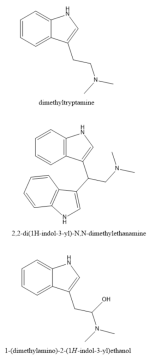
The sample came in the form of an orange oil. When analysing via LC-MS/MS and NMR, we discovered the sample was 49% freebase DMT, with the rest being mostly a DMT dimer (two DMT molecules joined at the alpha carbon in the alkyl chain), and some traces of beta-hydroxy-DMT

Here are the molecules in question:
1730028657329.png

The pharmacology of these impurities is obviously unknown, so for harm reduction´s sake, we wanted to advise the user based on some more experiments, whether recrystallizing that sample would be enough to clean the product off the impurities to avoid health risks.

After doing a single heptane recrystallization (as per our FAQ, 1g impure product in 30ml boiling heptane heated through hot water bath, stirring, and then pipetting the solvent away from the undissolved goo, and freeze-precipitating the purified DMT), the product turned to white crystals. We did another quantitative analysis and saw the product´s purity raised from 49% to 97.2%! There was no more dimer nor b-OH-DMT detected in the sample after the recrystalization

Thought this was interesting to share :)
 
Very interesting, thanks endlessness. Based on the synthetic route can you speculate where these impurities may have come from? The dimer is quite a cool looking structure.

Had the person bio assayed the product prior to it being sent in?
 
Very interesting, thanks endlessness. Based on the synthetic route can you speculate where these impurities may have come from? The dimer is quite a cool looking structure.

Had the person bio assayed the product prior to it being sent in?
Without going into too much detail Im pretty sure its because the formaldehyde, tryptamine can react with itself, leading to the formation of a dimer. So two tryptamine molecules each react with formaldehyde before reduction, linking them together.
The other reaction is the reduction that is not complete so a hydroxymethyl group may remain on the β-position of the tryptamine ring, resulting in β-OH-DMT.

In short it is because of the balance between reactants is not “optimal” and probably its not possible to achieve an balance with no side product. For example you will need the extra formaldehyde to drive the reaction forward but at the same time it will probably cause more of the dimer to form.

Note: I’m not a chemist so I might be wrong.
Mods: this is very close to synthesis talk so feel free to remove, if so apologies in advance.
 
Last edited:
Isn't the perceived wisdom round here that the oily polymers / dimers are just as active and not really considered "impurities" as such?
Though I guess they strictly are if the intent of the process is to make the monomer.
 
Had the person bio assayed the product prior to it being sent in?
I did, unknowingly... ;)

I tried this exact product (likely the same batch) a while ago. I dissolved 0.6ml of it in about 0.3ml of propylene glycol and vaporized the mixture with an e-cig.

It had a very sour and bitter taste and took quite a few hits to work. It would be difficult for me to break through this way, because of the taste and many hits required. However, a friend of mine didn't mind the taste nearly as much, so it might just be me. All my previous experiences were with changa and enhanced leaf so it's hard for me to say if it's the dimer causing this.

Anyway, I think I'll try recrystallizing it. Would it be safe for me to try the "impurities" after evaporating the removed heptane? From what I understand, DMT dimer should have similar pharmacology to DMT monomer, so in the worst case scenario it'll just turn out to be less potent, right?

Also, can I use hexane instead of heptane for the re-x?

Edit: Just to be clear, I'm not the person that sent the sample for analysis
 
Last edited:
Hello all,

At our lab, we recently received a synthetic DMT sample that was allegedly made using arclightshroom´s DMT synthesis protocol (I was not familiar with it but this was sent to us by the client)

The sample came in the form of an orange oil. When analysing via LC-MS/MS and NMR, we discovered the sample was 49% freebase DMT, with the rest being mostly a DMT dimer (two DMT molecules joined at the alpha carbon in the alkyl chain), and some traces of beta-hydroxy-DMT

Here are the molecules in question:

View attachment 101110

The pharmacology of these impurities is obviously unknown, so for harm reduction´s sake, we wanted to advise the user based on some more experiments, whether recrystallizing that sample would be enough to clean the product off the impurities to avoid health risks.

After doing a single heptane recrystallization (as per our FAQ, 1g impure product in 30ml boiling heptane heated through hot water bath, stirring, and then pipetting the solvent away from the undissolved goo, and freeze-precipitating the purified DMT), the product turned to white crystals. We did another quantitative analysis and saw the product´s purity raised from 49% to 97.2%! There was no more dimer nor b-OH-DMT detected in the sample after the recrystalization

Thought this was interesting to share :)

Fascinating work and great that it got bumped, since I missed it the first time around.

Are those structures correct? Because they seem to me to be at odds with your descriptions of them. The hydroxy-DMT as depicted is what I would call the α-hydroxy isomer, and it would tend to decompose into the corresponding aldehyde plus dimethylamine. Meanwhile, what you call the "dimer" isn't really a dimer of DMT at all in the picture, it just has an extra indole group stuck onto it, at what is conventionally known as the β-position.


I presume the structures are what came out of the NMR analysis and the ballpark descriptions of them are a fairly trivial point, but there's a friendly bit of peer-review for you :) Could you include the NMR results, perchance, or would this pre-empt publication elsewhere?
 
Would it be safe for me to try the "impurities" after evaporating the removed heptane? From what I understand, DMT dimer should have similar pharmacology to DMT monomer, so in the worst case scenario it'll just turn out to be less potent, right
I would say "no", until it has been cleared up on the point of whether the "dimer" is really a dimer and not just some weird disubstituted thingy of unknown pharmacology. Even then, the synthesis reaction dimer is not necessarily the same as the dimers and oligomers that form through indole ring oxidation of DMT itself. At the very least, I would recommend seeing how it responds to a mini A/B before the re-x, as this process would largely break up the "normal" (indole-ring-bonded) oligomers, but not a sidechain bonded dimer (even if it's not the bis(indol)ethylamine derivative).
 
Without going into too much detail Im pretty sure its because the formaldehyde, tryptamine can react with itself, leading to the formation of a dimer. So two tryptamine molecules each react with formaldehyde before reduction, linking them together.
The other reaction is the reduction that is not complete so a hydroxymethyl group may remain on the β-position of the tryptamine ring, resulting in β-OH-DMT.

In short it is because of the balance between reactants is not “optimal” and probably its not possible to achieve an balance with no side product. For example you will need the extra formaldehyde to drive the reaction forward but at the same time it will probably cause more of the dimer to form.

Note: I’m not a chemist so I might be wrong.
Mods: this is very close to synthesis talk so feel free to remove, if so apologies in advance.
Unfortunately, your explanation, while reasonable given the nature of the alleged synthesis, does not square with the structures as currently depicted. I think we simply need a bit more information before we can pick this puzzle apart.
 
Last edited:
Hello all,

At our lab, we recently received a synthetic DMT sample that was allegedly made using arclightshroom´s DMT synthesis protocol (I was not familiar with it but this was sent to us by the client)

The sample came in the form of an orange oil. When analysing via LC-MS/MS and NMR, we discovered the sample was 49% freebase DMT, with the rest being mostly a DMT dimer (two DMT molecules joined at the alpha carbon in the alkyl chain), and some traces of beta-hydroxy-DMT

Here are the molecules in question:

View attachment 101110

The pharmacology of these impurities is obviously unknown, so for harm reduction´s sake, we wanted to advise the user based on some more experiments, whether recrystallizing that sample would be enough to clean the product off the impurities to avoid health risks.

After doing a single heptane recrystallization (as per our FAQ, 1g impure product in 30ml boiling heptane heated through hot water bath, stirring, and then pipetting the solvent away from the undissolved goo, and freeze-precipitating the purified DMT), the product turned to white crystals. We did another quantitative analysis and saw the product´s purity raised from 49% to 97.2%! There was no more dimer nor b-OH-DMT detected in the sample after the recrystalization

Thought this was interesting to share :)
fantastic! thank you
 
Back
Top Bottom