• Members of the previous forum can retrieve their temporary password here, (login and check your PM).

Backsalted liquid crashing out. No pull needed.

Migrated topic.

Jees

Esteemed member
Donator
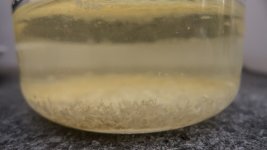
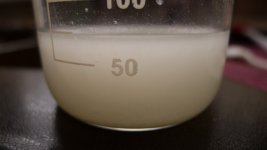
This comes from a oily alleged deems n-oxide, it got reduced with vinegar+Zn, Zn filtered off, based with ammonia til 10.5 to form a nice milk [first pic]. But I think of any based back-salted liquid.
During basing, zinc-salts mist formed from 7 and disappeared as zincates at 8.5 - 9 [see Dissolution] while the deems started to FB from 9 and up to make the milk.

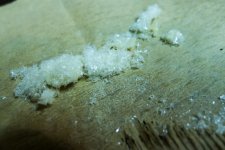
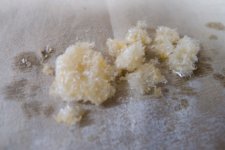
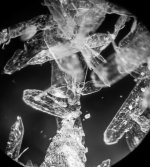
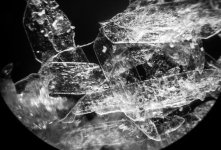
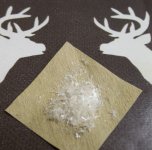
Then after 2 days (and some fridge) the milk crashed out completely [second pic] and retrieved on a coffee filter [3rd pic].

So this means there was no non-polar pull to retrieve the deems out of the base. What do you guys think? Safe? It is not essayed yet.
 

Attachments

  • milk.jpg
    milk.jpg
    83.3 KB · Views: 0
  • milkcrashed.jpg
    milkcrashed.jpg
    96.3 KB · Views: 0
  • Christmas.jpg
    Christmas.jpg
    96.3 KB · Views: 0
Dimitri and I are not so acquainted, but the looks of the crystals surely confirm some degree of purity. Do you have a weight before-after? Can you determine a melting point?

And, in analogy to the harmala's, does Dimitri provide a specific microscopic recrystallization-appearance?

If it is Dimitri allright, then this might seem like a nice clean-up route!:thumb_up:
 
I've no idea to determine a scientific complying melting point so far, and I did not weight before-after, sorry. It does smell like the real deal. A tip on the tongue confirms the right material.

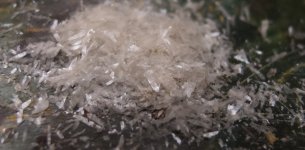
Under the microscope it seems to just forms shreds and not following a hard line. People who have been good in the art of re-crystallizing could get structured space ships out of deems, yet in different forms, but the regular kitchen hero just gets some fluffy stuff. In short: the structure is not a good parameter to judge deems on, it comes easily in different suits. Since it is polymorphic it can also be an oil for that matter.
In the pic it looks glass hard but it is very fragile actually.

But there's a difference with D that has been pulled with a non polar solvent:
this one here has the tendency to melt on its own, look at the pic of today it wanted to melt a bit in the coffee filter at room temp while drying over night.
(The turning a bit orange could be harmless oxidation as it often does on white D )
My first guess is that this happens only during the evaporating stage of the ammonia, I've moved it a bit on the coffee filter (the ammonia is gone now) and see if that 'melting' tendency stops.

Another trial could be to wash the wet fresh harvest with perhaps sodcarbed water and then dry. We know what to do ;)
 

Attachments

  • orange01.jpg
    orange01.jpg
    99.6 KB · Views: 0
If it continues to liquefy then washing might indeed be a good way to make sure no hygroscopic salt is left around the crystals...
 
It was 228 mg and redissolved it in a minimal vinegar + some water, then based with sodcarb to 10.65. The usual milk appears. But the first precipitation formed later now. At 10 instead of 9 (with ammonia). But from 10 and on the milk got steep and I suppose jobs done at 10.7.
After half a day there was sure less crystal drive to notice as it did with ammonia.
There are some tiny flocs visible and all hope is these will escalate.
Not going to put it in the fridge, as sodcarb drops out easily at lower temps.

...
 
So..

ammonia did OK, and sodcarb did not. Added ammonia to see if it could correct where sodcarb failed. It did, but lousy, extreme low yield like 10% :p
No big deal with these experimental amounts.

What precipitated was washed with sodcarb water to see if this could stop the "melting on coffee filter paper" that took place in previous posts.

A macro pic, and 2 microscope pics of the innumerable thin flakes that makes them so fragile.
 

Attachments

  • hmm03.jpg
    hmm03.jpg
    77 KB · Views: 1
  • hmm01.jpg
    hmm01.jpg
    91.9 KB · Views: 1
  • hmm02.jpg
    hmm02.jpg
    93.5 KB · Views: 1
Nice microscopy. Could cross-post to the "Just some crystals" thread. Maybe hygroscopix (earlier) is from residual ammonium acetate (very hygroscopic)? "Sod the sodcarb", then!
 
downwardsfromzero said:
... Maybe hygroscopix (earlier) is from residual ammonium acetate (very hygroscopic)? "Sod the sodcarb", then!
It seems that way.

Jees said:
...What precipitated was washed with sodcarb water to see if this could stop the "melting on coffee filter paper" that took place in previous posts...
Even after several days on the coffee filter paper it was not melting nor discoloring. Jipie :thumb_up:

This opens the experiments further to see how the ammonia precipitations yields are, to see if non-polar pulling of backsalted liquids can be replaced by this system.
 

Attachments

  • nosoak.jpg
    nosoak.jpg
    95.6 KB · Views: 0
You're rocking that microscope, Jees! Now that you've mastered recrystallizing harmala's on a microscopic slide, don't you wonder what the 'true face' of deems is? Keep up the good work!
 
I'm just thinking, a slower diffusion of gaseous ammonia into the solution should produce larger crystals. Maybe?

This would be achieved by placing a beaker ammonia solution of the appropriate concentration into a sealed container with the DMT vinegar. Ideally, passing diluted gaseous ammonia into the container at a slow rate would achieve even better results. This would avoid the decline in ammonia concentration that would result from using a solution, but is slightly more technically involved.
 
Must be possible I think, just like An1cca did with the harmalas in the VDS thread.
 
Back
Top Bottom