• Members of the previous forum can retrieve their temporary password here, (login and check your PM).

"Best" solvent?

Respectful

Esteemed member
Hi everybody - I'm a beginner extractor, I've read a lot of STB posts, and seen variation the choice of NPS solvent. I read that dichloromethane is probably provides better extraction, but it seems to be the most hazardous. I'm using n-Heptane now with ok results, but always obsessing about what could be improved!
 
Hi everybody - I'm a beginner extractor, I've read a lot of STB posts, and seen variation the choice of NPS solvent. I read that dichloromethane is probably provides better extraction, but it seems to be the most hazardous. I'm using n-Heptane now with ok results, but always obsessing about what could be improved!
I started with Heptane then to VM&P naphtha and the only difference I have noticed is color is slightly lighter with Heptane. No difference in yield or potency that I have seen.
Y
 
Hi everybody - I'm a beginner extractor, I've read a lot of STB posts, and seen variation the choice of NPS solvent. I read that dichloromethane is probably provides better extraction, but it seems to be the most hazardous. I'm using n-Heptane now with ok results, but always obsessing about what could be improved!
DCM may be more toxic than most alkanes (not counting hexane, which is - indirectly - neurotoxic), but you can weigh that up against the flammability hazard of lower alkanes [like heptane], which can turn into a more pressing hazard if used carelessly, and rather abruptly at that - up to and including actual explosion of vapour/air mixtures if there has been a particular lack of attention.

From a viewpoint of actual solvent properties, that can be assessed from various different perspectives depending on the particular situation one finds oneself in with regards to plant material, reagents and equipment.

Take necessary steps to educate yourself prior to switching over to a rather different solvent, so you can do so from a position of understanding the advantages and pitfalls you're likely to encounter, rather than relying on rumour and hearsay. By this I also mean you have to consider what might make something a "better solvent", and why.
 
'Best' depends on what your looking for in a solvent. If you are looking for something selective for DMT and not a lot else then n-heptane, naptha or hexane will work well. If you are wanting the pure DMT experience I'd recommend these. More suitable to 'solid' crystals.. meaning easier to handle and probably to vaporise too.

If you are wanting to extract all of a tree's alkaloids and not be selective for just DMT then something like DCM, toluene or xylene are very effective.. DCM trumps the other two in that it holds higher quantity, broader range of compounds and evaps insanely fast. Toluene and xylene hold smaller quantity (meaning more pulls might be required) and hold a slightly smaller range of compounds.. and take forever to evap. Xylene is the least toxic of the three. Overall I'd say this route would apply to someone planning to have extracts analysed.. or extract hobbyists who prefer to feel the differences between various plant species and the different combinations of alkaloids.

I think @Transform summed up the safety angle pretty well... choose your toxic I guess. None are probably great to be working with inside so I'd generally just recommend working in a really well ventilated environment with a mask and gloves no matter which you choose.
 
The other thing to bear in mind is that DCM is a bit denser than water, so it tends to sink to the bottom, except when there's a lot of dissolved matter in the water. That's when its high potential for forming emulsions really comes into play.

Here's something I've only just noticed, though - I've never seen mention of use of DCM in a drytek. Can anyone provide any kind of follow-up to this?
 
I'd be happy to give it a go and report back?
Thanks, although I'd be highly wary of DCM's propensity for emulsion formation. You might end up with a toxic mayonnaise analogue. At least DCM evaporates easily - speaking of which, it's near enough summer in your hemisphere. Only try this if you find it entirely convenient.
 
Okay, I'm still new to this and, due to my limited knowledge, I had the problem that DCM sounded really great, and even if you don't have any experience with it, it still sounds great. I think once you really know what you're doing, it'll be right up there again. But I've realized that all those advantages aren't good for inexperienced, unpracticed people. There's the constant doubt of not knowing what might have happened, for example, a problem with ventilation in the work area that might not be well-known, or simply being careless about wearing a mask because you can't smell anything. I can't put it any better than that. I think DCM should really be recommended more than just "use it only when you really know what you're doing."
 
Yes, I didn't want to point at you. Maybe I even made a false statement tbh.
It's more like there are to much sources not pointing out the explicit properties and toxicity of DCM. Like the first book I bought, I it DCM was announced as a solvent alternative which will increase your yields just by using it instead.
Not mentioned what it means not even that it will settle below.

Sorry, when I felt spoken to by accident!


In the end, I really just wanted to say the following without having thought about how I would say it beforehand. I think people who are inexperienced in the practical application of chemical chemicals should be strongly advised against using them. I say this from my own experience, as I unfortunately belong to the category of person who tends to downplay things or minimize the dangers when faced with them, just to have a clearer conscience. However, I consider this a very dangerous trait, especially when it comes to chemicals and vapors that don't have immediately noticeable effects, or at least not exclusively. Of course, everyone is responsible for themselves, but when handling chemicals, personal responsibility is more critical than almost anywhere else. I hope I've been able to clarify my statement somewhat.
 
Last edited:
Here's my earlier comment with a figure summarizing my own measurements of yield with different solvents, and a link to a Brazilian paper with directionally consistent but rather different measurements. I still can't explain the discrepancy; perhaps they didn't stir enough to reach equilibrium?

or simply being careless about wearing a mask
It's good to wear PPE, but typical respirators won't provide significant benefit with DCM. For all solvents, it's much more important to ensure adequate ventilation. I would work outdoors if at all possible, otherwise rig an improvised fume hood with a blower or fan. DCM also penetrates most gloves, and DCM trapped under a glove may be particularly irritating. I've seen advice to work without gloves, since a splash will quickly evaporate, but that's bad advice if you're also working with corrosives like sodium hydroxide. I personally wear ordinary nitrile gloves, but change them immediately if I get any contact. Impermeable gloves are available but uncommon.

Eye protection must always be worn. Thick, long-sleeved cotton clothing will protect against splashes. Most synthetic fibers may greatly increase injury from a fire, and must never be worn while using flammable solvents.
 
Last edited:
Well atm I got a half face mask with changeable filter... ?!

But I ordered mobile cook plate to move everything into bathroom to close door open window and a fan blow outward.

Can t do it on outdoor side of my apartment because of a curious neighborhood. You can not fart where I live without everyone talking about it.
 
I'm afraid your mask may not do much. Looking at 3M's guidance, the minimum respirator for DCM is either externally supplied air or SCBA (with an air tank on your back, like firefighters use), for all purposes except emergency escape. I think DCM is just so low-boiling that it easily saturates any respirator cartridge.

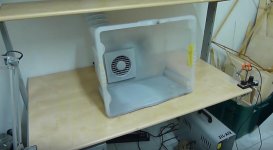
In an industrial or academic lab, I wouldn't expect the worker to wear any respirator. I would expect them to work in a hood. Venting out the window is good. It would be better to keep the DCM fumes in a smaller enclosure and vent from that, so the person in the room isn't exposed. They make tents for 3D printers that might be suitable, though I've never used one and you might need to upgrade the blower. You could also build a box around the fan in the window with a clear vinyl (not flammable polyethylene) curtain in front. You can test the airflow with a stick of incense or similar. I would leave the door at least partially open, since you need airflow in to replace the airflow out the window, and for rapid escape in case of emergency.

Take care that DCM boils very easily. If too much heat is applied, then it splatters everywhere. A pan of warm water and a fan blowing on the surface of the DCM will evaporate a small volume pretty quickly, no additional heat required. I generally prefer to evaporate solvents a little below their boiling point with strong airflow. That's almost as fast as boiling, and there's no risk of injury or lost product from bumping.

If your environment isn't suitable for more hazardous solvents, then there's always limonene. That pulls less than DCM or ethyl acetate but more than naphtha, and has low flammability and toxicity. It's somewhat expensive, but it's reusable.

 
I quitted DCM. Still got some but I generally didn't have the goods. I was looking in the end. Got used to naoh now what I didn't expect.

But d-limonen is not as easy to get or I am to thumb to find some that are free of additives where I live. Or it is extremely expensive when no additives.
Maybe some day, but for now I got used to a routine and good grade naptha with good handling except evap is a pain in the arse with a 100/140.

But the first freeze by 50g MHRB and just ~70% pulled was 370mg material before first cleaning.
Rly curious now what's left after the clean up.


Btw @ hood working
I already thought about a 200m³ vent sucking out to window
With a pipe to an PE box applied
Like a DIY airbrush hood

Not for DCM, but for all the cooking A/B or LYE stuff
sparyBooth.jpg


Something like that, the mobile cooking plate in front... Pipe out of window
 
Last edited:
Toluene and xylene hold smaller quantity (meaning more pulls might be required) and hold a slightly smaller range of compounds.. and take forever to evap.
It seems that not all toluene is created equal. In my neck of the woods, the toluene evaporates very quickly and efficiently: ~50ml will evaporate in 40 minutes with a fan on it; in less that 4 hours if left out in a dish.

The first two brands tried would integrate into the base soup. To be clear – this was not an emulsion. It was as if water had been added into the flask. The first brand would loose ~33% of its volume to the base soup and the second 99% of its volume. With persistence, one that separates properly was finally found.
 
Back
Top Bottom