• Members of the previous forum can retrieve their temporary password here, (login and check your PM).

Science paper Cation-π interaction of N,N-Dimethyltryptamine in hydrochloric acid solution characteristic to gastric acid

Pure science papers to share and discuss.

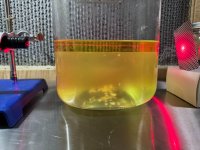
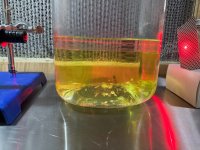
"When we had left N,N-DMT inside HCl solution of 0.1 M over a period of several hours up to a few days we didn’t detect the presence of N,N-DMT molecule. The significance of these facts in biology and medicine is that the HCl is an inhibitor of N,N-DMT activity and that it is the main agents for the decomposition of that molecule in the gastric fluid. Therefore, such an influence of HCl significantly reduces efficiency of N,N-DMT at oral intake."
 
Last edited:
This journal is really not one that can be taken seriously, and the quality of the research is far below standard. It also contradicts what we know about DMT in aqueous acidic solutions. I genuinely question whether this might simply be a group of first-year students who had to publish something for a school assignment. Still, I’m curious about your own view: what do you think of it, and why do you believe the mechanism proposed here is correct?
 
It's worth taking into account that oral DMT is usually taken as a salt, so the effects of HCl on the freebase don't seem too relevant in that sense. As for the supposed "decomposition of the molecule in the gastric fluid", people (including myself) have taken it as a freebase with no apparent reduction in potency whatsoever. It's weird that they don't even mention MAO.

I genuinely question whether this might simply be a group of first-year students who had to publish something for a school assignment
They appear to be doctors.
 
It's worth taking into account that oral DMT is usually taken as a salt, so the effects of HCl on the freebase don't seem too relevant in that sense.
In aqueous solution, DMT salts will simply remain protonated. In gastric fluid, protonation is dominated by hydrochloric acid, which is much stronger than acids such as citrate or fumarate. Therefore, if DMT enters the stomach as a citrate or fumarate salt, the equilibrium shifts toward protonation by HCl. If DMT is present as the freebase, it will rapidly be protonated by hydrochloric acid under gastric conditions.

Note:
In solution, these salts do not exist as fixed molecular ion pairs as they do in crystals. Instead, the system consists of freely solvated ions. The relevant species is protonated DMT (DMTH⁺), while anions such as chloride, citrate, or fumarate may all be present in solution simultaneously.

They appear to be doctors.
I haven’t checked the Bealls list, but IMO it should be on there.

Edit: it’s on the Bealls list.
 
Last edited:
In solution, these salts do not exist as fixed molecular ion pairs as they do in crystals. Instead, the system consists of freely solvated ions. The relevant species is protonated DMT (DMTH⁺), while anions such as chloride, citrate, or fumarate may all be present in solution simultaneously.
Thank you for clearing this up for me.

In any case, that's even more reason to not give credibility to their claim of HCl in gastric juices "decomposing" DMT.
 
This journal is really not one that can be taken seriously, and the quality of the research is far below standard. It also contradicts what we know about DMT in aqueous acidic solutions. I genuinely question whether this might simply be a group of first-year students who had to publish something for a school assignment. Still, I’m curious about your own view: what do you think of it, and why do you believe the mechanism proposed here is correct?
DMT might be stable in aqueous carboxylic acid solutions, such as acetic, citric, fumaric but maybe not in mineral acids which can and do behave differently/weirdly. I simply thought that HCl in the gastric fluid plays a role in rendering DMT inactive along with the MAO enzymes, since my experiences with Syrian Rue tea + MHRB tea were significantly stronger than purified Harmala alkaloids acetates + DMT Fumarate.

Maybe the Peganine, which has been demonstrated to inhibit gastric acid secretion according to https://sci-hub.ren/10.1016/j.phymed.2013.06.017 was the reason the tea combo was stronger? I don't know, but I'm giving up on the MHRB tea due to its very high tannin content and thus would just extract, but not the rue, which is probably wiser to just brew it as a tea or eat the seeds as is.

The mechanism in Vidak's et al paper seems plausible, I'm nether a chemist, nor do I have the equipment/laboratory to study this further, but I believe the HCl might be triggering dimerization/polymerization/oligomerization or some acid-catalyzed degradation of some sorts.

Some other papers that might be related or of interest:

The Acid-Catalyzed Polymerization of Pyrroles and Indoles
doi.org/10.1016/S0065-2725(08)60752-7

Cation-π Interactions in Serotonin:  Conformational, Electronic Distribution, and Energy Decomposition Analysis
doi.org/10.1021/ct0600316
 
DMT might be stable in aqueous carboxylic acid solutions, such as acetic, citric, fumaric but maybe not in mineral acids which can and do behave differently/weirdly. I simply thought that HCl in the gastric fluid plays a role in rendering DMT inactive along with the MAO enzymes, since my experiences with Syrian Rue tea + MHRB tea were significantly stronger than purified Harmala alkaloids acetates + DMT Fumarate.

Maybe the Peganine, which has been demonstrated to inhibit gastric acid secretion according to https://sci-hub.ren/10.1016/j.phymed.2013.06.017 was the reason the tea combo was stronger? I don't know, but I'm giving up on the MHRB tea due to its very high tannin content and thus would just extract, but not the rue, which is probably wiser to just brew it as a tea or eat the seeds as is.

The difficulty, as I mentioned earlier, is that once DMT, regardless of the salt form, is ingested, or even when it is taken as the freebase, it will by definition become protonated, among other things by stomach acid. From a chemical standpoint it should therefore not make a difference whether one takes the fumarate, citrate, or HCl salt, because as soon as these compounds dissolve in the stomach they are protonated predominantly by HCl. At that point the molecule carries the protonated amine while the original counter ion from the salt is no longer paired with it in the same way as in a crystal lattice.

The mechanism in Vidak's et al paper seems plausible, I'm nether a chemist, nor do I have the equipment/laboratory to study this further, but I believe the HCl might be triggering dimerization/polymerization/oligomerization or some acid-catalyzed degradation of some sorts.
I think the paper is very poorly written and clearly still resembles a draft. It also lacks several essential elements. My alarm bells went off when they say that the process takes “several hours to days”. That description is so vague that it immediately raises doubts about whether this meets basic scientific standards.

At the same time the authors claim that the DMT simply disappears. For chemists that is a very strange conclusion, because if a reaction actually takes place you would expect to identify which degradation products appear in solution so that you can demonstrate that the DMT is being converted. Even the most basic form, like doing TLC to identify the reaction taking place, seem to be to much of an ask.

Breaking down that aromatic ring in an HCl solution, similar to what would be present in the stomach, is something I find very difficult to imagine. Also in extractions discussed on the DMT Nexus where HCl is used we do not see this effect occurring.

All of this makes me distrust the paper and conclude that it does not meet the standards one would expect from a scientific publication. It’s sloppy work and doesn’t provide the basic data that makes the claim plausible.
 
Note:
In solution, these salts do not exist as fixed molecular ion pairs as they do in crystals. Instead, the system consists of freely solvated ions. The relevant species is protonated DMT (DMTH⁺), while anions such as chloride, citrate, or fumarate may all be present in solution simultaneously.
This is helping me understand a question I've had for a while: whether the ions are paired up in solution or moving around trading partners like a swing dance. Are you saying the DMTH+ and chloride- are moving around freely in solution?
From a chemical standpoint it should therefore not make a difference whether one takes the fumarate, citrate, or HCl salt, because as soon as these compounds dissolve in the stomach they are protonated predominantly by HCl. At that point the molecule carries the protonated amine while the original counter ion from the salt is no longer paired with it in the same way as in a crystal lattice.
This seems to contradict that interpretation tho. Are the ions still able to move around freely in the stomach or DMT is bound to the chloride anion?

As far as HCl pi bonding with DMT's benzene ring, I wonder if the researchers could test that property with benzene. I've seen papers talking about metal cations sandwiching between two benzene rings, but would that apply to DMT's rings too?
Bis%28benzene%29chromium-from-xtal-2006-3D-balls-A.png
 
several hours up to a few days we didn’t detect the presence of N,N-DMT molecule.
What is the rate of decay of the DMT in solution? I think one major difference between this experiment and the reality in the gastric system is the length of time that DMT, whether acid or freebase, is in the gut. It seems much more likely, imo, that the effect of endogenous MAO plays the primary role of DMT destruction in the gut than much of a role of the gut's HCL content's effects.

Syrian Rue tea + MHRB tea were significantly stronger than purified Harmala alkaloids acetates + DMT Fumarate.
I think it's important to consider that plant matter and isolated alkaloids are going to provide different experiences. With the plant matter, you can get a little more or a little less of what you're aiming for. It's very hard to know. You could've gotten more than you intended, in conjunction with other plant alkaloids and materials that interact and color the experience, which aren't present in extracted alkaloids to the same degree if at all.

One love
 
Back
Top Bottom