• Members of the previous forum can retrieve their temporary password here, (login and check your PM).

CIELO product(s) Analysis

Migrated topic.
1.) CIELO crystal formation vs. water content

Here is just a small test to check what is the influence of the water content on the crystal formation. Loveall and coworkers found a nice sweet spot at around 2,3 wt-% of water, which should be the fridge-level equilibrium of water miscibility with Ethyl Acetate. So a CIELO extraction was done and the resulting EA was completely dried with MgSO4. A prior brine wash was not done, as this could probably remove some Mescaline (it's quite a little soluble in water). Afterwards simply the corresponding amount of water was added - not by volume, but by mass, so it is quite comparable to the water-EA-table of the CIELO tek shown here. Afterwards Citric Acid was added in accordance with the mass ratio of CA to EA also given in the CIELO TEK. Then pictures of the corresponding crystallization were simply taken and the weight shown in that graph. Note that the Y-Axis is rather random, it was just normalized with it's highest number to 1. Totaly yield in % would be cooler, but the EA was taken from the first extraction pull and not from all pulls combined, so calculating back to a full yield in % is not possible, allthough when scaling up it would be a roughly 0,4 % of Mescaline Citrate in that first pull, which might make sense. In any way, absolute values are not the intersting stuff here.
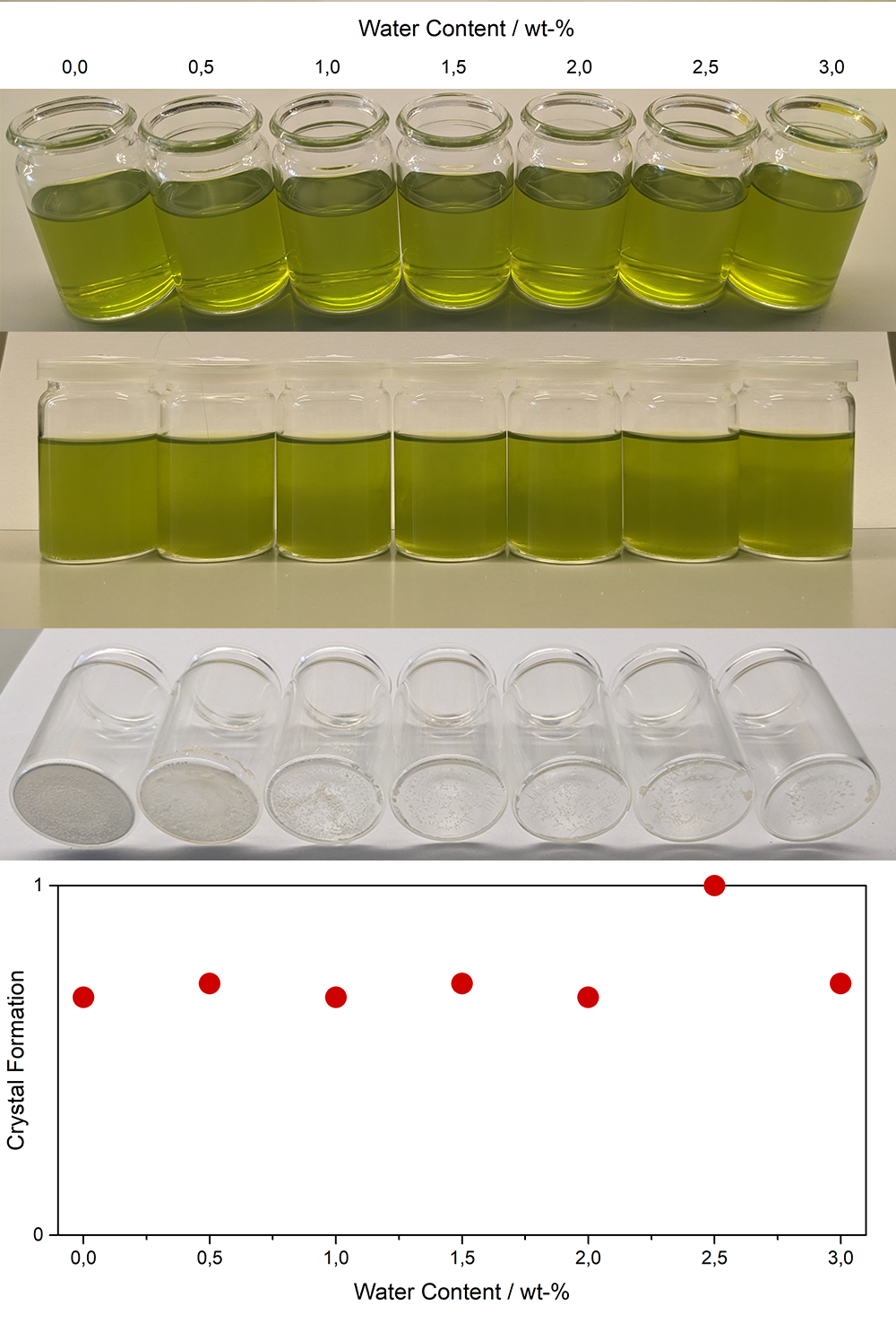
Wasseranalyse_CIELO_V2.png

What can be seen here?

First row:
The first row will demonstrate the aliquots of the EA going from chemically dry (0 %) to freezer dry (~2 %) to fridge dry (~2,3 %) and even no drying (~3 %). As no citric acid was added in the first row, there is nothing interesting ...

Second row:
Here this is a picture just 2-5 minutes after adding the citric acid to all 7 aliquots. First you might think not much happening, but if you observe closely you can see the clouds of Mescaline Citrate forming. It is the darker green stuff. Of course the Mescaline Citrate is not dark green, but instead the tiny crystallites will create light scattering and this simply will make the EA look darker. Now here comes the cool thing: you could draw a perfect line from 0 % at the bottom to 3 % at nearly max height. So in other words you can perfectly see how clouding gets stronger the more water is added. But that does not by itself mean Mescaline Citrate precipitation is stronger the more water is added - instead I believe this is more simply the precipitation speed. Citric Acid is very poorly soluble in 100 % dry EA. Therefore in order to get into contact with the Mescaline Freebase it must be dissolved first in order to undergo any acid-base-reaction. So the more water that is also in the EA the faster the EA can be dissolved and form Mescaline Citrate clouds. So I guess this is not definetly a sign that a lot of water is needed, but only that it would speed up the process.

Third row:
Here you see the final result after 1 week. Therefore all the CA should have dissolved and what can be seen should be Mescaline Citrate. Still I believed with very low water content maybe not all the CA was dissolved and would now add to the weight, introducing a potential error to yield-determination at low water content, but I think that was not the case actually as written below. In any way you can see that whatever crystals are seen look pretty bad at very low water content. It is more like a spread-out fine cover across the bottom, hard to scrape up if desired. Instead higher water content will grow the true CIELO crystals, but also some bigger chunks have been seen here. But as 1 week was given in time and also the chunks partially grew up the walls, I believed it might not be any CA anymore.

Fourth row:
Now here is the graph comparing all the weight. Of course just the whole container weight after-vs-before so it did not matter that the low-water-content-stuff was not removable. Here as told before it is simply set to 100 % regarding the highest yield. Now as I first was believing maybe I partially got some CA either at low water content (low solubility) or high water content (chunks) into this weight, I believe now this looks all like Mescaline Citrate. This is obviously not a true determination, but nearly all the samples have the same weight and actually except for 2,5 % the deviation is simply 1 or 2 mg, so basically NOTHING. Therefore I am pretty sure that all aliquots dropped their Mescaline Citrate quite efficiently, even the super-low water content samples, which might just take longer to complete the Freebase-CA-reaction.

Now of course the one very cool thing coming to eye is that the water content of 2,5 % is having the highest yield. That is also pretty close to what you would get when doing a fridge decant and found by Loveall and coworkers. I was actually thinking it looks a little bit weird, as I would also just assume if all the other samples dropped all their Alkaloids, then this sample should be also on the same level. But in any way if this sample is even higher than the other it is just even more congruent with the data that made up the CIELO Tek, so I guess then this might be no anomaly.

Of course this was just a small test with a small volume. The scales used for determining all weights (EA weight, water-volume, CA weight, precipitation weight) should be very precise and not induce any big error. But when more handling very small volumes like this then anyways a statistically relevant view can only be given when repeaing that whole stuff. But just as a small experiment it looks quite in accordance to the data that made up the CIELO Tek. Furthermore to me it looks like even a dry to nearly-dry EA will drop all the alkaloids. Solubility of CA in EA is not completely 0, so over time the full alkaloids might precipitate anyways. But as seen above and already confirmed by the CIELO Tek, a too low water content will not produce any "usable crystals", though technically what you might see is just the same alkaloid yield.


Now to get a better understanding how water might play a role in the formation of possible CIELO crystals another analysis was done.
 
Last edited:
2.) NMR-study on CIELO product(s)

1H-NMR of true CIELO crystals

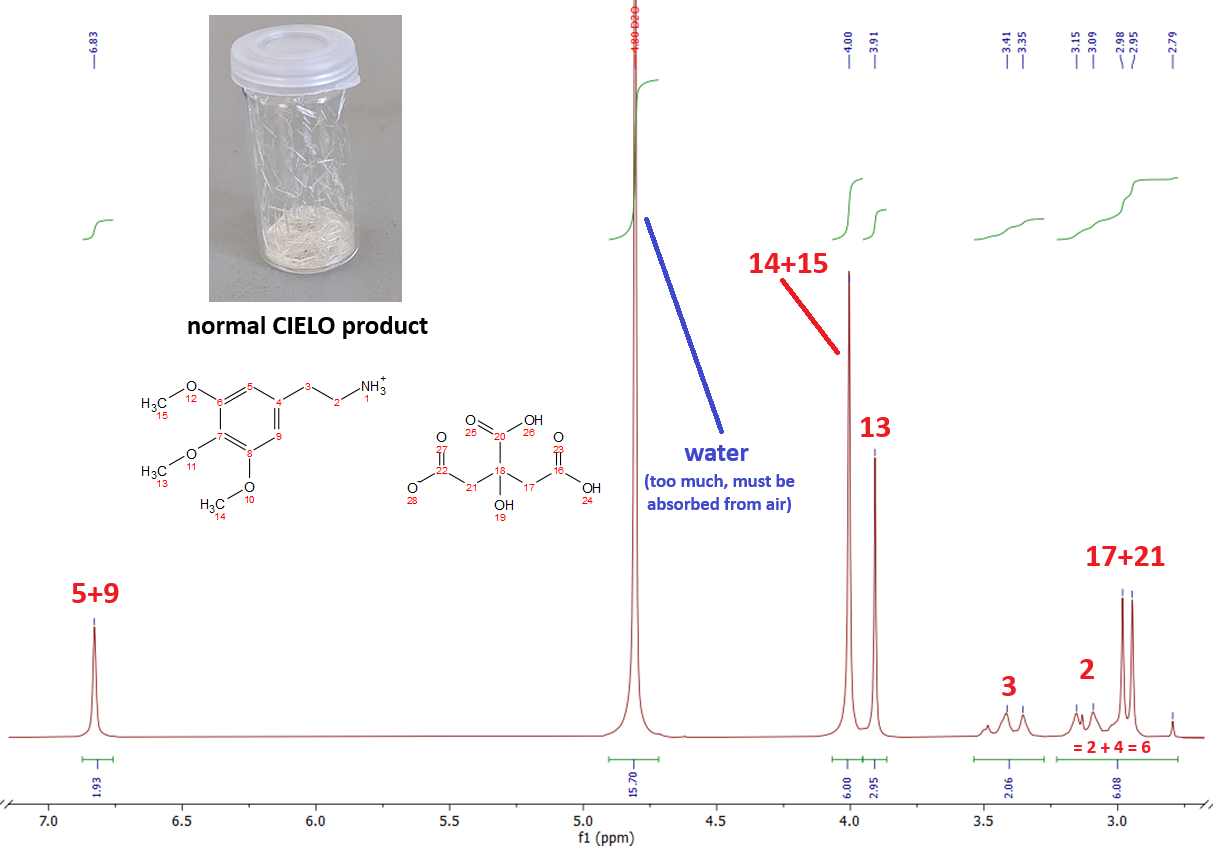
This is just a sample of the regular CIELO product. As usual, being a product extracted from nature, there can be variations in colour and crystal shape. But still if conducted the regular way, the crystals will overall have a quite similar colour and shape. Therefore this might be some representative sample to check the purity of a CIELO TEK product, similar to what Endlessness has already analyzed before.

CIELO_Product_-_beschriftet.png


As I told the spectrum shows way too much water, but that cannot be from the sample itself - as this is totally dry crystal. So sadly not a 3rd reference after the 2 former measurements from Endlessness, that have made Loveall create the Mescaline-Citrate x 1,5 H2O formula. But it was already confirmed 2x before so then maybe not too dramatic.

Besides it simply just shows all the expected Mescaline + Citric-Acid signals in exactly the expected ratio and integral. Nothing else found here. So in other words:

That sample is very pure Mescaline-Citrate - with only potential water traces like the old ones that were already analyzed before.


1H-NMR of CIELO goo

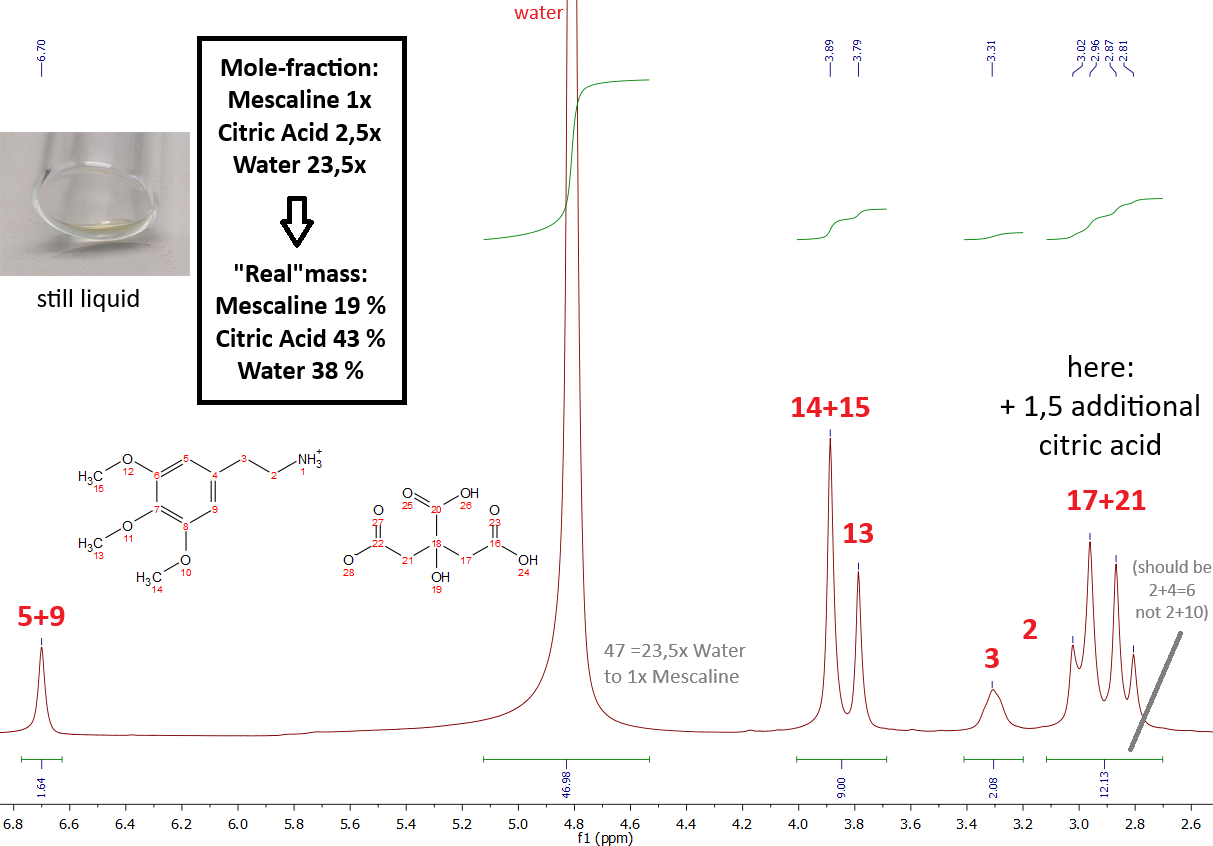
As written above this was some goo analyzed, but as long as a product like this does not have any truly refined shape or colour, it might actually still vary a lot. So if people receive goo from the CIELO tek, it cannot be stated that their sample will consist of totally the same molecules. Still, whatever is found here is very likely to just vary in a certain window from case to case, instead of completely lacking 1 or more components, while still having a comparable appeareance. 1H-NMR was used to determine the content of Mescaline-Citrate, Citric Acid and Water inside of the goo. After choosing a suitable signal for referencing, the molar ratio can be calculated between all possible components and then furthermore translated into a mass ratio, which is a much more usable value in real life:

1H_Mesc_Cit_Goo_Water_-_beschriftet.png

You can see a picture of the goo at the top left. It is still liquid and can flow slowly. In terms of molar constitution this goo is nearly all water with some small amounts of citric acid and even smaller amounts of mescaline inside. Due to many water molecules needed in order to solvatize (is that an english word?) these molecules, the viscosity is increased quite a lot as water molecules are not completely free-flowing anymore. Now translated to mass ratio it means that Mescaline is still the least component, but now making up nearly 1/5 of the whole goo. As we anyways wanted to precipitate it as Mescaline Citrate we can roughly add the same amount of Citric Acid to Mescaline Freebase and this means we get a mass of around 36 % Mescaline Citrate inside of the goo. The residual Citric Acid forms the excess Citric Acid, which is another ~ 26 (43-17) %. So not expressing the ratio by Mescaline Freebase and CA, but by Mescaline Citrate and excess CA the ratio is 1:1,4. The rest is water by 38 %.

I assume here too much water was present and even if all water was decanted, maybe this excess water "creeped into the crystals", which then did not grow along the walls, but formed the goo lagune on the bottom. Citric acid is super hygroscopic and as soon as some water was condensed at the bottom (goo) and not molecular dispersed in EA, it magically found its good friend and joined the party at the bottom. Still it seems only a part of the CA made it into the goo and more is also still inside the EA, as the excess of CA is normally more than 1,5x.

Now it was tested if this goo could be dried upon drying out. Leaving this goo for a long time ventilated will make it crystallize into some orange solid, still a little oily. In order to speed things up and also analyze the absolute maximum possible state it was dried at 40 mbar at 60 °C.


1H-NMR of dried CIELO goo

While drying bubbles formed and after a while the goo solidified into an orange solid. This solid did not flow at any times, so I believed it was now water-free. But man that was quite far from the truth:

1H_Mesc_Cit_Goo_trocknen_50C_50mbar_-_beschriftet.png

To make it short, the water content decreased from 38 % to 16 %. As Mescaline Citrate and CA cannot evaporate, it obviously increased the content of these 2 respectively in the resulting solid. But instead of being dry and therefore 60 % Mescaline Citrate and 30 % CA it was not much better, only increasing the amount of the desired product by a few %. Therefore even very strong drying will not remove all the water, as citric acid probably is the one that will not let go from its best friend.

Therefore people who might get a goo, it might not be wise to simply leave it until it will solidity. It will still contain a pretty huge load of water and even if it would be gone by any process, there is still no idea of how many excess citric acid is included, as it does not need to be a pretty close 1,4:1 Salt:CA like in this case.

Now in order to solve the problem a re-x can be done. Ethanol works, but IPA is cheaper I believe and equally available. Therefore when experiencing goo it is a good idea to do an IPA re-x. Solubility data is added here, although it might not help too much as you might not be able to weigh your goo and then you furthermore have no idea how much actual Mescaline Citrate is inside (though a content of 10-40 % will probably be normal?). Any way just use minimal amounts of IPA as usual with any re-x. But the important question would be now, is that stuff pure after doing this purification? Or is there still any contamination? It is perfectly white, while excess CA will cause a yellow coloration. Furthermore it is crystalline, so probably all the water is gone. But there is only 1 way to find out.


1H-NMR of IPA-Rex'ed CIELO goo

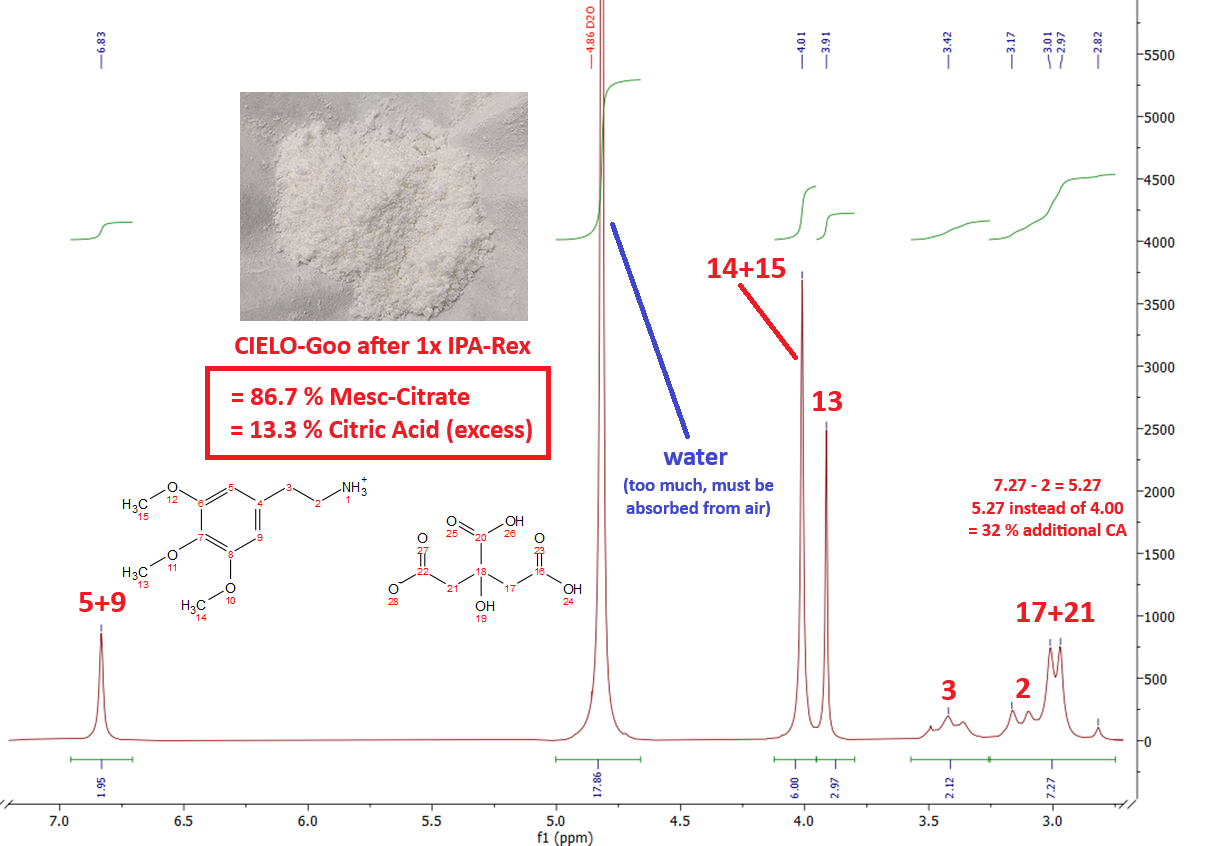
This is the CIELO Goo as analyzed above, but this time a IPA-Rex was performed. See at this thread to check how much IPA to use regarding solubility. The big question here is: As you have read at Sample 2 and 3, the problem with the Goo is an excess of Citric Acid and this probably causes also a lot of water to stick with the product. Therefore it could not even be completely removed, when going from Sample 2 to 3 (drying). So can a simple IPA Rex remove the excess Citric Acid and also the water?


IPA_REX_-_beschriftet.png


As before there is a big amont of water in this sample, but it must be absorbed from air when the sample was already inside of the D2O or it was already inside of the D2O in the first place. The crystals themself are totally dry and therefore it is nearly impossible that they still contain so much water, especially as they have basically the same amount like the original CIELO product from sample 1, that was already before proven to contain only traces by older measurements.

So no true conclusion on the water content here, but it should be minimal or even zero anyways, based on the optical appereance.

Anyways much more interesting is the Excess-Citric-Acid-amount. If you check the corresponding signal, it should be 4(+2=6) (compare to sample 1). If we check the signal here, we get (7.27-2=)5.27. So we have 32 % molar excess Citric Acid to the originally expected Citric Acid that belongs to our CIELO crystals. If we now calculate from molar ratio to mass ratio and compare it with the total expected mass, we get a purity of around


19 % -> 87 % (desired) Mescaline-Citrate
43 % -> 13 % (excess, still remaining) Citric Acid

So in other words:

When doing an IPA-Rex with a comparable sample as shown above, the Purity of the Mescaline-Citrate increased from 19 % (Sample 2, wet goo) to 86 % (Sample 4, white crystals chunks).

Actually for total purity and comparison, also the water content would be important to know. But I am sure in Sample 4 the water content is negligible, like in Sample 1. So that is why I am pretty sure that Purity of Sample 4 must be at least 80 %.

Therefore I would say:

IPA-Rex is a very easy emergency-process in case you get a CIELO-Goo. Some Citric Acid might remain, but you might just do the IPA Rex a 2nd time. Maybe I would even not care about this and simply eat 10 % more of your product, as the purity should not be much worse than what we have here. Still, to be totally safe you might just do the whole process 2x, but collect the IPA surfactant as it still might contain a LITTLE Mescaline-Citrate, which you can still put into your next CIELO extraction. I think that is much better than putting the whole Goo into the next CIELO round, as now this shows with IPA Rex you can easily extract the actives with high purity out of it.


Just a small disclaimer to know when doing the IPA Rex:
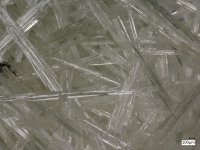
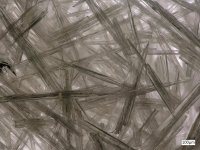
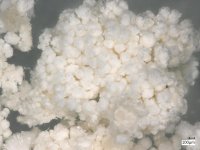
Most of the Mescaline Citrate will precipitate as big chunks at the bottom as you know it. But there will be also a very fine cloudy powder dispersed in the IPA. So if you just decant it, you will loose some of your product. Instead if you dont have a clear IPA after 1 night in the fridge, you should pour it through a filter and then add it later to your chunks again. The picture received from above is from exactly this stuff, that's why it looks so perfectly finely ground.
 
Last edited:
Small bonus:

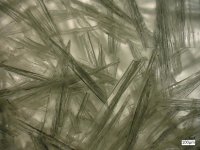
First normal CIELO product
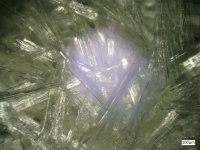
Second chunky CIELO IPA re-x precipitation
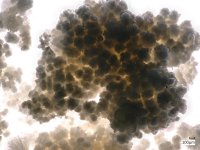
Third cloudy fine CIELO IPA re-x powder
 

Attachments

  • MC+03.jpg
    MC+03.jpg
    254.2 KB · Views: 8
  • MC+04.jpg
    MC+04.jpg
    270.9 KB · Views: 8
  • MC+13.jpg
    MC+13.jpg
    276 KB · Views: 8
  • MC+14.jpg
    MC+14.jpg
    285 KB · Views: 10
  • MC+Rex+Fest+08.jpg
    MC+Rex+Fest+08.jpg
    196.9 KB · Views: 10
  • MC+Rex+Fest+09.jpg
    MC+Rex+Fest+09.jpg
    197.8 KB · Views: 10
  • MC+Rex+Snow+05.jpg
    MC+Rex+Snow+05.jpg
    189.1 KB · Views: 8
  • MC+Rex+Snow+06.jpg
    MC+Rex+Snow+06.jpg
    232 KB · Views: 9
Thank you BW!

Endlessness did an NMR analysis of CIELo xtals and found 1.5 molecules of water per molecule of mono-mescaline citrate (~6% water). We think the needles are a hydrared salt. Looking forward to your data see if it confirms the standard cielo xtals water content, including the IPA re-X powder data which would be first of its kind.
 
Would hope to get that soon. Worst case I can bring at least the re-x sample to another friend for chromatography, which could at least confirm if the IPA rex removes the citric acid. About water content there will be then no info, but I guess for the rex it anyways looks super dry. But for the true CIELO product there intersting question about water content can't be answered by that :((


PS: Crap his machine works by absorption detection at 214 nm and citric acid is invisible at this wavelength :twisted: So there is no Plan B ... A detector like RID refractive index change would be needed ...
 
Hello on the new Nexus and good news!

I had those last samples stored for months as I'm not part of any institute anymore and cant do any measurement. But now after sending it to Endlessness, he could do some Analysis on this and that means the thread here is complete 🫡 That was also the last experiment that I had in mind, so it fits very well with not being able to do any experiments anymore, anyways 🥴🥴

Both samples have a lot of water inside. That should not be from the sample itself, because water is even as much as the dried goo. So probably it was absorbed by ambient air when it was already put into the D2O or the D2O already contained quite some water. Still, the most important question of those 2 last samples are if an IPA Rex can purify Cielo Goo as a rescue option to get rid of the excess Citric Acid and that can still be answered.
 
Last edited:
2.) NMR-study on CIELO product(s)

1H-NMR of true CIELO crystals

This is just a sample of the regular CIELO product. As usual, being a product extracted from nature, there can be variations in colour and crystal shape. But still if conducted the regular way, the crystals will overall have a quite similar colour and shape. Therefore this might be some representative sample to check the purity of a CIELO TEK product, similar to what Endlessness has already analyzed before.

CIELO_Product_-_beschriftet.png


As I told the spectrum shows way too much water, but that cannot be from the sample itself - as this is totally dry crystal. So sadly not a 3rd reference after the 2 former measurements from Endlessness, that have made Loveall create the Mescaline-Citrate x 1,5 H2O formula. But it was already confirmed 2x before so then maybe not too dramatic.

Besides it simply just shows all the expected Mescaline + Citric-Acid signals in exactly the expected ratio and integral. Nothing else found here. So in other words:

That sample is very pure Mescaline-Citrate - with only potential water traces like the old ones that were already analyzed before.


1H-NMR of CIELO goo

As written above this was some goo analyzed, but as long as a product like this does not have any truly refined shape or colour, it might actually still vary a lot. So if people receive goo from the CIELO tek, it cannot be stated that their sample will consist of totally the same molecules. Still, whatever is found here is very likely to just vary in a certain window from case to case, instead of completely lacking 1 or more components, while still having a comparable appeareance. 1H-NMR was used to determine the content of Mescaline-Citrate, Citric Acid and Water inside of the goo. After choosing a suitable signal for referencing, the molar ratio can be calculated between all possible components and then furthermore translated into a mass ratio, which is a much more usable value in real life:

1H_Mesc_Cit_Goo_Water_-_beschriftet.png

You can see a picture of the goo at the top left. It is still liquid and can flow slowly. In terms of molar constitution this goo is nearly all water with some small amounts of citric acid and even smaller amounts of mescaline inside. Due to many water molecules needed in order to solvatize (is that an english word?) these molecules, the viscosity is increased quite a lot as water molecules are not completely free-flowing anymore. Now translated to mass ratio it means that Mescaline is still the least component, but now making up nearly 1/5 of the whole goo. As we anyways wanted to precipitate it as Mescaline Citrate we can roughly add the same amount of Citric Acid to Mescaline Freebase and this means we get a mass of around 36 % Mescaline Citrate inside of the goo. The residual Citric Acid forms the excess Citric Acid, which is another ~ 26 (43-17) %. So not expressing the ratio by Mescaline Freebase and CA, but by Mescaline Citrate and excess CA the ratio is 1:1,4. The rest is water by 38 %.

I assume here too much water was present and even if all water was decanted, maybe this excess water "creeped into the crystals", which then did not grow along the walls, but formed the goo lagune on the bottom. Citric acid is super hygroscopic and as soon as some water was condensed at the bottom (goo) and not molecular dispersed in EA, it magically found its good friend and joined the party at the bottom. Still it seems only a part of the CA made it into the goo and more is also still inside the EA, as the excess of CA is normally more than 1,5x.

Now it was tested if this goo could be dried upon drying out. Leaving this goo for a long time ventilated will make it crystallize into some orange solid, still a little oily. In order to speed things up and also analyze the absolute maximum possible state it was dried at 40 mbar at 60 °C.


1H-NMR of dried CIELO goo

While drying bubbles formed and after a while the goo solidified into an orange solid. This solid did not flow at any times, so I believed it was now water-free. But man that was quite far from the truth:

1H_Mesc_Cit_Goo_trocknen_50C_50mbar_-_beschriftet.png

To make it short, the water content decreased from 38 % to 16 %. As Mescaline Citrate and CA cannot evaporate, it obviously increased the content of these 2 respectively in the resulting solid. But instead of being dry and therefore 60 % Mescaline Citrate and 30 % CA it was not much better, only increasing the amount of the desired product by a few %. Therefore even very strong drying will not remove all the water, as citric acid probably is the one that will not let go from its best friend.

Therefore people who might get a goo, it might not be wise to simply leave it until it will solidity. It will still contain a pretty huge load of water and even if it would be gone by any process, there is still no idea of how many excess citric acid is included, as it does not need to be a pretty close 1,4:1 Salt:CA like in this case.

Now in order to solve the problem a re-x can be done. Ethanol works, but IPA is cheaper I believe and equally available. Therefore when experiencing goo it is a good idea to do an IPA re-x. Solubility data is added here, although it might not help too much as you might not be able to weigh your goo and then you furthermore have no idea how much actual Mescaline Citrate is inside (though a content of 10-40 % will probably be normal?). Any way just use minimal amounts of IPA as usual with any re-x. But the important question would be now, is that stuff pure after doing this purification? Or is there still any contamination? It is perfectly white, while excess CA will cause a yellow coloration. Furthermore it is crystalline, so probably all the water is gone. But there is only 1 way to find out.


1H-NMR of IPA-Rex'ed CIELO goo

This is the CIELO Goo as analyzed above, but this time a IPA-Rex was performed. See at this thread to check how much IPA to use regarding solubility. The big question here is: As you have read at Sample 2 and 3, the problem with the Goo is an excess of Citric Acid and this probably causes also a lot of water to stick with the product. Therefore it could not even be completely removed, when going from Sample 2 to 3 (drying). So can a simple IPA Rex remove the excess Citric Acid and also the water?


IPA_REX_-_beschriftet.png


As before there is a big amont of water in this sample, but it must be absorbed from air when the sample was already inside of the D2O or it was already inside of the D2O in the first place. The crystals themself are totally dry and therefore it is nearly impossible that they still contain so much water, especially as they have basically the same amount like the original CIELO product from sample 1, that was already before proven to contain only traces by older measurements.

So no true conclusion on the water content here, but it should be minimal or even zero anyways, based on the optical appereance.

Anyways much more interesting is the Excess-Citric-Acid-amount. If you check the corresponding signal, it should be 4(+2=6) (compare to sample 1). If we check the signal here, we get (7.27-2=)5.27. So we have 32 % molar excess Citric Acid to the originally expected Citric Acid that belongs to our CIELO crystals. If we now calculate from molar ratio to mass ratio and compare it with the total expected mass, we get a purity of around


19 % -> 87 % (desired) Mescaline-Citrate
43 % -> 13 % (excess, still remaining) Citric Acid

So in other words:

When doing an IPA-Rex with a comparable sample as shown above, the Purity of the Mescaline-Citrate increased from 19 % (Sample 2, wet goo) to 86 % (Sample 4, white crystals chunks).

Actually for total purity and comparison, also the water content would be important to know. But I am sure in Sample 4 the water content is negligible, like in Sample 1. So that is why I am pretty sure that Purity of Sample 4 must be at least 80 %.

Therefore I would say:

IPA-Rex is a very easy emergency-process in case you get a CIELO-Goo. Some Citric Acid might remain, but you might just do the IPA Rex a 2nd time. Maybe I would even not care about this and simply eat 10 % more of your product, as the purity should not be much worse than what we have here. Still, to be totally safe you might just do the whole process 2x, but collect the IPA surfactant as it still might contain a LITTLE Mescaline-Citrate, which you can still put into your next CIELO extraction. I think that is much better than putting the whole Goo into the next CIELO round, as now this shows with IPA Rex you can easily extract the actives with high purity out of it.


Just a small disclaimer to know when doing the IPA Rex:
Most of the Mescaline Citrate will precipitate as big chunks at the bottom as you know it. But there will be also a very fine cloudy powder dispersed in the IPA. So if you just decant it, you will loose some of your product. Instead if you dont have a clear IPA after 1 night in the fridge, you should pour it through a filter and then add it later to your chunks again. The picture received from above is from exactly this stuff, that's why it looks so perfectly finely ground.

Thank you! While we couldn't confirm the x1.5 H2O hydration, confirming independently that we do indeed have monomescaline citrate is very important!
 
1.) CIELO crystal formation vs. water content

Here is just a small test to check what is the influence of the water content on the crystal formation. Loveall and coworkers found a nice sweet spot at around 2,3 wt-% of water, which should be the fridge-level equilibrium of water miscibility with Ethyl Acetate. So a CIELO extraction was done and the resulting EA was completely dried with MgSO4. A prior brine wash was not done, as this could probably remove some Mescaline (it's quite a little soluble in water). Afterwards simply the corresponding amount of water was added - not by volume, but by mass, so it is quite comparable to the water-EA-table of the CIELO tek shown here. Afterwards Citric Acid was added in accordance with the mass ratio of CA to EA also given in the CIELO TEK. Then pictures of the corresponding crystallization were simply taken and the weight shown in that graph. Note that the Y-Axis is rather random, it was just normalized with it's highest number to 1. Totaly yield in % would be cooler, but the EA was taken from the first extraction pull and not from all pulls combined, so calculating back to a full yield in % is not possible, allthough when scaling up it would be a roughly 0,4 % of Mescaline Citrate in that first pull, which might make sense. In any way, absolute values are not the intersting stuff here.

Wasseranalyse_CIELO_V2.png

What can be seen here?

First row:
The first row will demonstrate the aliquots of the EA going from chemically dry (0 %) to freezer dry (~2 %) to fridge dry (~2,3 %) and even no drying (~3 %). As no citric acid was added in the first row, there is nothing interesting ...

Second row:
Here this is a picture just 2-5 minutes after adding the citric acid to all 7 aliquots. First you might think not much happening, but if you observe closely you can see the clouds of Mescaline Citrate forming. It is the darker green stuff. Of course the Mescaline Citrate is not dark green, but instead the tiny crystallites will create light scattering and this simply will make the EA look darker. Now here comes the cool thing: you could draw a perfect line from 0 % at the bottom to 3 % at nearly max height. So in other words you can perfectly see how clouding gets stronger the more water is added. But that does not by itself mean Mescaline Citrate precipitation is stronger the more water is added - instead I believe this is more simply the precipitation speed. Citric Acid is very poorly soluble in 100 % dry EA. Therefore in order to get into contact with the Mescaline Freebase it must be dissolved first in order to undergo any acid-base-reaction. So the more water that is also in the EA the faster the EA can be dissolved and form Mescaline Citrate clouds. So I guess this is not definetly a sign that a lot of water is needed, but only that it would speed up the process.

Third row:
Here you see the final result after 1 week. Therefore all the CA should have dissolved and what can be seen should be Mescaline Citrate. Still I believed with very low water content maybe not all the CA was dissolved and would now add to the weight, introducing a potential error to yield-determination at low water content, but I think that was not the case actually as written below. In any way you can see that whatever crystals are seen look pretty bad at very low water content. It is more like a spread-out fine cover across the bottom, hard to scrape up if desired. Instead higher water content will grow the true CIELO crystals, but also some bigger chunks have been seen here. But as 1 week was given in time and also the chunks partially grew up the walls, I believed it might not be any CA anymore.

Fourth row:
Now here is the graph comparing all the weight. Of course just the whole container weight after-vs-before so it did not matter that the low-water-content-stuff was not removable. Here as told before it is simply set to 100 % regarding the highest yield. Now as I first was believing maybe I partially got some CA either at low water content (low solubility) or high water content (chunks) into this weight, I believe now this looks all like Mescaline Citrate. This is obviously not a true determination, but nearly all the samples have the same weight and actually except for 2,5 % the deviation is simply 1 or 2 mg, so basically NOTHING. Therefore I am pretty sure that all aliquots dropped their Mescaline Citrate quite efficiently, even the super-low water content samples, which might just take longer to complete the Freebase-CA-reaction.

Now of course the one very cool thing coming to eye is that the water content of 2,5 % is having the highest yield. That is also pretty close to what you would get when doing a fridge decant and found by Loveall and coworkers. I was actually thinking it looks a little bit weird, as I would also just assume if all the other samples dropped all their Alkaloids, then this sample should be also on the same level. But in any way if this sample is even higher than the other it is just even more congruent with the data that made up the CIELO Tek, so I guess then this might be no anomaly.

Of course this was just a small test with a small volume. The scales used for determining all weights (EA weight, water-volume, CA weight, precipitation weight) should be very precise and not induce any big error. But when more handling very small volumes like this then anyways a statistically relevant view can only be given when repeaing that whole stuff. But just as a small experiment it looks quite in accordance to the data that made up the CIELO Tek. Furthermore to me it looks like even a dry to nearly-dry EA will drop all the alkaloids. Solubility of CA in EA is not completely 0, so over time the full alkaloids might precipitate anyways. But as seen above and already confirmed by the CIELO Tek, a too low water content will not produce any "usable crystals", though technically what you might see is just the same alkaloid yield.


Now to get a better understanding how water might play a role in the formation of possible CIELO crystals another analysis was done.

Great work!

It looks like while I developed the TEK I was too inpatient with 0% water. I waited a couple days and din't see much happening. The ~2% water samples behaved much better as you have shown. I called the fully dried extract experimentally "problematic" which is confirmed with your results, and I really like your more thorough analysis and understanding.

I wonder at what % water beyond 3% goo starts? I may do the experiment.

I wonder what % water an extract dried with sodium carbonate has?
 
Back
Top Bottom