
• Members of the previous forum can retrieve their temporary password here, (login and check your PM).

Cleaning harmalas with canola oil. Results-->White

Migrated topic.
Although the pure white results of this TEK are amazing, I’m beginning to wonder if it’s really worth it. Here’s why:

The pigmented “impurities” in a caapi extraction may be alkaloids. Whatever they are, they dissolve in acidic water and precipitate in basic water, so they might very well be alkaloids and, who knows, they might even be active in some way.

The yields reported so far are discouraging. A yield of 70% on what started out as a fairly clean product suggests to me that more than pigments are being removed. And this leads to my next concern – we don’t really know what is being removed and what isn’t. For all we know, harmine is salted out into the acidic water, but THH stays with the oil. Without a “before and after” analysis of some crude product, we don’t really know what is being pulled and what remains behind.

I’m also concerned about the extended heating at relatively high temperature – it seems like it might be possible that some alkaloids are breaking down during the heating process. The fact that the oil gets so dark, even when there are initially only small amounts of impurities present, makes me wonder if the heating process isn’t creating some new impurities (this also might explain why the yields are so low).

I’ve always wanted to find a technique that yielded very pure harmala alkaloids, and with this TEK we just might have it, but there are still lots of questions to be answered. As soon as I get my canola oil, I’ll try again on some rue extracted alkaloids and report my results.
 
I'll definitely give it another go if you say your oil was hot when you salted out, just let me know.
I'd say it was warm, but I doubt it would be better when it comes to purity if you do it when hot. Could you post a picture of what you got?

The pigmented “impurities” in a caapi extraction may be alkaloids. Whatever they are, they dissolve in acidic water and precipitate in basic water, so they might very well be alkaloids and, who knows, they might even be active in some way.
It is possible. My thoughts are that they do not precipitate out in basic conditions and that they get very easily trapped within the freebase harmine. That may be why it gets hard to clean the harmalas after a certain point. With this method, these impurities stay behind in the oil layer.

I got ~24% loss on my harmine when doing this method. And if it was just harmine and impurities, then what was left behind could not be harmine, it must be something else. I guess I could redo the process with the cleaner product and see what my loss would be then and if it yielded an even purer product.
 
Dagger said:
I got ~24% loss on my harmine when doing this method. And if it was just harmine and impurities, then what was left behind could not be harmine, it must be something else. I guess I could redo the process with the cleaner product and see what my loss would be then and if it yielded an even purer product.
Yes – that would be an excellent experiment. If there is very little loss when repeating the purification, then it’s more reasonable that the loss is some sort of impurities (but 24% impurities? what could it be?).

If you have significant loss again, then the oil probably doesn’t release alkaloid salts very easily. If the oil turns dark again after heating, then the heat is probably altering/destroying the alkaloids.

Please try this and let us know what happens!
 
gibran2 said:
Although the pure white results of this TEK are amazing, I’m beginning to wonder if it’s really worth it. Here’s why:

The pigmented “impurities” in a caapi extraction may be alkaloids. Whatever they are, they dissolve in acidic water and precipitate in basic water, so they might very well be alkaloids and, who knows, they might even be active in some way.

The yields reported so far are discouraging. A yield of 70% on what started out as a fairly clean product suggests to me that more than pigments are being removed. And this leads to my next concern – we don’t really know what is being removed and what isn’t. For all we know, harmine is salted out into the acidic water, but THH stays with the oil. Without a “before and after” analysis of some crude product, we don’t really know what is being pulled and what remains behind.

I’m also concerned about the extended heating at relatively high temperature – it seems like it might be possible that some alkaloids are breaking down during the heating process. The fact that the oil gets so dark, even when there are initially only small amounts of impurities present, makes me wonder if the heating process isn’t creating some new impurities (this also might explain why the yields are so low).

I’ve always wanted to find a technique that yielded very pure harmala alkaloids, and with this TEK we just might have it, but there are still lots of questions to be answered. As soon as I get my canola oil, I’ll try again on some rue extracted alkaloids and report my results.

Nearly the same concerns have been raised about your caapi tek and the yields you claim to get. There is no real way to know what you are precipitating in your tek, the composition of your final product could very well contain alkaloids or precipitates other than harmalas, and bio-assay, as with this tek, is not enough to determine composition.

A yield of 70% is not bad at all if you end up with a product as pure as is pictured - pigments, oils, all sorts of stuff could be removed as a result. We have no real way to tell - but we can settle on a reasonable number - i'd be willing to lose a certain percentage of my initial product to end up with a very pure extract, and 30% is approaching something reasonable in my eyes.
 
narmz said:
Nearly the same concerns have been raised about your caapi tek and the yields you claim to get. There is no real way to know what you are precipitating in your tek, the composition of your final product could very well contain alkaloids or precipitates other than harmalas, and bio-assay, as with this tek, is not enough to determine composition.

A yield of 70% is not bad at all if you end up with a product as pure as is pictured - pigments, oils, all sorts of stuff could be removed as a result. We have no real way to tell - but we can settle on a reasonable number - i'd be willing to lose a certain percentage of my initial product to end up with a very pure extract, and 30% is approaching something reasonable in my eyes.
That’s not entirely true. First of all, it’s not really my TEK. It’s a simple A/B extraction to which I added photos. You’ll notice in the wiki that it isn’t called “Gibran’s TEK” – I didn’t want to take credit for a technique that’s been around for over 150 years.

All harmala alkaloids are soluble in acidic water, and entirely or mostly insoluble in basic water. The caapi extraction TEK uses these facts to ensure that harmala alkaloids are indeed extracted. There may be other alkaloids or other non-alkaloid substances that are soluble in acidic water and insoluble in basic water. If that’s the case, then those substances are also extracted.

The caapi extraction TEK, when done correctly, extracts ALL substances that are soluble in acidic water and insoluble in basic water and nothing else.

The concern I have about this oil purification method is that we don’t know what remains in the oil and what goes into the acidic solution. It may be that caapi extractions, regardless of technique, indeed contain 25% or more impurities. It may be that there are inactive alkaloids in caapi that aren’t generally discussed in the literature. It may be that a significant amount of harmala alkaloids remain in the oil. It may be a lot of things. All we know for sure is that the TEK separates entirely or partially one or more colorless (white) compounds from one or more pigmented compounds.

If crude caapi extract contains, let’s say, 3% pigmented inactive alkaloids, then we would have to question if 30% loss is acceptable to get a very pure product. I suppose it all depends on how the product is going to be used.
 
Ok. Did a second canola oil cleaning on the product. Results were 460mg from 740, that is a 280mg loss. I am not very happy with that kind of loss. Will post more on this later.

On a happier note, I tested another method for cleaning harmalas today, and was happily surprised with the results.

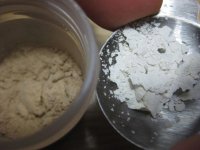
A sneak peak on the results of this new method that does not involve oils and is kitchen safe. The left picture is from a 2nd purification with regular water precipitation. The right picture is from one further purification with this new method:
 

Attachments

  • New+purifying+method.JPG
    New+purifying+method.JPG
    34.2 KB · Views: 0
Back
Top Bottom