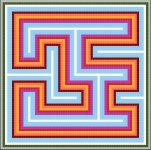
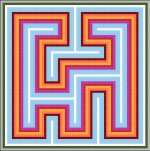
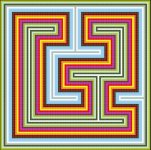
Thanks for your efforts there HT! It's akin to at least one of the ideas I've had regarding possible notation; there are several different matrix-based approaches and my observation is that they describe the path from an exterior perspective.
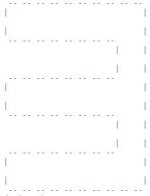
Here's another kind of matrix, which describes both the path and the dividing lines:
Code:
.1.1.1.1.1.1. ._._._._._._.
1.0.0.0.0.0.1 |. . . . . .|
.0.1.1.1.1.0. . ._._._._. .
1.0.0.0.0.1.1 | . . . . | |
.1.1.1.1.0.0. ._._._._. . .
1.0.0.0.0.1.1 |. . . . .|.|
.0.1.1.1.1.0. . ._._._._. .
1.0.0.0.0.1.1 |. . . . .|.|
.1.1.1.1.0.0. ._._._._. . .
1.0.0.0.0.1.1 |. . . . .|.|
.0.1.1.1.1.0. . ._._._._. .
1.0.0.0.0.0.1 |. . . . . .|
.1.1.1.1.1.1. ._._._._._._.
There will, of course, always be 36 zeroes (the path being through 36 squares) and 40 ones (the dividing lines including the complete perimeter). Is it a coincidence that their total, 76, matches the calculated number of permutations of one particular group of glyphs ('AF' - see below)? Probably.
But for me the biggest question is whether I can 'distill the essence' of some kind of notation in such a way that it eliminates rotational and mirror symmetries. Finding a generally applicable method for defining the start point of any glyph would be one way of achieving this, as long as the path direction can be rigorously set as well.
I've now something like eight pages of hand-written notes in need of typing up that I'll share in précis form here sometime soon {OK, it seems I've covered most of it in the wall of text that follows...} Mostly I've concentrated on systematically defining what possible glyphs there are that fit the definition 'halvable', which basically means that they have at least one line that cuts the glyph in half which the path crosses only twice.
For that analysis I've developed a notation base on where the path crosses the dividing line. These crossing points have been assigned the letters A to F, since there are six possible places (this was done to make it easier to handle the hand drawn notes, rather than for machine-readability). It turns out that there are three main groups of varying sizes: AB, AD and AF. There is some redundancy between and within groups, particularly AF, the largest group. There is another, entirely trivial group, CD, which is wholly redundant because all of the glyphs that meet that designation are also contained within the group AF (unless, of course, I might choose for convenience's sake - or whatever reason - to reduce the size of group AF - and I've been 'I-ching' to tell you this {groan} - from 64 glyphs [to which it was already reduced from 76 possibilities through internal and external redundancies]. That's a bit Linnaean, though

)
The various halves I have assigned, in as near a systematic way as possible, numbers such that each halvable glyph can be defined precisely by this alphanumeric code, e.g. AF(6,4). Halves AF 1 to 6 are asymmetric so their mirror images must also be taken into account, thus AF(6,4m) also exists and has one of its halves as the mirror image of that found in AF(6,4). When two similar asymmetric halves are combined it seems pertinent to note whether they are combined to give rotational symmetry or mirror symmetry, so the codes are, e.g., AF(1,1r) and AF(1,1m). There are four further, mirror-symmetric, AF halves which do not require this symmetry identifier, e.g. AF(10,2). Groups AB and AD can only combine in one way with their respective 'mating types' in contrast with AF's flippability. The redundant group CD is also flippable.
Having found 140 unique glyphs so far (and through the systematic approach having noticed and eliminated some duplicates in my original sketches) this highlights the remaining group, for the moment designated 'X', which can be split up into further subgroups using a variation of the A...F notation by splitting off one third of the glyph along a 'valid' dividing line (i.e. one with only two path crossings). In practice, there can be up to three such dividing lines in an 'X' glyph. I define them as, e.g. X(AB/AF) if the splitting lines are perpendicular and X(AD,BE) if the lines are parallel. Perpendicular and parallel division can occur at the same time in a glyph: X(AB,AF/AF).
There are some 'X' glyphs that do not contain any valid splitting line; these naturally fall into the category X(X). I'm planning to analyse the 'X' group by splitting the glyphs into quarters and systematically defining all the permissible permutations of these quarters. It would be great if I could think of - or be informed of

- a possible shortcut for this. I shall find it very satisfying to get a final answer as to how many possible glyphs there are. I'm feeling a little daunted about how I'll deal with symmetry questions in the 'X' group, however.
I hope this makes sense to at least some of you - I'll add some illustrations to clarify things later on.
And speaking of illustration in terms of the project as a whole, if later the animations and colour changes are essential data-defined parameters, Jacubey's point about the validity of including reflections and rotations of glyphs becomes more valid as I foresee this will add to the aesthetic appeal while simultaneously simplifying the task of encoding the glyphs, at the cost of having nearly eight times as many glyphs to deal with. I suspect that defining all the possible quarter-glyphs will help a lot in this direction. I mean, automation of this task is great but I would like to be able to immediately identify glyphs that are congruent despite having a different data identity.


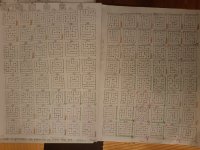


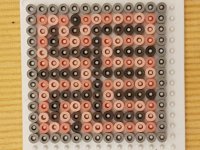




 I'm pleased because it was specifically design to have - or rather, lack, certain properties. So, should I cut to the chase and post that one first - or would we prefer a montage of the developments?
 - although I did also envisage its potential as some form of systematic ideographic script - like, what if it could be used as a tool for emotional language or something?