PresentlyAbsent
Corporal Habeus
Hello!
I followed the Tao of Rue Extraction and successfully extracted harmala alkaloids. My main question is:
What do I do with the filtered solution that is a product of the Manske steps? The guide says to keep this solution and "reduce it some more to 'push' any stray alkaloids out"
I reduced the solution by a lot (perhaps too much) and a lot of salt precipitated. This makes sense as it was roughly 10 g NaCl per 100 mL. But it's not clear what to do after its reduced. My intuition tells me to redissolve it in hot water and base it with sodium carb. But would I then need to wash the solution to get rid of the excess salt?
Anyway, my extraction was successful. I got about 1 g of harmalas from 75 g of seeds (roughly 1% to 1.5% yield). This is quite a bit less than the 3-5% yield I expected. The low yield is probably due to some harmalas still in the Manske filtered solution. I also expected a low yield since it's my first (complete) extraction and I spilled a bit and made a number of unnecessary container transfers.
I took some pictures to document the extraction. The step numbers match the steps in the ToRE.
• Step 1, 2, 3, & 4
I started with 75 g of rue seeds from. I did not grind the seeds. I tried grinding before, it made filtering a nightmare. I think I could handle it a second time around now that I have more experience filtering, but I've elsewhere on the Nexus that it doesn't make a significant difference. When filtering the solid seeds from the tea I used a course stainless steel (SS) mesh, a fine SS mesh, and lastly paper coffee filters. I skipped the cotton balls in the funnel filtering method. I think my fine metal mesh is roughly the same pore size as the cotton. I'm not sure on the mesh size - but the fine mesh is rather soft and flexible.
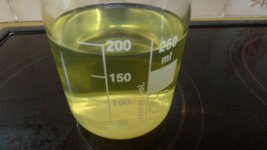
IMG: This is the tea after it had been filtered through coffee filters. This is 5 seperate 40 min boils .
• Step 5: Base
In a seperate bowl, I combined room-temp water with sodium carb. I made the sodium carb by backing sodium bicarb (baking soda) in an oven at 400°F for 2 hours. Internet sources said 200°F for an hour works, but I wanted to be sure it all converted. I poured this solution in the tea and an immediate color change from yellowish-brown to yellowish-cream occured, as expected.
IMG: This is after adding sodium carb solution to the tea
About 24 hours later, the mixture settled. I decanted the liquid and filtered the solids with coffee filters.
IMG: Solids after adding base for the first time.
IMG: I redissolved the solution in a hot 3:1 mixture of water:vinegar and filtered again.
• Step 6: Manske
I followed the "recommended" Manske procedure. That is, mix 10 g of salt per 100 mL solution. I had about 90 mL so I added 9 grams to the hot solution. I let the solution cool slowly to room temp, then left in the fridge over night. The crystals stopped growing after around 5 hours, but I let it go over night.
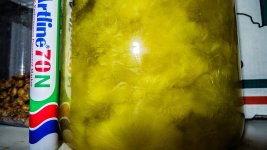
IMG: Crystals in the jar.
IMG: After decanting.
• Setp 7: Filter
IMG: After filering the first Manske.
IMG: Close up shot of crystals on coffee filter
• Step 8,9:
I redissolved the crystals in a minimum amount of water and added another 9 g of NaCl for my 90 mL. However, when I added the salt yellow crystals started forming immediately. I believe this is because the solution was warm and not hot. After it cooled completely and I filtered, the crystals were very thin and very yellow (butterscotch as some say). I was a little disappointed because I expected them to be even redder than from the first Manske.
IMG: Crystals filtered from my second Manske step spread out on a coffee filter.
I decided to re-Manske. This time I made sure the solution was piping hot and I also dissolved the crystals in about 1.5 times more water/vinegar to allow room for the crystals to grow.
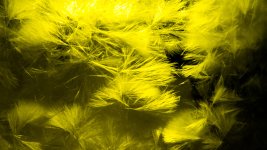
IMG:Crystals in a jar after my third Manske attempt. Very pretty.
IMG: The same crystals filtered and layed out on the filter paper.
The guide calls for the Basing/Manske-ing steps to be repeated at least one more time to increase purity. I was more concerned about completing the extraction that I decided to skip straight to the final basing (also I was pretty exhausted by this time -- this was day 4 of the extraction).
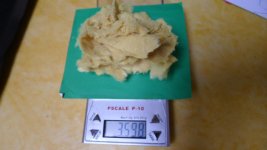
After basing with sodium carb (I decided not to seperate harmine and harmaline), I washed and dried the alkaloids and got a nice looking tan powder.
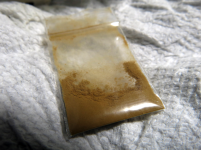
IMG: Final extracted harmala alkaloids.
I couldn't wait so I vaped about 25 mg of the harmalas in my GVG. I found I had to remove the diffuser to get enough heat on them. About 5 min later I vaped ~20 mg of DMT. I did not break through but I felt the calming of the harmalas and the experience definitely lasted longer. I very excited to try pharmahuasca. While vaping DMT is incredible, it is so short and sometimes holding my breath on the third or fourth toke is hard. Breathing just feels so amazing!
Anyway, I just wanted to say I'm very grateful for the Nexus as it has been a tremendous resource.
I followed the Tao of Rue Extraction and successfully extracted harmala alkaloids. My main question is:
What do I do with the filtered solution that is a product of the Manske steps? The guide says to keep this solution and "reduce it some more to 'push' any stray alkaloids out"
I reduced the solution by a lot (perhaps too much) and a lot of salt precipitated. This makes sense as it was roughly 10 g NaCl per 100 mL. But it's not clear what to do after its reduced. My intuition tells me to redissolve it in hot water and base it with sodium carb. But would I then need to wash the solution to get rid of the excess salt?
Anyway, my extraction was successful. I got about 1 g of harmalas from 75 g of seeds (roughly 1% to 1.5% yield). This is quite a bit less than the 3-5% yield I expected. The low yield is probably due to some harmalas still in the Manske filtered solution. I also expected a low yield since it's my first (complete) extraction and I spilled a bit and made a number of unnecessary container transfers.
I took some pictures to document the extraction. The step numbers match the steps in the ToRE.
• Step 1, 2, 3, & 4
I started with 75 g of rue seeds from. I did not grind the seeds. I tried grinding before, it made filtering a nightmare. I think I could handle it a second time around now that I have more experience filtering, but I've elsewhere on the Nexus that it doesn't make a significant difference. When filtering the solid seeds from the tea I used a course stainless steel (SS) mesh, a fine SS mesh, and lastly paper coffee filters. I skipped the cotton balls in the funnel filtering method. I think my fine metal mesh is roughly the same pore size as the cotton. I'm not sure on the mesh size - but the fine mesh is rather soft and flexible.
IMG: This is the tea after it had been filtered through coffee filters. This is 5 seperate 40 min boils .
• Step 5: Base
In a seperate bowl, I combined room-temp water with sodium carb. I made the sodium carb by backing sodium bicarb (baking soda) in an oven at 400°F for 2 hours. Internet sources said 200°F for an hour works, but I wanted to be sure it all converted. I poured this solution in the tea and an immediate color change from yellowish-brown to yellowish-cream occured, as expected.
IMG: This is after adding sodium carb solution to the tea
About 24 hours later, the mixture settled. I decanted the liquid and filtered the solids with coffee filters.
IMG: Solids after adding base for the first time.
IMG: I redissolved the solution in a hot 3:1 mixture of water:vinegar and filtered again.
• Step 6: Manske
I followed the "recommended" Manske procedure. That is, mix 10 g of salt per 100 mL solution. I had about 90 mL so I added 9 grams to the hot solution. I let the solution cool slowly to room temp, then left in the fridge over night. The crystals stopped growing after around 5 hours, but I let it go over night.
IMG: Crystals in the jar.
IMG: After decanting.
• Setp 7: Filter
IMG: After filering the first Manske.
IMG: Close up shot of crystals on coffee filter
• Step 8,9:
I redissolved the crystals in a minimum amount of water and added another 9 g of NaCl for my 90 mL. However, when I added the salt yellow crystals started forming immediately. I believe this is because the solution was warm and not hot. After it cooled completely and I filtered, the crystals were very thin and very yellow (butterscotch as some say). I was a little disappointed because I expected them to be even redder than from the first Manske.
IMG: Crystals filtered from my second Manske step spread out on a coffee filter.
I decided to re-Manske. This time I made sure the solution was piping hot and I also dissolved the crystals in about 1.5 times more water/vinegar to allow room for the crystals to grow.
IMG:Crystals in a jar after my third Manske attempt. Very pretty.
IMG: The same crystals filtered and layed out on the filter paper.
The guide calls for the Basing/Manske-ing steps to be repeated at least one more time to increase purity. I was more concerned about completing the extraction that I decided to skip straight to the final basing (also I was pretty exhausted by this time -- this was day 4 of the extraction).
After basing with sodium carb (I decided not to seperate harmine and harmaline), I washed and dried the alkaloids and got a nice looking tan powder.
IMG: Final extracted harmala alkaloids.
I couldn't wait so I vaped about 25 mg of the harmalas in my GVG. I found I had to remove the diffuser to get enough heat on them. About 5 min later I vaped ~20 mg of DMT. I did not break through but I felt the calming of the harmalas and the experience definitely lasted longer. I very excited to try pharmahuasca. While vaping DMT is incredible, it is so short and sometimes holding my breath on the third or fourth toke is hard. Breathing just feels so amazing!
Anyway, I just wanted to say I'm very grateful for the Nexus as it has been a tremendous resource.


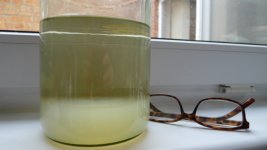
 . My style is to A/B as much as needed to obtain a very glass crystal clear yellow solution before the manske step taking place. Each acid state gets filtered to the bone, each time catching dirt. In the last base-step the decanted layer was almost clear as water.