• Members of the previous forum can retrieve their temporary password here, (login and check your PM).

From Brasil with love 🇧🇷 - emulsion situation -

Juramidama

Rising Star
Hi there.. another fellow traveller here from the lands of Jurema..

I wanted to post on homework where I think think this question belongs but I don't have permission yet 😆
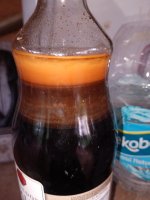
I'm having a problem with a thick emulsion that formed I'm about to siphon out and clean tru clear water as I saw.

This happened after warm the whole thing up (water + mimosa + soda (sodium hydroxide )+ Zippo fluid) taking care not to go beyond 45°C.

Before the warm bath, the separation of the "dark mimosa water" and the fluid was perfect clear but after ended up like this and it's been more than a week now.

For the first mix I used deionized water but after the bath I raised the liquid level with warmed-up tap-filtred water (to raise the level closer to the bottle neck) and I don't know if this water might cause something on this.

I'm looking for advice on what to do on the last steps..

This is my first extraction
Thanks for reading and hope one of you know something better

Cheers
 

Attachments
  • IMG_20251114_171006184_MFNR.jpg
    IMG_20251114_171006184_MFNR.jpg
    2.8 MB · Views: 4
Last edited:
Hi there.. another fellow traveller here from the lands of Jurema..

I wanted to post on homework where I think think this question belongs but I don't have permission yet 😆
I'm having a problem with a thick emulsion that formed I'm about to siphon out and clean tru clear water as I saw.

This happened after warm the whole thing up (water + mimosa + soda + Zippo fluid) taking care not to go beyond 45°C.

Before the warm bath, the separation of the "dark mimosa water" and the fluid was perfect clear but after ended up like this and it's been more than a week now.

For the first mix I used deionized water but after the bath I raised the liquid level with warmed-up tap-filtred water (to raise the level closer to the bottle neck) and I don't know if this water might cause something on this.

I'm looking for advice on what to do on the last steps..

This is my first extraction
Thanks for reading and hope one of you know something better

Cheers
Hey and welcome! Lovely to have you here. Don't worry about the homework section, what you're more likely looking for is the FAQ.

I think tap water has been a likely source of your problems, especially since the problem started exactly at the time it was added. In the picture it looks like the mineral content in the water has reacted with the strong base to form a powdery precipitate which then promotes emulsion formation - rather an unfortunate situation.

You can try vibrating it with some kind of massage device if you happen to have one available. This often helps the particles to coalesce, breaking up the emulsion. Failing that, try pouring everything vigourously into another container.

By this do you mean sodium carbonate? That will react with magnesium and calcium in the tap water to form their highly insoluble carbonates, making a worse emulsion than in the case of having used sodium hydroxide.

Best of all would have been if you had simply stuck with using distilled water. Clean rainwater might provide a cheaper alternative, or you can also raise the liquid level by adding inert solid objects, such as steel bearings, glass marbles or clean basalt chips, just as a few examples - but be careful to avoid breaking the bottom of the container when dropping them in if you choose to do this!

That, however, is getting ahead of the need to break the emulsion, so give it a go the vibration trick or/and the pouring trick and let us know how it goes.
 
Hey!! Thanks for the reply!! So good to have an advice.. make sense that thing with the water..

By soda I mean sodium hydroxide.. the alkaline agent.

But great.. since I don't have this vibrating device I was thinking in siphon the clear yellow layer on top into a detailed water can and see..


Thanks!!
 
Ah, okay - "soda" typically refers to sodium carbonate when used as a standalone (and when not in the context of soft drinks, of course). For clarity, sodium hydroxide would always be used with the "caustic" qualifier, since it's quite an important distinction!

For a short name, "lye" is commonplace around here, or the chemical formula, NaOH. This helps to prevent confusion - as well as the possibility of dangerous mishaps. Nomenclature is terribly important in chemistry and can even be a matter of life and death in certain cases!


So… with that out of the way 😁 - other vibrations like a washing machine or refrigerator may also help. It's also possible to set a phone to vibrate continuously, although that will drain the battery rather rapidly. If you have access to an old or broken phone, it's often quite straightforward to gain access to the little eccentrically-weighted motor, if you want to get DIY about it.

If the emulsion still resolutely refuses to break down, your final option would be to separate the whole emulsified layer into a tall, thin vessel - or maybe just carry on adding distilled(!) [or alkaline - see below] water to what you already have, if the neck of your container is thin enough.


Incidentally, it may be worthwhile to think about exactly what happened when the tap water was added to the mixture at the point when the emulsion started forming. Since you already had a layer of naphtha laden with alkaline DMT freebase, this was likely able to start forming an insoluble precipitate of alkaline earth hydroxides on the surface of the water as it passed through the layer. The naphtha gets stuck on the surface of these particles right from the start, making them harder than usual to disperse. The effect is compounded at the interface between the naphtha and the strongly alkaline bark soup, with the calcium and magnesium salts precipitating in the presence of both water and naphtha.

So, here's a thing - calcium hydroxide has a retrograde solubility curve. This means its solubility decreases as a solution gets warmer, and conversely, it increases in a cold solution. This reminds me of another possible trick to try, namely freezing your extraction. You'd have to ensure you use a container in such a way that it wouldn't get cracked by expanding ice if you chose to do this. Fortunately there are several simple ways to do that, which I can explain if necessary.

One final point is that, in future, if adding water like you did, it's prudent to add some base like lye or, ideally, washing soda to the water beforehand. The precipitate of calcium and magnesium can then be allowed to settle out harmlessly before adding the water to the extraction mixture. If you did have a funnel with a long enough neck to reach all the way through the naphtha layer, that also would have helped to prevent emulsion formation.
I was thinking in siphon the clear yellow layer on top into a detailed water can and see..
Do you mean a graduated cylinder? That would be a good idea, but you can include all the cloudy part as well, since this could aid separation.

As previously suggested, you may as well top up the extraction container with alkaline water since this will reflect both the original goal and the modified one, and may even contribute to breaking up at least some of the emulsion during the process.
 
Wow!!! Thanks so so much for such a class!!
It's been super helpful


I'm actually about to go to my friend's to take of the freezer the first production.. let's see.

I was wondering if it would make sense adding the other bottle of Zippo fluid to the original soup.. the one with the original tick emulsion..

That original emulsion problem came together with 2 events that happened one after the other in the same afternoon: first was the warming-up of the whole soup with the fluid already in (using Bain-Marie below 50°C ) shaking that a couple of times. After that I added warmed-below-50° Tap water to top the bottle.. the rest is history hahahah

Anyways thanks a lot!!!
 
Back
Top Bottom