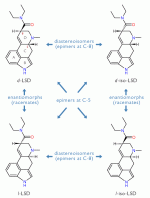
How do these impurities change the optimum course of action of LSD and the experience it creates? One of the theories is that, because d-LSD-25 is like a key (its outer electron shell has a specific shape), it fits into a number of tiny locks called "receptor sites." These are located somewhere in the brain - nobody is sure where, but one theory suggests that they might be in the brain stem. It is known, however, that these receptor sites interact only with extremely specific molecular configurations.
The various ergot compounds, cycloalkamides of LSD and lumi-LSD plug into the same receptor sites as LSD does. But these compounds evidently don't turn the lock in the smooth, clean manner of LSD. Many of these compounds have effects similar to symptoms of ergot poisoning - the St. Anthony's Fire of the Middle Ages. These symptoms include inflamed joints, headaches, nausea, and hot and cold flashes.
Hi
Isomers of LSD are another possible contaminant and indeed are reported present by the drug analysis groups. There are four possible isomers of LSD, but only the d-lysergic acid diethyl amide form is active. The other rotation forms - l-lysergic acid diethyl amide, d and l iso-lysergic acid diethyl amide (contrary to recent reports!) - are inactive. they have no pharmacological role, except possibly as a catalyst for some latent effect of LSD, or to block the action of LSD at the receptor site.
If a contaminated batch of diethyl amine is used in the manufacturing process, or if the chemist purposely decides to make them, LSD homologues might be present in the final crystal. Molecules similar to LSD in structure but with some addition, subtraction or rearrangement of action, homologues plug into the same keyhole that LSD does.
Some of these homologues have profound effects that vary in course of action and potency. For example, the strongest of he homologues, ALD-52, has 91 percent the potency of LSD and is said to have a slightly different effect upon the mind (there is some dispute about this).
However, as Albert Hofmann puts it in "Drugs Affecting the Central Nervous System": LSD has the highest and most specific effect and may therefore be considered as the genuine prototype of psychotomimetic compounds."
Thus, all impurities found in LSD are like imperfect keys. Such substances as ergot alkaloids, cycloalkamides and other lysergic acid derivatives, and LSD homologues and lumi-LSD are drugs that might open the door part way. But only pure LSD opens the doors of perception all the way.
In addition to manufactured impurities, impurities can also arise from decomposition of LSD. Dr. Albert Hofmann points out in his paper "The Chemistry of LSD": "The free base as well as the tartrate of d-lysergic acid diethyl amide, like all lysergic acid derivatives, is very sensitive to light and oxidizing agents. All preparations must be stored carefully, protected from light and from oxygen of the air, to prevent them from being destroyed within a short time."
Even if, by some chance, an underground batch were made pure, it would turn to bunk in time, especially if put in conventional underground packaging (blotter or windowpane) that does not protect it from light or air. Pharmaceutical LSD is stored in vacuum vials in nitrogen gas. A pure, viable form of black-market LSD should find its way to the consumer in a tablet coated with pure, inert buffering material or in a vacuum vial, but this expensive packaging is certainly not reconcilable with dealing for profit.
Why is it that most of he underground LSD in the United States is made wrong? There are several other possible explanations. One chemist, for instance, told me that it was "because all the pros are out of the field." That is to say, most underground chemists, whether motivated by altruism or greed, are incompetent to manufacture pharmaceutical-grade chemicals.
Erowid LSD (Acid) Vault: "LSD Purity", by Bruce Eisner (1977)