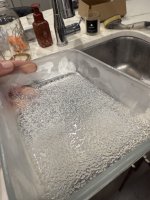
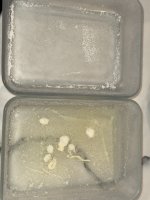
no. because then you would need to neutralize the lye with vinegar, and then afterwards youd need to re-basify again. Granted, you *could* but, the molar mass of sodium hydroxide is 40g, while acetic acid is 60g, meaning it takes 3 parts by weight of pure acetic acid, to neutralize 2 parts sodium hydroxide. In 5% vinegar, and assuming acetic acid is exactly as dense as water, this works out for 5% of the stronger sort of cleaning vinegar, to require roughly 20x1.5 =30ml of cleaning vinegar to neutralize each gram of sodium hydroxide.
What you can do now though is run a mini AB on what you have. Im not sure how much vinegar to use but it wont be much really. dmt has a molar mass of 188g/Mol so, for every suspected gram of DMT there, you add 188/60 then times 20 for 5%, lets just call it 60ml vinegar. excess wont hurt so calculate it based on your expected best case scenario then add like 20-30% more or something. Otherwise, you should be able to tell using ph strips or a ph meter, the ph wont drop all the way down until the DMT is reacted, although it may take a little bit of time to actually react and do that. follow a tek for this not just what ive said, theres more to it.
I dont know who norman is or what their tek entails, they dont appear in the search engine, but, usually we start by acidifying the bark if we want to do a defat in the process. In a dry tek, which i assume is what this one is, we rely on a fairly pure source, and fairly good crystalization so that the crystals will form out of the fatty naptha, which you can then proceed to rinse away with additional cold naptha, to get acceptably pure spice, although the fats may themselves be solvating some DMT so while its an easy low effort method, the yield does suffer and the quality isnt as great as if the fat were omitted right from the outset.
Most teks balance yield, quality and complexity and sacrifice one for the other(s), MHRB generally contains nothing but DMT and trivial contaminants that are in low quantity and are easily removed.
On that note, take a ml of naptha and evaporate it on some glass and see if it leaves behind oil or not. you are supposed to check this anyway with your naptha source. its uncommon but it does happen.