• Members of the previous forum can retrieve their temporary password here, (login and check your PM).

Exp. Report Haphazard Oral Administration Thread

Experience report

stuartroelke

Established member
Artist
Some of you may be aware that I have a lot of interest in salvia.
Some of you may also know that I have tried numerous times to solve the oral administration problem through disabling enzymes ("salviahuasca")
I am no scientist, just a curious person who grows lots of Salvia divinorum and has plenty to waste.

In the interest of time, I figured I'd post simple, haphazard experiments here as I personally sort through the noise.
I have no interest in lengthy explanations or placebos; I will simplify rants are much as possible here.
If an experiment isn't obviously perceptible, I will mark it as a failure and modify my methodology.

Initially these experiments will revolve around ease—plain leaf is the most accessible form.
Therefore, I will ingest plain leaf capsules or salvia "matcha" after disabling enzymes.

This is a relatively safe and straightforward experiment, though I may occasionally comment about potential negative health effects or interactions.

Let the games begin.
 
Schisandra chinensis experiment 1:

This assumes:
- CES1 is the primary enzyme responsible for removing the acetyl group (salvinorin A -> salvinorin B)
- Stomach acid doesn't have any negative impact on salvinorin A
- Solubility / permeability isn't extremely low in the gut

Schisandrin B (from Schisandra chinensis) exhibited non-competitive inhibition of CES1

The method:
Boiled 5g dried Schisandra chinensis berries for ~60 minutes, then cooled and drank.

Waited ~30 minutes while doing yard work.

Ingested 1 gram of dried Salvia divinorum leaf packed into gelatin capsules.

T 00:30:00
Feeling nothing. Took a break from yard work to snack and drink tea.

T 01:30:00
Still nothing. Took an edible.

T 03:00:00
Failure.

Future testing:
Might need to increase the dosage of Schisandra chinensis, though too much could cause indigestion due to acidity.
Could also test with more dried Salvia divinorum powder—not sure how much would actually be necessary after CES1 inhibition.
 
Haphazard Oral Administration Thread
:ROFLMAO: love the choice of title. Highly reminiscent of a lot of my 'research' too.

Are there other CES subtypes that ought to be targetted? It depends on which sort is occurring in the stomach. This was the working basis for some of the ingredients in Twig Harper's salvia syrup. A species of arenaria has been used fairly successfully for CES inhibition, but even if you saw those things already it still seems worth mentioning.
 
:ROFLMAO: love the choice of title. Highly reminiscent of a lot of my 'research' too.

Are there other CES subtypes that ought to be targetted? It depends on which sort is occurring in the stomach. This was the working basis for some of the ingredients in Twig Harper's salvia syrup. A species of arenaria has been used fairly successfully for CES inhibition, but even if you saw those things already it still seems worth mentioning.
I have read some posts and done my own testing (loperamide, CBD isolate, lecithin, &c). Though, that was all done when I hadn’t grown excess quantities of plain leaf—I was just blending handfuls of fresh leaves into slurry without weighing anything. This time I’ll be a little more intentional, with the final tests likely revolving around overwhelming my system with large quantities of pure salvinorin A.

Are there papers mentioning the inhibition strength for Arenaria?
 
Last edited:
While diving deeper into Lopinavir / Ritonavir (HIV medications that inhibit CES1), I accidentally stumbled on an extremely accessible, potent, and safe CES1 inhibitor that can be found year-round all over the northern hemisphere—genuinely shocked nobody has mentioned it before. Don’t want to get hopes up too soon; I will test ASAP. Stay tuned.
 
Last edited:
Betula spp. experiment 1:

This assumes:
- CES1 is the primary enzyme responsible for removing the acetyl group (salvinorin A -> salvinorin B)—seems like this could be true
- Stomach acid doesn't have any negative impact on salvinorin A
- Solubility / permeability isn't extremely low in the gut

Turns out schisandrin B has a high IC50, and the amount found in Schisandra chinensis is likely low—that experiment made me feel particularly dumb. Without wanting to do extensive research, I've already made the assumption that some ridiculous dose of dried schisandra berries would be required to inhibit CES1 effectively (maybe ~1kg or more). A reduction like that would be far too expensive, wasteful, and acidic. My gut also felt unwell the next day.

Therefore, I started looking into Lopinavir / Ritonavir—prescriptions for treating HIV that strongly inhibit CES1. Fortuitously, I stumbled on an article about holistic HIV treatments and discovered what is seemingly too good to be true: betulinic acid—a byproduct of oxidized betulin found in concentrations of ~1% in the outermost bark of birch trees—has been documented as a potent CES1 inhibitor on numerous websites (examples: source 1, source 2, source 3). Based on the IC50, I'm guessing I'd need to absorb something like 20mg of pure betulinic acid to effectively inhibit CES1 (would appreciate confirmation from someone with more experience). Betulinic acid is also stable, extremely easy to extract, and plentiful year-round in areas where Betula spp. grow. Jackpot.

The method:
Boiled 20g of fresh Betula nigra bark for ~90 minutes, added 4 tablespoons of jujube syrup (a sweet reduction of dreid Ziziphus fruit that I regularly use to promote relaxation or sleep—happens to contain betulinic acid too), then cooled the decoction and brought to work.

Drank on my drive home (roughly ~30 minute car ride). Stomach started feeling a little sore, but no nausea or need to use a restroom.

Mixed 2 grams of dried Salvia divinorum leaf powder with 10ml 75% alcohol, then added 4oz of water and chugged. Much worse flavor than the birch bark tea.

T 00:30:00
Feeling a slight mood shift; could be placebo, the jujube syrup, or a buzz from 10ml of 75% alcohol. Still no nausea or need to use a restroom, but my stomach is certainly feeling a spell of discomfort. Start reheating leftovers for dinner.

T 01:00:00
While eating, I begin to notice prickling sensations on my skin and near my joints. I thought it would be very easy to determine the difference between placebo and common hallucinations associated with salvinorin A, but I'm struggling to remain impartial / objective. Stomach discomfort is more intense, yet somehow manageable.

T 01:30:00
Feeling like I'm back to baseline with the same level of stomach discomfort. Not nearly as bad as most traditional psychedelic brews.

Future testing:
Absorption of salvinorin A and betulinic acid in the gut might be extremely low (~1-5%), so I'm eager to test lecithin as a means of improving lipophilic terpenoid solubility and bioavailability. I already boiled 20g of Betula alleghaniensis bark, though I am not emotionally prepared to perform another test today (feeling low). Hopefully tomorrow I will be ready. If lecithin doesn't produce a significant difference, then I'll begin increasing dosage dramatically. I expect to puke at least once before these experiments are over.

Additionally, I ordered third-party tested Betulinic Acid capsules (50mg + sunflower lecithin) from a holistic supplement supplier as a means of further testing my theory before going through the arduous process of carefully collecting hundreds of grams of birch bark and extracting it. This was the only affordable source of betulinic acid I could find, but I'm not going to complain that it already inlcudes a "pro liposomal" formula—hoping it's not a scam.
 
Last edited:
You might want to look at the Birch polypore fungus too:
I actually have—the concentration of betulinic acid in both Fomitopsis betulina (birch polypore) and Inonotus obliquus (chaga) is very low. Strong brews of chaga have also been linked to kidney neuropathy. Bark is probably a better (and safer) source.

It would be fantastic if I could convert betulin to betulinic acid (birch bark is ~30% betulin according to some sources). Though, I’m not certain how a controlled conversion could be achieved with rudimentary equipment. Drying, powdering, and then heating?

EDIT:

From minimal research, it seems heat won’t oxidize betulin to betulinic acid—it’s far too stable and rigid. That conversion would require dangerous oxidizing reagents or bacteria (source 1, source 2).
 
Last edited:
Betula spp. experiment 2:

This assumes:
- CES1 is the primary enzyme responsible for removing the acetyl group (salvinorin A -> salvinorin B)—seems like this could be true
- Stomach acid doesn't have any negative impact on salvinorin A
- Solubility / permeability isn't extremely low in the gut
- All Betula spp. contain a reasonable quantity of betulinic acid

Summary of previous experiment: betulinic acid—a byproduct of oxidized betulin found in concentrations of ~1% in the outermost bark of birch trees—has been documented as a potent CES1 inhibitor on numerous websites (examples: source 1, source 2, source 3). Based on the IC50, I'm guessing I'd need to absorb something like 20mg of pure betulinic acid to effectively inhibit CES1 (would appreciate confirmation from someone with more experience). Betulinic acid is also stable, extremely easy to extract, and plentiful year-round in areas where Betula spp. grow. Jackpot.

The method:
Boiled 20g of fresh Betula alleghaniensis bark for ~120 minutes, added 4 tablespoons of jujube syrup (a sweet reduction of dreid Ziziphus fruit that I regularly use to promote relaxation or sleep—happens to contain betulinic acid too), then cooled the decoction overnight. The next morning I became worried that this might produce different results from Betula nigra (liquid appeared less cloudy / potent), so I boiled 5g more of Betula alleghaniensis and 5g Betula nigra for ~60 minutes and added it.

Took 1g of soy lecithin to promote bioavailability, waited ~30 minutes, drank the birch concoction, then waited another ~30 minutes.

Mixed 3 grams of dried Salvia divinorum leaf powder with 10ml 75% alcohol, then added 4oz of water and chugged.

T 00:30:00
Feeling a slight mood shift again; definitely thinking it's either from the birch tea or a mild buzz from 10ml of 75% alcohol. Stomach is tolerating the birch significantly better this time. Is this related to regular exposure, or is yellow birch not a strong enough option?

T 01:00:00
Feeling a cognitive shift, but still don't feel comfortable claiming that "this is obviously a salvia trip resulting from stomach absorption"—it's just not "trippy" enough at this dose. I've experienced stronger sensations from quidding 2-4 fresh leaves (and I didn't count how many leaves went into my 3g of dried powder).

T 01:30:00
Halfway through dinner. Still feeling something mild, but it's more like being a little stoned.

Future testing:
Perhaps Betula alleghaniensi is a less potent source of betulinic acid compared to Betula nigra. Today, I decided to collect a decent amount of bark from Betula papyrifera trees because they have definitely been found to contain ~1-2% betulinic acid. I will boil 40g tonight and hopefully test all of this again tomorrow.

Tracking how many leaves I'm using will be essential from this point on, as I do want to document wastfulness. I'm gifted with a garden where I can grow excessive quantities of Salvia divinorum, but that's obviously not going to be the case for everyone.

Still waiting for the Betulinic Acid capsules (50mg + sunflower lecithin) that I had ordered from a holistic supplement supplier; still hoping I'm not getting scammed.
 
Last edited:
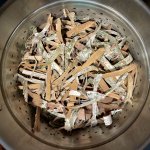
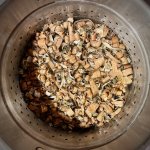
Haven't been uploading pictures, but figured this was worth noting:

I just hand peeled 40g of my Betula papyrifera bark into a pasta pot and am already noticing a massive difference in texture and scent. The bark left a powdery residue on my fingers, and—once boiled—my decoction turned more grey than brown. Decided to add a splash of high-quality olive oil to see if more of the lipophilic triterpenoids can be extracted (perhaps it will also assist with absorption once ingested).

Early on, I had assumed that all birch bark contained betulin and therefore must contain betulinic acid. Now I'm starting to wonder if certain Betula spp. (like Betula alleghaniensis) have little to none.

IMG_6697.jpgIMG_6700.jpg
 
Last edited:
I just had my first orally ingested salvinorin A experience—this is such an unbelievable blessing friends :)

There is much to write and test—as I improvised with some key additions after diving into Twig Harper's salvia syrup based on @Transform's suggestion—but I'm still feeling the prickly comedown and not fully prepared to do any significant amount of speculation.

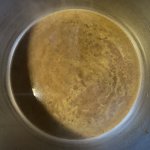
For now, enjoy this image of a reduction made from 40g Betula papyrifera bark and 1tsp olive oil:

IMG_6705.jpg
 
Last edited:
Betula spp. experiment 3 + CaCO3 experiment 1 (SUCCESS):

This assumes:
- CES1 is the primary enzyme responsible for removing the acetyl group (salvinorin A -> salvinorin B)—seems like this could be true
- Stomach acid does have negative impact on salvinorin A
- Solubility / permeability isn't extremely low in the gut (will roughly quantify the absorption later)
- Betula papyrifera contains a higher percentage of betulinic acid

Betulinic acid has been documented as a potent CES1 inhibitor on numerous websites (examples: source 1, source 2, source 3). CaCO3 might prevent acidic hydrolysis of salvinorin A (deacetylation due to stomach acidity), and I'm basing this on other threads that I discovered after investigating @Transform's suggestion of "Twig Harper's salvia syrup"—one of the comments from @Godsmacker mentioned a stronger quid experiences after ingesting CaCO3 (calcium carbonate—found in common antacids). So, I decided that it wouldn't hurt to change my hypothesis: stomach acidity does have negative impact on salvinorin A.

The method:
Boiled 40g of fresh Betula papyrifera bark for ~90 minutes in 1 gallon of tap water with 1 tsp high-quality olive oil (for capturing more lipophilic betulinic acid), reduced for ~60 minutes until it was ~8oz of liquid, then added 4 tablespoons of jujube syrup (a sweet reduction of dreid Ziziphus fruit that I regularly use to promote relaxation or sleep—happens to contain betulinic acid too), then placed the decoction in the fridge. I didn't feel emotionally prepared for testing this the next day, so I waited a full 48 hours before consuming.

Took 1g soy lecithin (increases bioavailability) with 500mg of CaCO3, waited ~15 minutes

Took 1g soy lecithin (increases bioavailability), 500mg of CaCO3, drank the birch concoction, then waited another ~30 minutes.

Mixed 4.112 grams (sloppy weighing) of dried Salvia divinorum leaf powder with ~30ml 75% alcohol (I didn't measure this time), then added 4oz of water and chugged.

T 00:30:00
Sat down to draw. No stomach upset again, which means I definitely adapted to the birch tea after drinking it four times in seven days (didn't document the first brew because it was 8g birch and didn't involve salvinorin A). Feeling what is undeniably salvia-esque, but not profound enough to deem it a success. Chatting with Nexus folks.

T 00:45:00
Left chat and stood up to use the restroom—immediately started feeling intense salvia sensations that are comparable to smoking one large drag of 5x. Anxiety goes up as I realize that I have no idea how hard I'm about to trip. Restroom, water, laid down in my plant room to listen to music.

T 01:00:00
Listening to songs off of Oneohtrix Point Never's Tranquilizer while getting some interesting closed-eye visuals (will sketch and upload later). D.I.S. makes more sense to be in this headspace. Feeling introspective whenever I open my eyes, and having deep thoughts about how certain objects in the room remind me of my childhood. Occasionally I'm just laughing to myself. I get up to talk to my partner about it, but feel awkward with the sudden change in atmosphere (like when tripping and thinking a change of scene might be necessary, but expectation doesn't match reality). Color and spacial distortions, having trouble forming sentences or concentrating. Go back to the plant room to listen to music.

T 01:30:00
Got up briefly and moved to the bed. Struggling to get comfortable, but still listening to music. Interesting closed-eye visuals continue—more mellow now.

T 2:00:00
Feeling the same afterglow as I get after a strong breakthrough. Mildly prickly sensations on skin. Get back to Nexus chat and inform folks. Go to bed.

T ~4:30:00?
Wake up after two hours of sleep and notice really interesting patterns on my walls. Visuals fade as I walk to the restroom. Face looks oddly unfamiliar in the mirror. Feels very similar to waking up after doing MAOIs too close to bed, but a new sensation that is not similar to salvinorin A.

Future testing:
I somewhat expected to get here due to my haphazard approach, but I desperately need to determine if success was dependent on betulinic acid, CaCO3, lecithin, a larger dose of dried Salvia divinorum leaf powder, jujube syrup, or a combination. This means that I'll need to test each element separately. If stomach acidity is an issue, then I'll definitely need to go back to testing enteric capsules when I shift to developing salviapharmahuasca (the ultimate goal of these tests).

Waste is still a concern, and unfortunately I didn't count the number of leaves used (was impatient). 4g of plain leaf is less waste than 1g of 5x, and I personally feel that 20-30 minutes of a 5x peak is worth the exchange. Maybe others disagree. Perhaps I'll be able to reduce waste even more with additional testing.

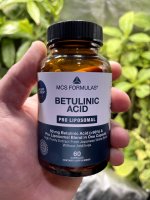
Additionally, the Betulinic Acid capsules (50mg + sunflower lecithin) arrived (see attached image). Testing those obviously means that I'll inevitably be combining BA with lecithin, but a high concentration of potent CES1 inhibitor might factor out CaCO3 and the stomach acidity problem—boiling birch is a very poor method of extraction because the desired compound is lipophilic (why I added olive oil). If this supplement does work well, then I'll want to learn how to extract my own BA from Betula papyrifera bark sooner rather than later. I'm assuming this could be done with acetone followed by evaporation and an A/B extraction, but I'll consult with professionals before attempting. There's also a chance that CaCO3 will always be preferable to use due to ease of access and low cost (similar to how lecithin allows me to conserve on homegrown weed).

Stay tuned for more exciting revelations.

 

Attachments

  • IMG_6720.jpg
    IMG_6720.jpg
    4.2 MB · Views: 2
Strong brews of chaga have also been linked to kidney neuropathy.
Looking into this, it's nephropathy as a result of oxalates in chaga

Great to see how your experiments have been progressing. Tickling my alchemical receptors quite nicely as a matter of fact :D
 
MCS Formulas Betulinic Acid capsules experiment 1:

This assumes:
- CES1 is the primary enzyme responsible for removing the acetyl group (salvinorin A -> salvinorin B)—seems like this could be true
- Stomach acid doesn't have any negative impact on salvinorin A
- Solubility / permeability isn't extremely low in the gut
- MCS Formulas Betulinic Acid capsules are legit
- 50mg betulinic acid + lecithin is enough to absorb and inhibit CES1 effectively

Betulinic acid has been documented as a potent CES1 inhibitor on numerous websites (examples: source 1, source 2, source 3). MCS Formulas sells a betulinic acid supplement (50mg + sunflower lecithin for bioavailability) that may be legit.

The method:

Took one MCS Formulas Betulinic Acid capsule, waited ~30 minutes.

Mixed 1 gram of dried Salvia divinorum leaf powder with ~10ml 75% alcohol, then added 4oz of water and chugged.

T 00:30:00
Nothing. Painting and drinking water.

T 01:00:00
Slightest salvia feeling may be present—back to asking "is this placebo or not?" Not trippy enough to be certain.

Future testing:
This either confirms that MCS Formulas BA capsules are not legit, 1 gram of dried Salvia divinorum leaf powder doesn't contain enough salvinorin A to absorb effectively in the gut, or lowering stomach acidity is necessary to prevent acidic hydrolysis of salvinorin A (deacetylation).

It would have been smarter to test CaCO3 and 4 grams of dried Salvia divinorum leaf powder to see whether or not BA and lecithin even factor in to the equation. That will be my next move. If that works, then I'll test without any CaCO3—maybe 4 grams of dried Salvia divinorum leaf powder is enough to overwhelm the system? If that doesn't work, then CaCO3 + lecithin + 4 grams of dried Salvia divinorum leaf powder. If that works, then just lecithin and 4 grams of dried Salvia divinorum leaf powder. If that doesn't work, then I will assume stomach acidity is more responsible for removing the acetyl group than CES1 enzymes. That would be very funny since so many folks have assumed the trick to oral administration of salvinorin A must be a complicated secret.

If all of those tests without a CES1 inhibitor fail, I will pivot back to taking a MCS Formulas BA capsule with 4 grams of dried Salvia divinorum leaf powder. If that doesn't do anything, then I'll start doubting the legitimacy of MCS Formulas BA capsules and go back to 40g Betula papyrifera bark tea and 4 grams of dried Salvia divinorum leaf powder. Then 40g Betula papyrifera bark tea + lecithin + 4 grams of dried Salvia divinorum leaf powder. Then 40g Betula papyrifera bark tea + CaCO3 + 4 grams of dried Salvia divinorum leaf powder...

Somewhere along this path I will determine what pieces are essential to the puzzle, and at some point I can start extracting / purifying compounds and coming up with a reliably dosed "pharma" formulation. As of now, the working title for this capsule system is "vertigo" ("pharmasalviahuasca" doesn't have the same ring to it). Please recommend other names if you don't like it; I just need a shorthand title for the substance and future tek writeup.
 
Last edited:
If you have lots of variables, there are ways of constructing tests such that you can test multiple variables at once, without having to go through all the permutations. Maybe you've heard of Taguchi orthogonal parameters already, but here's where it's been discussed before:
 
Maybe something else in the bark is an even more powerful CESI than betulinic acid?
I am wondering about that, but couldn’t find other documentation about inhibitors in birch (that would also be quite the coincidence).

Perhaps wood esters extracted from the bark are overwhelming esterases? Or, maybe CaCO3 reduces stomach acidity and inhibits CES1? I’ll research both possibilities ASAP.

Taguchi orthogonal parameters are completely new to me. Seems like it might be difficult to score at this moment because I would only be noting a 1 (success) or 0 (fail). I think it could become extremely useful if I start experiencing distinctly different durations / intensities of trip (examples: without CES1 inhibitors the trip is shorter, without lecithin I need more salvinorin A, without calcium carbonate the trip is shorter and I need more salvinorin A, &c). I think that will become especially relevant while I’m working on the “vertigo” tek (working title for “pharma” capsule version).

I’m really trying to test carefully without accidentally dosing myself to the moon. I was very lucky that my first active combination was pretty much a perfect functional dose. Also, I have yet to vomit.

EDIT:

1. “Enzyme saturation” is the term I was looking for, and it’s unlikely to be possible without absurd quantities of wood esters.

2. CaCO3 could slow down activity of CES1 by raising pH, but it likely doesn’t work like that in a human body. CES1 is primarily in the liver; I don’t believe CaCO3 alters liver pH. I am not a doctor, though common sense tells me livers don’t work that way.
 
Last edited:
CaCO3 experiment 2:

This assumes:
- Inhibiting CES1 may not be necessary, or ~4g of Salvia divinorum leaf powder might be enough to saturate enzymes and still cause a potent effect
- Stomach acid does have negative impact on salvinorin A
- Solubility / permeability isn't extremely low in the gut
- CaCO3 might have some additional unknown effect that increases potency

The method:

Took 500mg of CaCO3, waited ~15 minutes

Took 500mg of CaCO3, then waited ~30 minutes.

Mixed 4.1 grams of dried Salvia divinorum leaf powder with ~10ml 75% alcohol, then added 4oz of water and chugged.

T 00:15:00
Got back from a quick walk and started painting. Feeling a little something—slightly more than my earlier placebo-like sensations.

T 00:45:00
Feeling it a bit more, but does not qualify as "trippy" or a success.

T 01:00:00
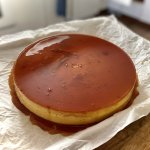
Decided to eat flan (image attached) that my partner and I had made for the holidays. This shockingly kickstarted the feeling more. Starting to consider that—as with all entheogens—digestion and diet factor into potency. Perhaps the egg custard contains enough lecithin to increase bioavailability? Still not feeling it as much as I'd like.

T 02:00:00
Not feeling anything anymore.

Future testing:
I tested only CaCO3 in the off chance that this comment from @Godsmacker might have revealed stomach acidity to be the primary cause of deacetylation, and that—despite CES1 potentially being responsible for removing the acetyl group—an antacid would reduce this breakdown just enough to allow sufficient salvinorin A absorption in the gut. Unfortunately, not much happened other than confirmation that ~4g of dried Salvia divinorum leaf powder seems to have some effect. Perhaps this quantity is necessary for low-level enzyme saturation? Or, it's a large enough quantity of salvinorin A for a reasonable amount to absorb through mucosal membranes in the throat?

Looking back at @Transform's suggestion of applying Taguchi orthogonal parameters, it may have been smarter to first test lecithin with CaCO3. If that worked, then I could have tested each individually. If it didn't work, then I could have immediately assumed each individual component likely wouldn't work on its own. Today I will be testing lecithin and CaCO3 together, and if it does work then I will follow up with lecithin on its own. If it doesn't work, then I will begin tests with betulinic acid again.

I finally counted the number of dried leaves required to make my powder, and—at this moment—it is serendipitously averaging at ~0.1g per leaf (hooray for easy math). This means ~40 homegrown leaves were required to achieve my first trip, which does indeed seem a bit wasteful when compared to quidding. Though, it is important to understand that salvinorin A is absurdly potent. Using ~40 dried leaves per capsule (or ~4g of dried powder) isn't much. Considering averages from research papers (0.1-0.3% salvinorin A by dry weight), I'm ingesting maybe 4–12 mg of salvinorin A in order to have a threshold experience. The tradeoff of being a little wasteful for the sake of both convenience and increased duration seems worth it. I regularly grow ~12 Salvia divinorum plants in zone 6b/7a and am able to accumulate hundreds of grams of dried leaf every summer. Commercially available dried leaves are also cheap when compared to the street value of other psychoactive substances.
 

Attachments

  • IMG_6764.jpg
    IMG_6764.jpg
    3.2 MB · Views: 1
CaCO3 experiment 3 + Lecithin experiment 1 (SUCCESS—strongest trip yet!)

This assumes:
- Inhibiting CES1 may not be necessary, or ~4g of Salvia divinorum leaf powder might be enough to saturate enzymes and still cause a potent effect
- Stomach acid does have negative impact on salvinorin A
- Solubility / permeability isn't extremely low in the gut, or lecithin increases bioavailability enough for a reasonable amount of salvinorin A to absorb
- CaCO3 might have some additional unknown effect that increases potency

The method:

Took 1g soy lecithin (increases bioavailability) with 500mg of CaCO3, waited ~15 minutes

Took 1g soy lecithin (increases bioavailability), 500mg of CaCO3, then waited another ~30 minutes.

Mixed 4.01 grams of dried Salvia divinorum leaf powder with ~10ml 75% alcohol, then added 4oz of water and chugged on an empty stomach.

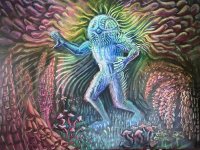
Threw on Thank You for Almost Everything by Vegyn and Francis Hornsby Clark and started working on an old painting that I have yet to finish (see attached image).

T 00:30:00
I laughed out loud once I looked at my timer—can immediately feel it coming on ~30 minutes after chugging the salvia matcha. This seems to be a very predictable onset.

T 00:45:00
Already can tell that this is a success, but also aware that this might be a stronger experience. Painting is grounding me to reality.

T 01:00:00
After ~30 minutes I'm debating laying down. Decide to drink water and continue working for as long as I can. It's a fun challenge.

T 1:30:00
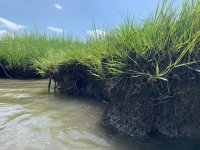
Struggling to continue. Cannot stop thinking about undercut banks in low-tide marshes (see attached reference image); I want to be buried in mud. I transition from inspired euphoria to hypnotic sensations that are pulling me away from painting—almost like my brain is completely exhausted of all its resources and cannot keep up. I start to think about sleep and death. I'm not tripping very hard per se, but a huge wave of fatigue has definitely washed over me. This may be the longest I've ever been in this headspace (like smoking a hit of 5x stretched over an entire hour). Play The Road To Hell Is Paved With Good Intentions by Vegyn, then lay down on a yoga mat and close my eyes.

T 1:45:00
Feel bad that I'm just laying on the floor between states. Grab a beer, sit, and attempt to do a more genuine meditation. After twenty minutes my head hurts. Drinking seems to bring the trip back more—I've noticed a weird synergy with alcohol and salvia in the past. Maybe this has to do with alcohol causing dynorphins to release and act on KORs.

T 02:00:00-03:00:00
Stomach is grumbling, so I begin heating up food despite still tripping (intensity is comparable to plain leaf now). Perhaps my headache is from attempting to do this on an empty stomach? Eating on salvia is hell. Crunchy textures are unpleasant; pickled foods taste insane. Had struggled with this during my last successful test.

Future testing:
The answer was in the flan.
I'm officially qualifying lecithin as a required piece of the puzzle, as it potentially increases bioavailability by 3-5x. Perhaps the same results could be experienced through consuming 3-5x the amount of dried Salvia divinorum leaf powder (12-20g), but that seems unnecessarily wasteful. Lecithin supplements are easy to find at most pharmacies...
Or, just eat some flan ;)

Good news is that I didn't waste much time with my last test, as now I only have to try 4g of dried Salvia divinorum leaf powder with lecithin before writing out the preliminary tek (minimal necessary ingredients). It would be lovely if lecithin and salvia are all that's needed, though I'm willing to "improve" my tek by including pure salvinorin dosing, CES1 inhibitors (may still increase potency or duration), and dietary concerns (source of lecithin / quantity used, combining with alcohol, consumption on an empty stomach, CES1 inhibitor interactions, magnesium supplementation to clear head fog, &c).
 

Attachments

  • IMG_6790.jpg
    IMG_6790.jpg
    7.2 MB · Views: 2
  • Facebook Image.jpg
    Facebook Image.jpg
    553.8 KB · Views: 2
Last edited:
Back
Top Bottom