blue.magic
Esteemed member
I want to share one mistake I made in the past when attempting harmala separation to possibly help others avoid it...
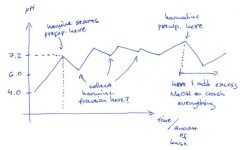
To selectively precipitate harmine from harmaline according to the VDS protocol, one should dissolve the free base harmalas in vinegar and then slowly add ammonia solution until pH about 7.2-7.5 where harmine precipitates , can be filtered out and one can proceed precipitating harmaline.
Even though my syrian rue seeds are tested to be almost 1:1 harmine:harmaline, I usually ended up with LOTS of harmine and only tiny fraction of harmaline:

Now I could have finally solved the mistake. Instead of using vinegar, I simply dissolved harmala hydrochloride salt in warm water and started adding ammonia.
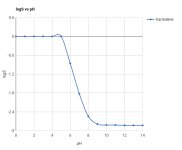
This neutralization process produces ammonium chloride salt, which is in itself acidic (at least in aqueous solutions) and skews the pH readings. This made me overshoot the splitting point and most of the harmaline precipitated in the first fraction.
According to the VDS protocol, one should use acetic acid and ammonia instead, which produces ammonium acetate, a weak, yet neutral salt. Although pH of ammonium acetate solution is not super stable, it should be stable around the range where harmine precipitates.
Now is it possible to reliably separate harmine and harmaline from harmala hydrochloride solution? Using sodium hydroxide solution, this should form sodium chloride, a strong neutral salt that certainly won't skew the pH readings. What do you think?
Of course, the sodium hydroxide used must be pure (lab grade, not common lye for cleaning) and diluted before dropwise addition.
I was also thinking about using potassium hydroxide, as it more soluble in water and thus allows higher concentration of harmalas (less water needed).
Being able to separate harmine/harmaline directly from HCl salt will save one step since the separation can be done right after the last Manske step and there would be no need to make free base only to redissolve it again in vinegar.
To selectively precipitate harmine from harmaline according to the VDS protocol, one should dissolve the free base harmalas in vinegar and then slowly add ammonia solution until pH about 7.2-7.5 where harmine precipitates , can be filtered out and one can proceed precipitating harmaline.
Even though my syrian rue seeds are tested to be almost 1:1 harmine:harmaline, I usually ended up with LOTS of harmine and only tiny fraction of harmaline:
Now I could have finally solved the mistake. Instead of using vinegar, I simply dissolved harmala hydrochloride salt in warm water and started adding ammonia.
This neutralization process produces ammonium chloride salt, which is in itself acidic (at least in aqueous solutions) and skews the pH readings. This made me overshoot the splitting point and most of the harmaline precipitated in the first fraction.
According to the VDS protocol, one should use acetic acid and ammonia instead, which produces ammonium acetate, a weak, yet neutral salt. Although pH of ammonium acetate solution is not super stable, it should be stable around the range where harmine precipitates.
Now is it possible to reliably separate harmine and harmaline from harmala hydrochloride solution? Using sodium hydroxide solution, this should form sodium chloride, a strong neutral salt that certainly won't skew the pH readings. What do you think?
Of course, the sodium hydroxide used must be pure (lab grade, not common lye for cleaning) and diluted before dropwise addition.
I was also thinking about using potassium hydroxide, as it more soluble in water and thus allows higher concentration of harmalas (less water needed).
Being able to separate harmine/harmaline directly from HCl salt will save one step since the separation can be done right after the last Manske step and there would be no need to make free base only to redissolve it again in vinegar.