• Members of the previous forum can retrieve their temporary password here, (login and check your PM).

how best to extract the solvent

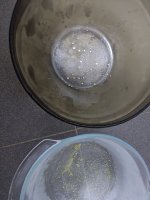
Today I made an interesting discovery. I poured the extract from one extraction (40ml) into three containers: a gray baking sheet, a white heat-resistant glass, and a dark heat-resistant glass. The result was that there was practically nothing to collect on the gray baking sheet, fine sand on the white glass, and large crystals on the dark glass... So does the container we freeze in matter?!
And one more question: If I have 40ml of extract, is it better to divide it into 2-3 containers, or will all of it be okay in one?
 

Attachments

  • 17557597755582nacz.jpg
    17557597755582nacz.jpg
    262.6 KB · Views: 14
As I understand it, imperfections and scratches on glass can help crystals start forming, so it helps them grow faster. There should be more or less the same amount on DMT on the three containers (assuming the same amount of heptane in each), so you should wait more for the two with less crystals.

And one more question: If I have 40ml of extract, is it better to divide it into 2-3 containers, or will all of it be okay in one?
I've done multiple 40ml pulls (around 200ml) in the same container and it worked well, so I don't think you need to split the 40ml. It's a matter of DMT concentration, and dividing a single pull won't alter that. Combining multiple pulls will average out the concentration, so in that case if the last pulls don't have much it can be good to evaporate a little bit until fine crystals form when blowing on its surface.
 
How much baking soda do you use per 100 grams of bark? I used to use 50 grams of baking soda, but now I'm reading that a maximum of 20 grams is fine, and baking soda is very poisonous....
 
I take it you mean caustic soda, AKA sodium hydroxide? Baking soda isn't alkaline enough to do the job.

Yes caustic soda is pretty poisonous ( though it does get used as an ingredient in pretzels ... the dose makes the poison in this case ) and, well, caustic. Which is why you should be being very careful to avoid splashing the solution around and taking care not to pipette any of the bark soup up with your NPS. If you get any on your skin then wash it off immediately under the tap, you'll notice a soapy feel, this is the caustic soda making soap out of the fats in your skin!

The quantity to be used is primarily related to the amount of water you are using, not the amount of bark. You need to achieve a ph of greater than 12.5 in order for the freebasing to occur.

20g in a litre should be fine, as long as you haven't used lots of acid in a previous stage that will need to be neutralised to achieve the required ph level.

Extra NaOH will act to help prevent emulsions and perhaps break down plant matter to liberate more DMT. Don't worry about having used 50g instead of 20g, this time. It won't hurt the final product.

To be extra safe you should water wash the NPS as it is pulled off the soup, this removes any suspended caustic soda solution micro droplets from the NPS.

To water wash, simply squirt the NPS into a jar containing a little water as you pull it off of the soup, then you can wait for the NPS to settle into a nice layer and pipette that off the wash water into your freeze precipitation dish. Adding a pinch of sodium carbonate to the wash water will help prevent any slight acidity in the water from turning some of your freebase back into a soluble salt again and thus being removed from the NPS.

See here for lots of discussion on this: The Base in Your Product

 
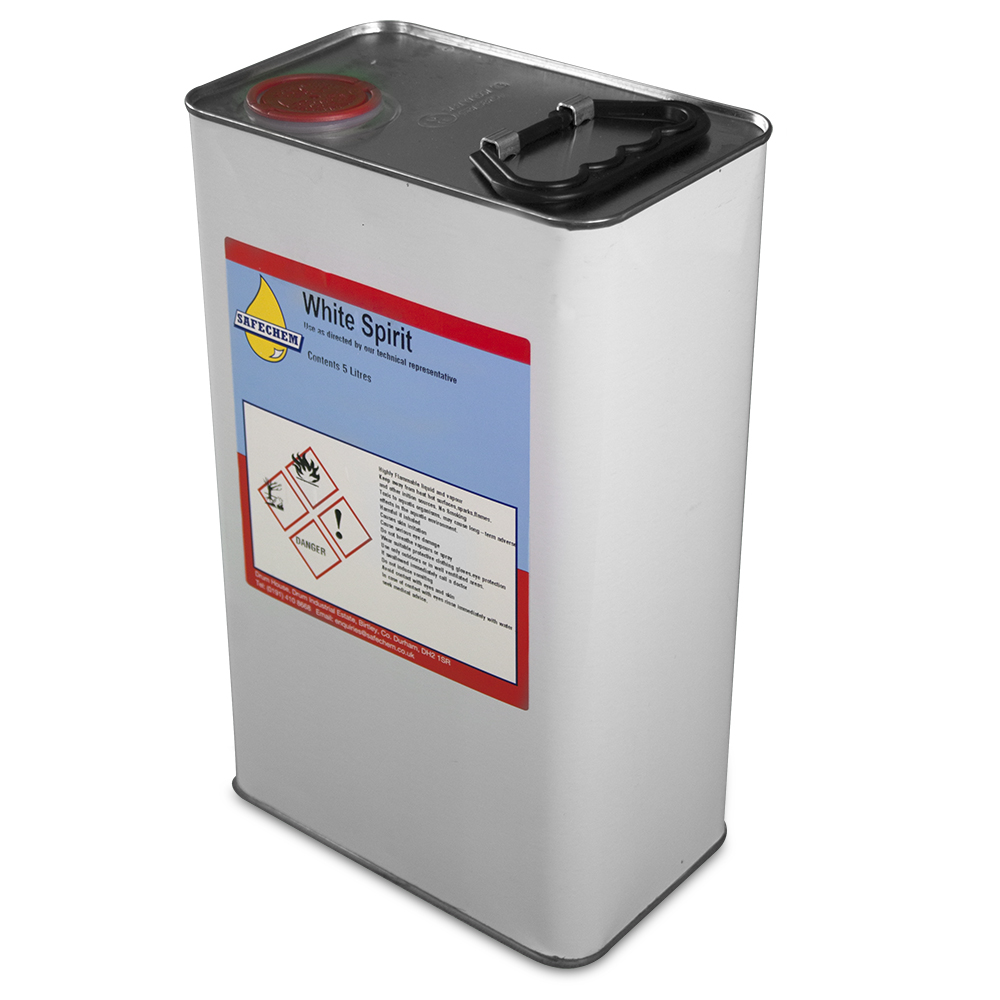
I have a question about the last step... The DMT purification process (crystallization). I have something like this... can I use it?

 
I have a question about the last step... The DMT purification process (crystallization). I have something like this... can I use it?

If you really had no other choice, you'd be better off using that for the initial extraction. White spirit evaporates too slowly for it to be a satisfactory solvent for a re-x.

Of course, if you already had some you'd be able to check its rate of evaporation for yourself, not to mention whether it even evaporates completely cleanly. This last point is probably the crucial one - there's no point in doing a re-x with a solvent that leaves a slow-evaporating, oily residue in your product.

You might be better off tracking down something like automotive degreaser/brake cleaning fluid, but in that case you'll need to check it's definitely just C6-C7 alkanes and doesn't contain any other stuff like isopropanol or butyl acetate, which totally prevent re-x from happening without using slow evaporation instead of the usual thermal gradient.

Simplest might be just to buy a big can of Zippo lighter fluid - but the evap test still applies.
 
I have a lot (4x125ml) of Zippo lighter fluid! :)). What does the evaporation test look like? I use this one ---> and there's nothing about it here (Cybs' Hybrid ATB 'Salt' Tek - DMT-Nexus Wiki).
Here's what the wiki has to say about the evaporation test. I should add that the pyrex dish needs to be scrupulously clean - detergent residues can cause a false positive for what looks like a small amount of evaporation residue. Another thing for the To Do list…
 
Can contaminated DMT affect the quality of a trip? Or is this nonsense and only affects health?

Can I use Zippo lighter fluid instead of heptane throughout the extraction process?
 
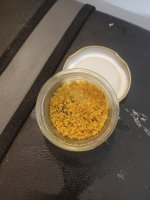
after the re-x process, I obtained yellow powder.... what could I have done wrong? it should be white?
 

Attachments

  • 17571042790258373177727687812752.jpg
    17571042790258373177727687812752.jpg
    1.7 MB · Views: 10
 
Back
Top Bottom