No END it seems to me very straight forward with great thought for a monkey like me..lol
The pic's make it very easy to understand:thumb_up: again great work!!:d
EXCELLENT POST! I have found it extremely difficult to accessible information on thee methods and their appropriate applications. Thank-you SO MUCH!
I do have a question. For a new compound that does not have any reference samples available, how would one confirm the presence and purity of it in a sample?
^The Nexus, as far as i understand it, does not support discussion of what may be termed 'RC's.
However in the interests of safety and testing it may be required to analyse them.
Unknown compounds without reference require either careful chromatograph data figure comparisons,
or advanced structural determination methods, NMR or X-Ray methods probably beyond this thread or the budget of anyone here?
We do not have any problem discussing RC's, as long as the potential dangers are recognized and info on harm reduction is clearly available. Here are three relevant links:
With the recent discussions regarding what should be our policy when talking about different drugs, we've decided to establish some changes in how we deal with talk about different substances. Drug use is a transcultural phenomenon that has always been a part of human (and animal!) existence...
This is an interesting video that explains how Heroin addicts were unwittingly sold a research chemical instead. Under normal circumstances the chemical would have produced similar effects, however it was synthed badly and produced a toxin... Just thought it may serve to remind people of the...
forum.dmt-nexus.me
Regarding analysing these substances, harm reduction organizations such as the one I collaborate with have legal access to reference standards and are constantly working to be up-to-date on the new trends and substances appearing on the market. But in the case that one does not have the standard itself, there are several ways to help identifying a compound. The best is of course if you do several different analysis with different methods to complement each other.
Usually NMR is the method of choice since it gives very good structural information, and is usually what is used when a completely new substance appears and needs to have it's structure described. Before analysing with NMR, the substance needs to be separated through some method like column chromatography or ion exchange, because the NMR results cannot really be 'read' if there's a bunch of substances mixed in, you wont know what peak is from what substance.
Other methods can give some structural info too, like LC-MS/MS (which separates the substance and then bombards the substance with electrons, but instead of just once like normal GC/LC-MS, it does it several successive times, and through the different fragments one can get info on the substance's structure).
Even "simple" GC/LC-MS with access to a database of spectra already can be enough in some cases, since you might not have the standard itself but the spectra may match up perfectly with something already described in the database (which may have been added by a law enforcement agency or a university/research group that had access to the standard). The identification can be done visually or can be done through automated mechanisms like using NIST library, which will search through hundreds of thousands of substances in the database and give you the best guesses with % possibility of match.
Some people/research groups might actually go through the trouble of synthesizing the suspected substance and analysing it, so that they can confirm if the suspected substance is really what they think it is.
There are other methods using X-Ray or FTIR that also give structural information, but since I never worked with them I am not sure how 'complete' the structural info they give by themselves is.
In the case of our organization, up till now it usually has either done with standards, or with access to NIST database and comparing the mass spectra of the unknown substance to the ones in NIST database. Usually when its this second case, we try to confirm through other methods (reagents, TLC, physical properties, etc) to try to diminish possibilities of being a mistaken match, and also we are honest about our limits and uncertainties when giving results.
Now we have just gotten access to LC-MS/MS, which is very good, but we're only doing th first tests, but over time we'll have more experience with that and it should help with identification. We also have the possibility of sending the substance to a university that has NMR (though the whole process of first isolating the substance, sending to the university, having them test it and getting the results, may take long so its only done if really necessary).
Fundamental Concepts
Lecture Supplement: X-ray Crystallography
43 X-ray Crystallography
• X-rays are diffracted by electrons • Diffraction: constructive or destructive interference of scattered waves • Pattern of diffracted x-rays useful to obtain orientation of atoms in space (molecular
structure) History
• 1895: discovered by William Röentgen; called x-rays • 1912: von Laue, Friedrich, and Knipping: "Interference Effects with Röentgen Rays"
Experiment: passed x-rays through crystal of sphalerite (zinc sulfide); distinct diffraction pattern observed
Conclusions: (a) Crystals cause distinct x-ray diffraction patterns due to atoms. (b) Crystals are composed of periodic arrays of atoms.
• 1914: English physicists Sir William Henry Bragg and his son Sir William Lawrence Bragg showed that the scattering of x-rays could be represented as a "reflection" by successive planes of atoms within a crystal Implication: diffraction pattern can be used to determine relative positions of
atoms within a single crystal (i.e., molecular structure) First single crystal structure: NaCl
• 1915: Braggs awarded Nobel Prize Structure Determination: A Simplified Tour
For diffraction to be observed, the wavelength (λ) of radiation must be about equal to the distances between the atoms (about 0-5 Å; 1 Å = 10-10 m); so-called "hard" x-rays correspond to x-rays or neutrons...etc
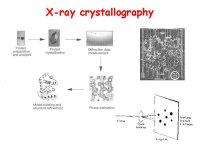
X-ray crystallography allows us to be able to determine the precise atomic positions and therefore the bond lengths and angles of molecules within a single crystal. X-ray crystallography is a technique in which the pattern produced by the diffraction of x-rays through the closely spaced lattice of atoms in a crystal is recorded and then analysed to reveal the nature of that lattice. Like other techniques, crystallography has its limitations as it only produces an average picture of a structure. However it is extremely powerful in that the results are very accurate, giving bond lengths to a few tens of a pico-metre; (1 Å = 100 pm).
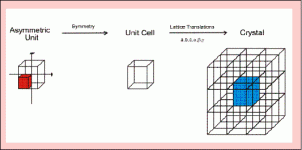
UNIT CELL: Simplest repeating unit - array of lattice points joined together, is fundamental to a particular structure.
Yes, thank-you again endlessness! That is very comprehensive and I'm gonna take some time now to read over your messages multiple times. I really need to take a basic chem course to get my head straight. I removed the reference to an RC anyway as I don't want to step close to any lines.
Two legitimate questions. and some extra thought about it.....
So. SO regarding environmental aspects of using analytical methods and how this can be useful to a person conducting amateur research...
1) So speaking as an environmentalist how do you detect pollution using analytical methods? i.e. PFAS, lead, pharmaceutical trace elements, etcetera. I know that depends on the analytical method and you can just experiment... like literally just experiment using TLC but i want to know for the sake of science!
So.
Two: What Personal Protective Equipment do you need for doing something like TLC on a PFAS, metal (like lead or asbestos for instance, or benzene if you go that far? We want to be harm reductive and know more about the local landscape. I also find it almost ironic that I talk about using PPE with a PFAS since it's basically going to persist into the environment forever and all that; but that information is really good for citizens to know themselves.
I.e. how can we integrate analytical methods into people who want to trace pollution like say for instance... to environmental pollution? (Think about... Thin Layered Chromatography.. something easy enough for people to DIY)
I know there's some great chemists here... With PFAS for instance its like mathematically possible to make more PFAS than can be tested; right? (i.e. you can pretty much make as many as possible and I know that the original Teflon chemical had a fluoride element attached at the very end and that basically caused people to get black teeth after chronic exposure).
I'm not entirely sure what you mean by this, but there are limitless possible variations of polyfluorinated organic substances, but there would have to be a reasonably good use case for their mass production. This limits the actual number of different PFAS in production - although it's interesting to draw a potential analogy betweenthe occurrence of black market drug analogue development in order to circumvent legal restriction, and the possibility that companies like DuPont may develop alternative PFAS in order to circumvent environmental legislation, rather than for improved performance or, indeed, better biodegradability and ecocompatibility.
Analytical techniques that offer accurate means of identifying and quantifying chemicals include GC-MS, TLC, UV-Vis A technique called and LC-MS. With its powerful instruments for chemical analysis and research applications, TLC separates mixes according to polarity, UV-Vis analyzes light absorbance, GC-MS analyzes volatile compounds, and LC-MS identifies complex molecules.
Analytical techniques that offer accurate means of identifying and quantifying chemicals include GC-MS, TLC, UV-Vis A technique called and LC-MS. With its powerful instruments for chemical analysis and research applications, TLC separates mixes according to polarity, UV-Vis analyzes light absorbance, GC-MS analyzes volatile compounds, and LC-MS identifies complex molecules.
Possibly you haven't read the entirety of this thread, but the information you appear to have summarised here has been explained in considerable detail in several of the preceding posts.
There are also a few points about your own post which suggest to me you may not really have read that through either. I have highlighted one of them, and another point to consider is that TLC isn't necessarily associated with much in the way of instrumentation:
^this, therefore, doesn't entirely make sense. LLMs may seem great, but you do need to check thsir output with some sense of understanding of the topic cocerned.
I hope this feedback proves to be useful for you! (ESL?)
This site uses cookies to help personalise content, tailor your experience and to keep you logged in if you register.
By continuing to use this site, you are consenting to our use of cookies.



 it seems to me very straight forward with great thought for a monkey like me..lol