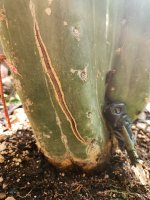
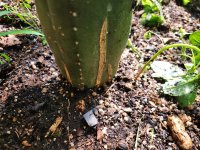
13 years ago, when I was starting college, I bought a small cactus from a street vendor, claimed to be "San Pedro". I didn't really believe it was (and had no clue anyways), but it was 2 euros so I got it for my dorm.
That cactus never got transplanted into a bigger pot, and for over 9 years it has been at what used to be my bedroom at my parents house. Lacking light and water, it's suprising it survived. Due to the little space for roots it hasn't grown that much, and what grew over the years is thin and curved due to lack of light.
Now that I've learned a bit more about cacti and started appreciating them much more, I have remembered that I have that one there (plus it really seems to be a pachanoi if I remember correctly, I'll have to check but it doesn't matter if it's not). I would like to get it in better shape. That will require potting it in a much larger pot and probably add some fertilizer.
Besides that, what could I do for it to not be so thin? From what I've read, new growth that becomes thinner due to lack of light stays that way. Would cutting the thin growth help? If so, I imagine it would be better to do it once the plant has had a chance to grow more roots in its new, more spacious pot. Also, would it make any sense to try to grow the cut, thin part once cut? I'll have to measure it when I go to my parents' house, but it must be about 20-cm, quite curved, no more than 3cm diameter for most of it.
I'm feeling a bit guilty about neglecting that poor plant for so long, and would really like if I were able to return it to a more or less healthy state, even if it will never be too good of a specimen.
That cactus never got transplanted into a bigger pot, and for over 9 years it has been at what used to be my bedroom at my parents house. Lacking light and water, it's suprising it survived. Due to the little space for roots it hasn't grown that much, and what grew over the years is thin and curved due to lack of light.
Now that I've learned a bit more about cacti and started appreciating them much more, I have remembered that I have that one there (plus it really seems to be a pachanoi if I remember correctly, I'll have to check but it doesn't matter if it's not). I would like to get it in better shape. That will require potting it in a much larger pot and probably add some fertilizer.
Besides that, what could I do for it to not be so thin? From what I've read, new growth that becomes thinner due to lack of light stays that way. Would cutting the thin growth help? If so, I imagine it would be better to do it once the plant has had a chance to grow more roots in its new, more spacious pot. Also, would it make any sense to try to grow the cut, thin part once cut? I'll have to measure it when I go to my parents' house, but it must be about 20-cm, quite curved, no more than 3cm diameter for most of it.
I'm feeling a bit guilty about neglecting that poor plant for so long, and would really like if I were able to return it to a more or less healthy state, even if it will never be too good of a specimen.








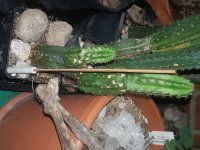

 It looks sad, though.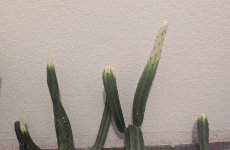
 Your fate is CIELO my dears, for now rest.. I should probably research whether folks have tested if cutting new growth or leaving during stressing has a large affect.