

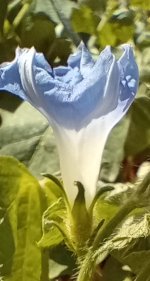
Ipomoea hederacea has a calyx that has ends that curl outward.
See the image below.
This remains visible as the fruit begins to form, as seen below.
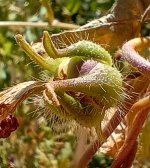
The fruit also has hairs on the calyx and sepals.
When the fruit ripens the sepals dry and pull back. The smooth fruit then splits to reveal the seeds as it dries.
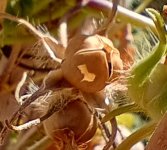
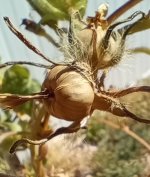
Ipomoea hederacea is native to the US and is a close relative of Ipomoea nil and Ipomoea purpurea.
I don't grow Ipomoea purpurea, so will have to add images of that one later, but online you can see that the sepals are shorter than in I. hederacea and Ipomoea nil as seen below.
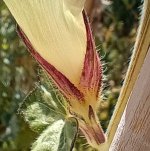
Above is the calyx of a variegated leaf Ipomoea nil. Its sepals do not spread outward.
Another form below, without variegated leaves.
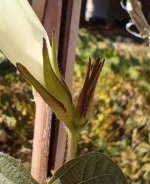
As you can see above, the calyx is covered with hairs. Ipomoea purpurea has this trait as well but has shorter sepals.
Below another view of the sepals and calyx of Ipomoea nil.
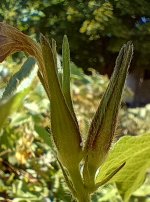
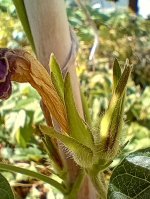
Above, another example of I. nil. The sepals bend slightly outwards but lack the curve of I. hederacea.
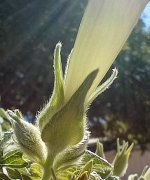
Below is an example of an Ipomoea collected in Africa that resembles Ipomoea pubescens from America. I've had this successfully cross with Ipomoea nil, but the offspring doesn't produce seeds or visible pollen, sadly. It has a much softer type of hair on the calyx with it's specific shape.
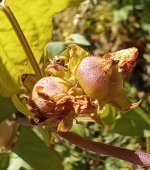
Above is fruit of Ipomoea triloba. Its fruit capsules has a distinct covering of hairs and when still green is often slightly sticky. It lacks hairs on its sepals, not shown. This one has a white flower, also not shown. More mature fruits are shown below. This is widespread in parts of the US.
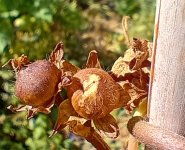
If I recall correctly, the fruit of Ipomoea purpurea and the seeds tend to be smaller than those of I. nil and I. hederacea, and the fruit point downwards, while the others do not.
And a note about what is shown here, as well as regarding Ipomoea purpurea.
None of these species have significant quantities of lysergic alkaloids whatsoever. Their hairy leaf surfaces prevent Periglandula fungi from being able to establish large enough colonies to make meaningful quantities of alkaloids.
Likewise, reports of Ipomoea purpurea being used historically as a psychedelic are purely the result of misidentification of the species. None of the Morning Glories I show, nor Ipomoea purpurea, have any history of use as psychedelics. No analysis of properly identified Ipomoea in the Ipomoea nil complex has revealed significant quantities of lysergic alkaloids. Some, like one study of I. hederacea appears to show infinitesimal amounts of these alkaloids present in some seeds, but these studies lack replication.
As a rule of thumb, if the base of the flower isn't yellow and white, with or without various shades of blue, then the plant is probably not active. Also the fruit, calyx and sepals of the psychedelic forms, generally speaking, never have any form of hair on them.
The nil complex does have a history of a type of medical use.
Ipomoea purpurea and Ipomoea nil both have been used as an herb classically called Pharbitidis Semen, which if used as a search term online can reveal more about their actual use and effects.
Or to put it another way,
These are not the drugs you are looking for.
See the image below.
This remains visible as the fruit begins to form, as seen below.
The fruit also has hairs on the calyx and sepals.
When the fruit ripens the sepals dry and pull back. The smooth fruit then splits to reveal the seeds as it dries.
Ipomoea hederacea is native to the US and is a close relative of Ipomoea nil and Ipomoea purpurea.
I don't grow Ipomoea purpurea, so will have to add images of that one later, but online you can see that the sepals are shorter than in I. hederacea and Ipomoea nil as seen below.
Above is the calyx of a variegated leaf Ipomoea nil. Its sepals do not spread outward.
Another form below, without variegated leaves.
As you can see above, the calyx is covered with hairs. Ipomoea purpurea has this trait as well but has shorter sepals.
Below another view of the sepals and calyx of Ipomoea nil.
Above, another example of I. nil. The sepals bend slightly outwards but lack the curve of I. hederacea.
Below is an example of an Ipomoea collected in Africa that resembles Ipomoea pubescens from America. I've had this successfully cross with Ipomoea nil, but the offspring doesn't produce seeds or visible pollen, sadly. It has a much softer type of hair on the calyx with it's specific shape.
Above is fruit of Ipomoea triloba. Its fruit capsules has a distinct covering of hairs and when still green is often slightly sticky. It lacks hairs on its sepals, not shown. This one has a white flower, also not shown. More mature fruits are shown below. This is widespread in parts of the US.
If I recall correctly, the fruit of Ipomoea purpurea and the seeds tend to be smaller than those of I. nil and I. hederacea, and the fruit point downwards, while the others do not.
And a note about what is shown here, as well as regarding Ipomoea purpurea.
None of these species have significant quantities of lysergic alkaloids whatsoever. Their hairy leaf surfaces prevent Periglandula fungi from being able to establish large enough colonies to make meaningful quantities of alkaloids.
Likewise, reports of Ipomoea purpurea being used historically as a psychedelic are purely the result of misidentification of the species. None of the Morning Glories I show, nor Ipomoea purpurea, have any history of use as psychedelics. No analysis of properly identified Ipomoea in the Ipomoea nil complex has revealed significant quantities of lysergic alkaloids. Some, like one study of I. hederacea appears to show infinitesimal amounts of these alkaloids present in some seeds, but these studies lack replication.
As a rule of thumb, if the base of the flower isn't yellow and white, with or without various shades of blue, then the plant is probably not active. Also the fruit, calyx and sepals of the psychedelic forms, generally speaking, never have any form of hair on them.
The nil complex does have a history of a type of medical use.
Ipomoea purpurea and Ipomoea nil both have been used as an herb classically called Pharbitidis Semen, which if used as a search term online can reveal more about their actual use and effects.
Or to put it another way,
These are not the drugs you are looking for.
Last edited:



![[:]](/data/avatars/s/58/58936.jpg?1707488068)

